


What is enterprise AI?
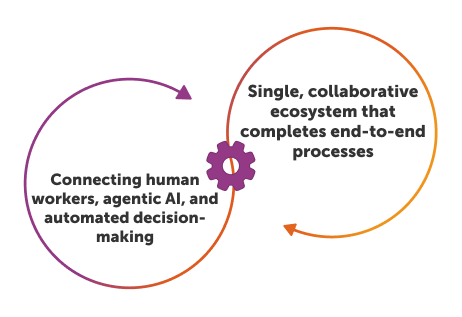
Enterprise artificial intelligence (AI) is the strategic foundation for how organizations evolve toward autonomy, connecting human workers, agentic AI, and automated decision-making in a single, collaborative ecosystem that completes end-to-end processes. When orchestrated effectively, this combination increases operational efficiency, drives innovation, and improves decision-making in an increasingly fast-paced, complex business environment.
The explosion of agentic AI and autonomous agents, projected to be in 40% of enterprise applications by 2026, vastly increases the importance and urgency of enterprise AI. To stay competitive, large organizations need the ability to move faster, scale operations, and spark innovation. Enterprise AI provides the key, freeing human workers to focus on strategic, cognitive work by automating routine tasks and harnessing data to drive faster, more informed decisions.
Key takeaways
Key takeaways for enterprise AI highlight that successful adoption requires pairing intelligent agents with human oversight, establishing strong data governance, and scaling strategically.
- This technology pairs AI agents, machine learning, and human oversight to run end-to-end processes, not just isolated tasks.
- Adoption is accelerating. Gartner projects 40% of enterprise applications will include task-specific AI agents by the end of 2026, up from less than 5% in 2025.
- A data foundation and governance program come first, not later. Frameworks like the National Institute of Standards and Technology (NIST) AI Risk Management Framework and the International Organization for Standardization (ISO) and International Electrotechnical Commission (IEC) 42001 offer a starting structure.
- The returns are real: SoftBank gained capacity equivalent to 4,500 full-time roles, and Cargill saves $10–15 million a year from a single automated process.
- Most companies are still early in the journey: task-level pilots come first, followed by cross-functional orchestration, then broader autonomy with humans retained for high-stakes calls.
From AI pilots to the autonomous enterprise
An autonomous enterprise represents the ultimate end state of enterprise AI, where agentic AI, robotic process automation (RPA), and human workers jointly execute most of a process with minimal manual handoffs. Getting there happens in stages, and most organizations sit somewhere on this path today, using rules-based systems for stable tasks and more adaptive AI agents for everything else:
| Stage | What happens | Human role | Typical capability | |
| 1 | Assisted | Task-level bots and simple AI agents support individual workflows | Humans make all key decisions | Basic data analysis, decision support |
| 2 | Intelligent | Agentic process automation (APA) coordinates RPA, AI agents, and people across end-to-end processes | Humans stay in the loop for oversight and exceptions | Predictive, real-time analytics; formal governance and security frameworks |
| 3 | Autonomous | Self-learning autonomous agents plan, execute, and self-correct with little manual input | Humans retain oversight for critical, high-stakes decisions | Independent execution, adaptive workflows |
Few organizations are fully autonomous yet. Most are still piloting the assisted stage in one or two functions, which is normal—the jump from assisted to intelligent is usually where a governance framework and a real data foundation become non-negotiable.
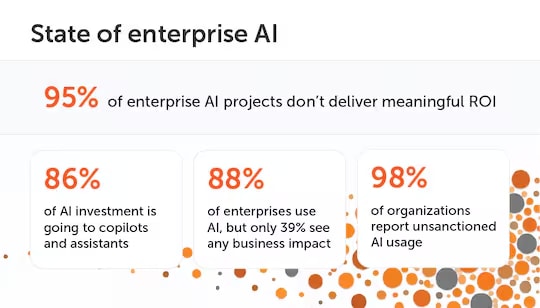
MIT research indicates that 95% of enterprise AI pilots never deliver measurable ROI, despite significant spend and executive focus. McKinsey reports that while 88% of organizations now use AI, only 39% see any EBIT impact—most of it less than 5%.
Key technologies powering enterprise AI
The key technologies powering enterprise AI aren't one model—they're several disciplines, each suited to a different part of the job.
- Machine learning finds patterns in historical data to forecast outcomes and flag anomalies—the engine behind fraud scoring, demand forecasting, and predictive maintenance.
- Generative AI, built on large language models, drafts text, summarizes documents, and increasingly writes the code that connects systems together.
- Natural language processing (NLP) lets agents read and respond to human language, powering the chatbots and document-understanding tools that parse contracts, emails, and support tickets.
- Deep learning, a subset of machine learning built on neural networks, handles harder pattern-matching problems like image recognition and genomic sequence matching.
- Computer vision reads and interprets images and video, from manufacturing sensor feeds to insurance claims photos.
- Agentic AI plans the next step and acts on it directly within defined guardrails—moving data, filling forms, and triggering downstream systems without needing every step spelled out in advance.
Real customer results
Real customer results demonstrate that the technology delivers massive capacity gains, accelerates processing times, and generates millions in annual cost savings across various global industries. Applications span every industry, from fraud detection and risk scoring in financial services—often powered by machine learning models trained on transaction history to diagnostics support and systems monitoring in healthcare. Three examples from our customer base:

SoftBank (telecom)
Moving beyond routine task work, SoftBank used generative AI and the platform to reengineer processes equivalent to 4,500 full-time roles. The company saved 700 hours on call-volume forecasting and cut recruitment hours by 85%, and is now extending agentic AI into strategic decision-making.

Cargill (agriculture).
Cargill needed to process orders arriving in dozens of formats from thousands of customers, from large enterprises to small farms. It streamlined 70% of its order-management workflow with no business disruption, cutting order processing to under a minute and saving up to $15 million a year.

KPMG (professional services)
KPMG paired agentic AI with document-processing tools to overhaul knowledge management and learning content, then orchestrated those workflows into self-learning agents that flag issues before they escalate. The firm reduced back orders by $50 million and saved $30 million by accelerating days sales outstanding, with $150 million in further opportunities identified.
In this video, Automation Anywhere CEO Mihir Shukla sits down with Alex Banks to explain how AI agents deliver real enterprise ROI, why the real trillion-dollar opportunity in AI isn't in the infrastructure layer, and what it looks like when agentic process automation is applied to mission-critical enterprise processes
Enterprise AI benefits across industries
- Banking and financial services: real-time fraud detection, AI-driven risk scoring, and generative AI-drafted client reports and investment summaries
- Insurance: faster claims processing, risk-based pricing models, and personalized policy offerings built on customer data
- Public sector: citizen-facing chatbots, predictive models for urban planning and public health, and streamlined internal casework
- Manufacturing: sensor data feeding predictive maintenance, bottleneck detection, and mass customization at the production line
- Telecommunications: network-traffic analysis that catches disruptions before customers notice, plus AI-driven customer service
- Healthcare: imaging analysis, genomic matching, administrative automation for scheduling and billing, and predictive analytics for early intervention
- Customer operations: agents that resolve routine tier-one tickets independently and surface sentiment trends from feedback at scale
- Cybersecurity: continuous analysis of network traffic and user behavior to catch insider threats, phishing, and account compromise before they escalate
- Software development: generative tools embedded in code repositories to speed up development cycles, flag vulnerabilities, and draft documentation
Why this matters now

Speed and productivity.
Work that took weeks can finish in minutes. Alight processes claims six times faster than manual methods and has cut call volumes in half; Sumitomo Rubber Industries shortened a logistics process from 20 days to four hours.

Scalability.
Machine learning extracts insight from large datasets in seconds and makes it available across the organization, rather than trapped with the team that generated it. IQVIA boosted analytics efficiency by 80% while cutting data-entry costs by 65%.

Innovation capacity.
Freeing people from repetitive execution gives them time for the strategic thinking that drives R&D and process redesign—a meaningful offset in industries where overall R&D productivity has been declining.

Governance and trust.
Consistent rules and guardrails, including data governance controls for how information moves through the system, protect sensitive data and support compliance. According to Accenture research, companies that generate enterprise-wide value from AI are nearly three times as likely to have formal governance programs in place.

Cost efficiency.
Synergy manages 179,000 annual billing exceptions this way, for roughly $2.3 million in yearly savings—proof that the return isn't limited to headline-grabbing transformations.

Stronger security posture.
The same pattern-recognition that powers forecasting also spots malicious behavior: unusual login patterns, anomalous data access, and phishing attempts get flagged and contained faster than manual review allows, which also helps satisfy audit and compliance requirements.
Common implementation roadblocks
Common implementation roadblocks for enterprise AI include fragmented data pipelines, thin artificial intelligence expertise, unclear return on investment (ROI), and internal stakeholder resistance.
- Fragmented data. Disparate systems and inconsistent formats undermine accuracy and weaken any machine learning model trained on that data, which is why a data governance program has to come before scaling.
- Thin AI expertise. A shortage of skilled practitioners slows projects. Low-code platforms, such as Automation Anywhere's AI Agent Studio, lower the skill bar for building and deploying agents without a data science team.
- Unclear return on investment (ROI). Budget owners hesitate over upfront cost, but value often shows up immediately—Petrobras recovered $120 million in savings within three weeks of deploying a generative AI workflow.
- Stakeholder resistance. Change management, clear value cases, and visible early wins help align teams that are wary of job displacement or unclear about the benefits.
- Missing business context. A model that doesn't know how a company defines "revenue" or which system is the source of truth will produce technically correct but practically wrong answers.
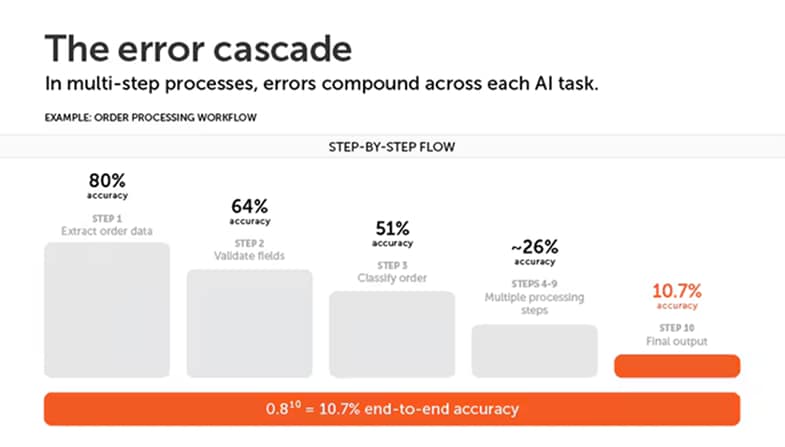
- Compounding accuracy loss across multi-step workflows. Chaining AI tasks multiplies their accuracy rates instead of adding them. A 10-step order-processing workflow where each step runs at a respectable 80% accuracy ends up around 10.7% accurate end-to-end (0.8¹⁰), even though every individual step looked solid in isolation—which is why per-step validation matters more than a single final accuracy number.
- Evaluation gaps. As workflows add more steps and more agents, small errors compound; ad hoc testing doesn't scale, so outputs need continuous, structured evaluation rather than one-time review.
A practical rollout framework
A practical rollout framework for enterprise AI requires defining clear goals, assessing data readiness, starting with focused pilots, and scaling through a centralized governance model.
Define goals and success metrics tied to specific, measurable use cases rather than the technology itself.
Assess data and infrastructure readiness, including a data governance framework for consistent, secure data management.
Start with focused pilots. Merck saved 150,000 hours streamlining compliance document processing, which then seeded further initiatives across operations and product development.
Establish governance, such as an internal AI ethics review, to uphold fairness and transparency standards as programs scale.
Orchestrate agentic thinking with rules-based execution using an APA platform so AI agents, RPA, and humans work from one system of record instead of disconnected tools.
Scale through a center of excellence (CoE) that governs, measures, and continuously optimizes initiatives across departments rather than letting each team reinvent the approach.
Build an AI-ready culture. Train the workforce to collaborate with agents rather than compete with them, and have leadership visibly use the tools—adoption follows example more than mandate.
Enterprise AI tools and integration
Selecting the right tools depends on what already runs the business. Most large organizations layer this technology on top of existing ERP systems (like SAP or Oracle) and CRM platforms (like Salesforce), plus cloud AI services such as Microsoft Azure AI or IBM watsonx.
Purpose-built agentic platforms, including Automation Anywhere, sit above that stack as an orchestration layer—connecting ERPs, CRMs, APIs, legacy systems, and human expertise so a process can span multiple tools without custom integration work for every connection. That's different from single-purpose AI platforms (categories like C3 AI occupy this space) built primarily for model deployment rather than end-to-end process orchestration.
Integration typically runs through pre-built connectors, open APIs, and event triggers, so agents can read and write to existing systems without a rip-and-replace migration. The best AI agents for a large organization are usually the ones with strong observability—audit trails, role-based access control, and encryption—since IT and compliance teams need to see what an agent touched and why.
When evaluating vendors, weigh five factors: scalability (can it grow with the business, not just handle today's volume), customization (does it adapt to existing processes rather than forcing a rebuild), integration (does it connect to the ERP and CRM systems already in place), vendor support (is there help through implementation and beyond), and security (are encryption and access controls built in, not bolted on).
The technology stack behind the platform
The technology stack behind an enterprise AI platform consists of a robust data foundation, an intelligent orchestration layer, and strict governance controls for safe deployment. It starts with enterprise-grade data pipelines, pre-built APIs, and integration platform-as-a-service (iPaaS) connectors that bring real-time data into the system.
On top of that, an APA layer coordinates AI agents, traditional bots, APIs, documents, and people into goal-driven workflows that plan, execute, and self-correct—effectively the connective fabric linking AI insight to real-world execution.
The governance and compliance layer matters just as much, and it's where data governance decisions live: secure guardrails, observability into agent behavior, and evaluation tools to benchmark accuracy.
Two frameworks are worth building toward—the NIST AI Risk Management Framework, a voluntary U.S. government framework for managing AI trustworthiness, and ISO/IEC 42001, the international standard for AI management systems. Both treat data governance, not just model performance, as core to responsible deployment; a poorly governed data pipeline undermines even a well-trained machine learning model.
This layered stack is also what enterprise architecture teams evaluate when deciding where agentic AI fits: the data layer determines what's possible, the orchestration layer determines what actually runs end-to-end, and the governance layer determines what's safe to run without close supervision.
Measuring success
Measuring success in enterprise AI requires tracking automation rates, financial returns, user adoption, decision speed, and governance metrics on a continuous basis. Track a handful of metrics monthly, or use a platform with real-time dashboards:
- Orchestration rate: share of tasks and processes running without manual handling
- ROI: hard savings plus soft gains like accuracy and experience improvements
- Adoption: percentage of workers actively using the tools and percentage of processes covered
- Governance metrics: model accuracy, data privacy incidents, downtime, explainability, and data governance program maturity
- Decision speed: how much the system compresses cycle times and improves forecast accuracy
Track and report on these and similar enterprise AI performance metrics at least monthly, or use an APA platform that provides real-time dashboards. Communicate progress and shortfalls frequently, and conduct quarterly reviews to head off potential issues and share insights on AI deployments.
How the platform supports the journey
Automation Anywhere supports the enterprise AI journey by unifying agentic process automation, purpose-built AI agents, and strict governance in one comprehensive platform. When organizations deploy enterprise AI through Automation Anywhere, they gain the ability to move from isolated pilots to full-scale production without swapping vendors.
The Agentic Process System unifies RPA, agentic AI, and orchestration so organizations can move from pilots to production without swapping vendors. It combines a governed APA layer, purpose-built agents for functions like accounts payable and customer onboarding, and observability tools that give IT and compliance teams visibility into what agents are doing and why. For teams evaluating vendors in this space, that combination of orchestration and governance is usually what determines whether a pilot scales or stalls rather than any single AI model's raw capability.
Automation Anywhere is shaping the future of enterprise AI and helping organizations move quickly toward becoming autonomous enterprises. The Agentic Process Automation System provides a unified orchestration platform that delivers real business results through enterprise-wide automation. Book a demo to see the power of agentic process automation in action.
Frequently asked questions
How can enterprise AI support sustainability and ESG goals?
Enterprise AI supports sustainability and environmental, social, and governance (ESG) goals by automating the massive data-gathering and disclosure workflows required for strict compliance. ESG reporting creates heavy administrative burdens, and few companies are cutting ESG budgets to save money. Streamlining the data-gathering and disclosure workflow behind ESG reporting cuts costs and speeds up compliance.
What's the biggest misconception about implementation?
The biggest misconception about enterprise AI implementation is that most pilots fail and the technology eliminates human jobs. In practice, thousands of deployments show measurable impact, and job growth has increased in roles the technology directly touches, shifting people toward oversight and exception-handling.
What's the difference between this capability and an autonomous enterprise?
It represents the thinking-and-acting layer of intelligent agents, while an autonomous enterprise is the resulting operational model that emerges once that AI layer runs most processes with minimal human intervention.
How does this technology affect workforce roles?
Enterprise AI affects workforce roles by shifting employees out of repetitive execution and into cognitive, strategic, and exception-handling work. This transition requires new skills, such as prompting generative AI tools, working with governed data, and, for builders, mastering basic development skills.
What are the best intelligent agents available today?
The best enterprise AI agents available today are purpose-built for specific functions like finance or human resources (HR) and feature robust governance. Rather than being general-purpose, the strongest options are evaluated on governance features like audit trails and role-based access control, since those determine whether an agent is safe to trust with real transactions.
Can AI improve decision-making in enterprise architecture?
Artificial intelligence improves decision-making in enterprise architecture by surfacing system usage patterns to inform where orchestration adds the most value. Machine learning models analyze data flows to determine where to add advanced orchestration versus where a simpler rules-based bot is sufficient, helping architecture teams sequence rollouts effectively.
What ROI benchmarks should mature programs expect?
Mature enterprise AI programs should expect ROI benchmarks that reflect complex processes running rapidly with minimal human oversight. An AI capability maturity model gives a rough benchmark, demonstrating that the highest returns occur when programs run complex processes autonomously, reserving people only for critical decisions.
How will regulations like the EU AI Act affect adoption?
Regulations like the European Union (EU) AI Act will affect enterprise AI adoption by pushing organizations toward centralized, well-governed, and transparent platforms. The EU AI Act sets governance, risk-management, and transparency requirements that restrict higher-risk uses. Rather than slowing adoption, this compliance burden accelerates the need for better-governed enterprise AI programs.