



What is autonomous IT? (The architecture of autonomy)
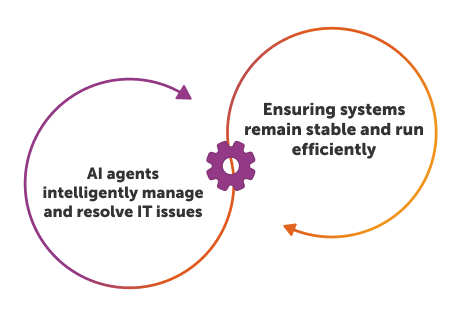
Autonomous IT is an advanced operating model where artificial intelligence, large language models (LLMs) and machine learning to manage and resolve issues within the IT environment without manual intervention.
Unlike traditional automation, autonomous IT operations move beyond scripted, rules-based tasks. Instead, they use contextual understanding and agentic workflows to achieve desired outcomes. This represents the peak of autonomous operations, where the system doesn't just follow a path, but it decides the path based on a goal.

From scripted workflows to agentic reasoning
Traditional IT automation, epitomized by legacy platforms like ServiceNow, BMC etc., relies on “if-this-then-that” logic. These rigid, predefined scripts execute specific tasks under ideal conditions.
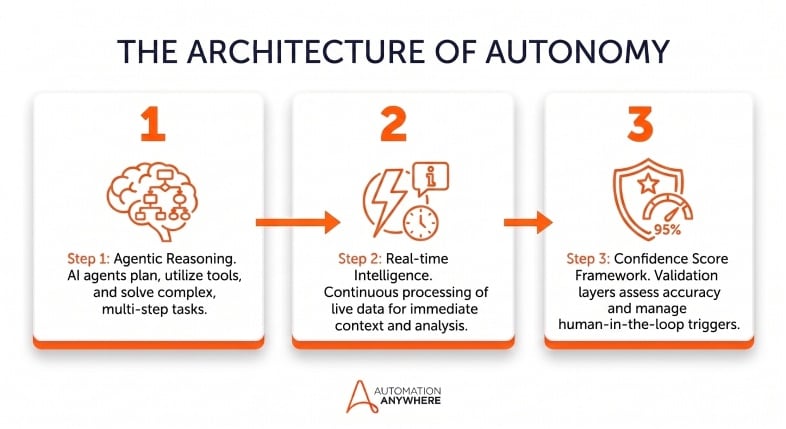
In contrast, goal-oriented AI agents employ agentic AI systems to understand the intent behind a request or the impact of an incident. They dynamically adapt to achieve a goal, even when variables are unexpected, effectively eliminating repetitive work.

Real-time intelligence & linear chain architecture
Effective Autonomous IT demands a live, up-to-the-minute view of the IT environment, unlike stale CMDB data. It requires a different structural approach with steps connected end to end, where each incremental step generates an output that becomes the input to the subsequent step. For agentic workflows, this “linear chain architecture” can proceed backward, too, where questions move from a “backward leader,” and the process works in reverse to determine which prior agents or data are required to achieve that result. This linear approach enables real-time anomaly detection and automated remediation across the entire infrastructure.

The “confidence score” framework
AI agents operating in an autonomous system utilize a “confidence score” framework. This system of guardrails and risk assessments determines when to act and when to escalate to IT teams, ensuring agents execute actions only when the risk is low and providing a critical layer of AI governance.
For example, an agent might determine that an end-user comment can be interpreted as either a minor complaint or a request to replace an expensive hardware asset. The combination of ambiguity and potential cost would trigger a call for human intervention. Conversely, an agent might extract data from a support conversation with a 99% match against a known value in a database. That high level of confidence would then trigger the agent to move forward autonomously.
The ServiceNow “Automation Ceiling”: Why IT leaders are seeking alternatives
Many IT leaders are finding their traditional automation initiatives stalled. Legacy platforms like ServiceNow introduce an “automation ceiling” because they were built for service management, not fully autonomous operations.

The seat-based tax vs. results-based value
ServiceNow’s pricing model often imposes a “seat-based tax,” where increasing operational scale directly translates to higher licensing costs as more users require access. Automation Anywhere, conversely, offers a results-based value proposition, where investments correlate with efficiency gains and operational outcomes achieved through autonomous IT, rather than merely counting users.

The maintenance debt
The hidden costs associated with ServiceNow, often termed “the ServiceNow Tax” include significant maintenance debt. This encompasses the continuous upkeep of custom scripts, heavy reliance on implementation partners, and protracted deployments that can extend for 6 to 12 months beyond contract signing. This operational overhead combines with high licensing to create persistent “ticket fatigue.”

Why “AI add-ons” aren’t AI-native
Many legacy platforms are attempting to address the automation ceiling by offering “AI add-ons,” essentially bolting AI capabilities onto existing, non-AI-native architectures. This approach falls short compared to Automation Anywhere’s “agent-first” architecture, an AI-native platform that enables AI reasoning and autonomous automation for IT without the inherent limitations of a retrofitted solution.
Are you experiencing high operational costs and slow deployments with your current IT automations? Try our interactive ROI calculator to see how much you could save by switching to autonomous IT.
Auto-Resolution Target
80%
0 service desk agents
freed up to work on other tasks
Service Desk Agent Savings
$0
License Cost Reduction
$0
MSP Consolidation
$0
Total Annual Benefits
$0
Cost Per Ticket Comparison
Current
$0
With Automation Anywhere
$0
Reduction
80%
3 Years Benefits
$0
With 0 service desk agents & based on
0 tickets/year
Estimated based on multiple industry reports and customer data
Core capabilities: What defines an autonomous IT platform?
What defines an autonomous IT platform is its ability to transcend traditional automation and deliver an advanced operating model for IT service desk, employing AI to understand intent, reason contextually, and detect, diagnose, and remediate complex IT issues proactively. These platforms represent the structural shift needed to handle modern IT complexity, the widening talent gap, and other pressing issues facing IT leaders.

Agentic ITSM: Goal-oriented service reasoning
The concept of Agentic in ITSM moves beyond rigid “if-then” workflows to “intent-action” agents, fundamentally transforming service delivery in next-gen ITSM.
Instead of configuring dozens of variations of a “software access” workflow, an AI agent built on agentic process automation understands the user’s goal, identifies permissions via the CMDB, verifies roles in the HR system, and executes the provision. The “agentic” edge is its ability to handle ambiguity and exceptions, such as an urgent request from a client site, without breaking the automation.

Zero-touch service desk: The “resolution-first” experience
A zero-touch service desk delivers a “resolution-first” experience and can deflect 80% of tier 1 volume, according to Gartner, by applying AI for the IT service desk at scale. Direct integration into communication channels like Slack, Teams, and email, where AI agents resolve requests in-stream as they happen, is the key. The “ticket” effectively becomes an invisible background artifact, eliminating the manual task for human agents and transforming reactive processes into proactive resolutions.

Self-healing infrastructure: Autonomous remediation
Self-healing infrastructure leverages AI agents to continuously monitor telemetry and autonomously execute “remediation playbooks,” such as clearing caches, scaling pods, or restarting services, based on real-time confidence scores.
This capability reduces mean time to resolution (MTTR) from hours to seconds by eliminating the traditional human-centric “detect → alert → triage → fix” loop and ensuring fast operational recovery.

Predictive AIOps: Reducing noise through contextual reasoning
Predictive AIOps utilizes LLMs to correlate disparate alerts across the IT stack, significantly reducing alert noise. An AI agent moves beyond simply identifying “high CPU usage”; it sees “high CPU usage + recent deployment + database latency” and provides an immediate, reasoned root-cause analysis. This capability transforms raw data into actionable intelligence that IT teams use to focus on mission-critical issues rather than alert storms.

Autonomous governance & control tower: The safety layer
The autonomous governance and control tower establishes a critical safety layer through centralized “guardrails” that precisely define an AI agent’s capabilities. For example, agents can reset passwords, but restrictions prevent them from modifying production firewall rules without explicit human approval. This framework builds trust by providing full “chain of thought” audit logs for every autonomous action, ensuring compliance with standards like SOC2 and GDPR.
Automation Anywhere vs. ServiceNow: A strategic comparison
Comparing Automation Anywhere’s IT Automation with legacy ITSM platforms like ServiceNow reveals a strategic divergence in focus, value, and operational impact. The table below highlights why Automation Anywhere stands out as a superior alternative to ServiceNow for organizations aiming for true autonomous IT.
| 1 | Criteria | Automation Anywhere (IT Automation) | Legacy ITSM (ServiceNow) |
| 2 | Primary Focus | Autonomous Resolution (Results) | Ticket Management (Process) |
| 3 | Pricing Model | Results-Based (Value-driven) | Seat-Based (Labor-Driven) |
| 4 | Go-Live Speed | 6–12 Weeks | 6–12 Months |
| 5 | Workflow Build | Natural Language / Agentic | Rigid Rules / Pro-Code Scripts |
| 6 | End-User ROI | 80%+ Auto-Resolution | High Manual Intervention |
This comparison underscores the fundamental shift: while ServiceNow optimizes a human-centric ticketing process, Automation Anywhere’s Agentic Process Automation System directly delivers results, translating into faster go-live times, greater end-user ROI through high auto-resolution rates, and a more adaptive approach to workflow design compared to the rigid, script-dependent nature of legacy ITSM.
For a deeper dive, explore the Automation Anywhere vs. ServiceNow comparison page.
The buyer’s checklist: Evaluating autonomous IT vendors
When evaluating autonomous IT vendors, it’s critical to ask the right questions to ensure the platform can deliver on the promise of true autonomy. This checklist helps IT leaders identify solutions that move far beyond traditional automation.
- Discovery & real-time visibility. Does the platform offer a live, comprehensive view of the current state of every endpoint, application, and network component across your environment?
- Agentic reasoning vs. bots. Can the system dynamically handle “unseen” variables and complex exceptions without breaking or requiring human intervention, enabling intelligent orchestration and execution that goes far beyond rules-based robotic process automation (RPA) bots?
- Integration depth. Does the autonomous IT solution seamlessly connect to your existing legacy systems and modern cloud applications without requiring expensive middleware or extensive custom development?
- ROI transparency. Does the vendor provide a clear “AI ROI calculator” or similar tool to transparently prove tangible labor and license savings that deliver concrete business value?
- Security & guardrails. Can you implement robust “progressive deployment” or “ring-based” rollout strategies for AI actions for fine-grained control and adherence to security policies?
- Vendor lock-in & data portability. Can you easily migrate your data, workflows, and configurations away from the current vendor should business needs or regulatory requirements evolve?
- Total cost of ownership modeling (not just licensing). Does the vendor provide comprehensive tools to model the total cost of ownership, going beyond licensing to include infrastructure, integration, ongoing maintenance, and talent requirements?
- Change management and adoption support. Does the vendor offer support for change management, training, and user adoption programs?
- LLM/model transparency. Do you have clear visibility into which specific LLMs or AI models are utilized, where they are hosted, and how their data residency aligns with your sovereign and compliance requirements?
- Audit trail and explainability for regulated industries. Does the platform provide an immutable audit trail and sufficient explainability for all AI-driven actions and decisions to meet compliance obligations?
- Integration with existing identity providers. Does the platform integrate with your existing identity providers, such as Single Sign-On (SSO) and System for Cross-domain Identity Management (SCIM), for streamlined user authentication, authorization, and lifecycle management?
- Disaster recovery and SLAs. Does the vendor offer disaster recovery plans and service level agreements (SLAs) for the platform, guaranteeing continuous operation and data availability in the event of unforeseen disruptions?
Real-world impact: Turning zeros into heroes
Autonomous IT delivers tangible, measurable results that empower IT teams to transition from reactive problem-solvers to strategic innovators, validating that tools previously held them back.

85% increase in customer satisfaction
Big 5 Sporting Goods uses autonomous IT to dramatically improve its support function, achieving an 85% increase in customer satisfaction. Automatically remediating employee requests and prioritizing human intervention only for unsolved issues helps the retailer save 24,000 hours annually.
75% reduction in event-driven tickets
By leveraging proactive remediation capabilities, autonomous IT platforms can achieve a 75% reduction in event-driven tickets. This means incidents are detected and resolved autonomously before they even become tickets, effectively eliminating the noise and allowing IT staff to focus on higher-value tasks.

35% increase in employee productivity
Freeing IT staff from repetitive, manual tasks like password resets and routine troubleshooting allows tech support desk reps to achieve a 35% increase in throughput. This enables IT professionals to dedicate their expertise to strategic architecture, innovation, and complex problem-solving that directly drives business growth.

40% reduction in TCO
Autonomous IT solutions deliver up to 40% reduction in total cost of ownership (TCO) by combining software licensing savings with the elimination of manual labor across IT operations. This validates that traditional tools were indeed expensive, not just in licensing, but in the human effort required to operate them.
Ready to move beyond the ticket?
The time to break through the legacy automation ceiling is now. Remaining on legacy platforms and workflows, or continuing to rely on ServiceNow means your organization will struggle to achieve the lofty benefits of autonomous IT.
Ready to move beyond the ticket? Automation Anywhere APA for IT helps you reduce cost per ticket, cut MTTR, and lessen identity risk with autonomous IT. It connects your entire operational stack, including Jira, Splunk, Okta, and, of course, ServiceNow, automating work where it already happens, from your service desk to compliance ops to license optimization, and beyond.
Here’s what to do next:
Frequently asked questions
What is the difference between autonomous IT and traditional IT automation?
Autonomous IT uses machine learning and agentic AI to understand context and resolve issues without human intervention. Traditional automation relies on predefined rules and results in an "automation ceiling."
Can I use Automation Anywhere alongside my existing ServiceNow deployment?
Yes, Automation Anywhere can integrate with your existing ServiceNow deployment to reduce seat count and license costs. It augments your current system by autonomously resolving tickets and freeing up human agents, building on your existing investments.
How does autonomous IT improve security and compliance?
Autonomous IT provides real-time monitoring for security operations and maintains a "chain of thought" audit log for all autonomous decisions, ensuring compliance with SOC2 and GDPR.
What is the typical time-to-value for an agentic ITSM solution?
The typical time-to-value for an agentic ITSM solution is significantly faster than traditional deployments, often ranging from 6 to 12 weeks for initial implementation. This rapid deployment enables quicker realization of ROI for IT through autonomous issue resolution and operational efficiencies.