


As organizations move beyond simple chat interfaces, the focus has shifted toward building agentic workflows that can execute tasks autonomously. These AI-driven agentic workflows are built on large language models (LLMs) that enable them to interpret goals, evaluate context, and determine a course of action across dynamic, multi-step processes.
Orchestration coordinates their work within defined governance framework boundaries, ensuring that agent behavior remains traceable, controlled, and aligned with business rules. Together, these capabilities allow organizations to automate processes that involve variability, exceptions, and decision-making.
What are agentic workflows?
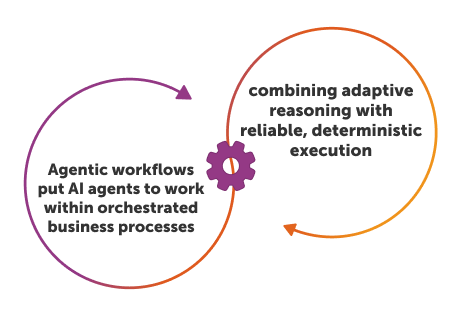
Agentic workflows are sequences of business process tasks executed dynamically by AI agents, orchestrated as part of larger end-to-end automations. Where traditional automation tools, like robotic process automation (RPA), follow fixed rules and linear paths, agentic workflows are driven by AI agents that can reason, make decisions, and adapt dynamically to changing conditions in real time without requiring constant human oversight or preset instructions for every scenario.
At the core of an agentic workflow is the AI agent itself. Agents are not scripts; they are built on artificial intelligence models that provide the capacity to interpret goals and evaluate context. They can interact with existing systems, analyze data, collaborate with other agents, and engage with human users through natural language. This makes them suited to work that is dynamic, long-running, or judgment-heavy, the kinds of business processes that have historically been difficult to automate.
Agentic workflows organize this capability into structured process execution through orchestration: the coordination layer that sequences tasks, manages dependencies between agents, defines where human oversight is required, and enforces governance. Orchestration is what makes agentic workflows create real value in enterprise environments. Without it, autonomous agent behavior introduces operational risk.
How agentic workflows work
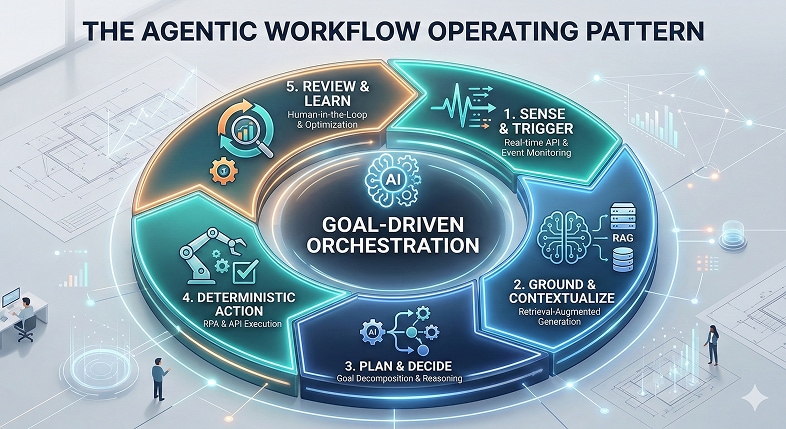
Agentic workflows follow an operating pattern: agents sense what is happening, decide what to do, act on that decision, and review the outcome. Importantly, while the reasoning that drives this cycle is adaptive, the execution of individual actions is primarily deterministic carried out by reliable, rules-based AI tools.
Signal capture and event monitoring
What happens: The workflow begins when an AI agent detects a trigger an incoming document, a system event, a data change, or a user request expressed in natural language. In those cases, the agent first interprets the request and contextually disambiguates the user’s intent to determine whether to initiate a workflow. This highlights an important distinction from traditional automation, which typically relies on predefined intents or rigid triggers. This is the starting condition that sets the agentic AI for workflows in motion.
Enabling capabilities: Event monitoring, system integrations, and APIs that surface real-time data from across enterprise applications. Orchestration ensures triggers are routed to the appropriate agent or process without manual human intervention.
Why it matters: Automatic initiation eliminates the delays and missed handoffs that come from relying on humans to spot and route incoming work. When triggers arrive without explicit instructions an incoming document, an unstructured request, a data event requiring classification the agent interprets intent before acting, which is what keeps everything downstream correctly directed.
A misread signal at this stage compounds through every step that follows. Confidence scoring catches ambiguous inputs and flags them for review rather than letting them proceed silently. Deterministic triggers such as scheduled events or threshold crossings are logged with source and timestamp, ensuring every workflow initiation is traceable regardless of trigger type.
Context, memory, and RAG
What happens: Before acting, the agent retrieves the information it needs relevant policies, historical data, prior interactions, and the current system state. This ensures the agent isn't "guessing" but is operating on facts.
Enabling capabilities: Retrieval-augmented generation (RAG) and connected knowledge bases. These allow AI agents to pull accurate, current information from approved sources rather than relying solely on the pre-trained knowledge of the large language models.
Why it matters: Decisions grounded in context are more accurate and defensible. By retrieving current policies, system state, and historical interactions, agents gain the situational awareness needed to act consistently with enterprise rules and past actions. Constraining agents to approved sources prevents "hallucinations" and ensures the agent output remains aligned with your specific business truth and current data.
Reasoning and planning
What happens: The agent uses reasoning to evaluate information and inputs and weighs option, then applies its assessment to create a plan. It breaks its goal into a sequence of steps, determines what actions are needed, and selects which tools or automated processes to invoke. It also identifies where it can proceed independently versus where human oversight or approval is required. Throughout, orchestration manages the handoffs between steps and agents.
Enabling capabilities: The reasoning capacity of enterprise AI models, which allows agents to work through complex problems, evaluate options, and produce an explainable chain of logic rather than black-box output.
Why it matters: This is the stage that separates agentic automation from rule-based systems. Agents can navigate variability and make reasoned judgments about which execution path to take. Because reasoning steps and assumptions are logged, decisions are explainable after the fact, supporting audit and accountability in regulated environments.
Action execution and task fulfillment
What happens: The agent activates the appropriate tools to execute tasks it has planned. The actual execution updating records, processing transactions, triggering downstream workflows is handled by a combination of deterministic components such as RPA, which perform these steps with precision, and non-deterministic operations. Where a step requires explicit approval, orchestration pauses the workflow and routes it to a human.
Enabling capabilities: Tool calling is how agents interact with external systems at execution time invoking APIs, triggering RPA, running code, and sending communications. Pre-built integrations and native connectors extend the range of systems agents can reach, while role-based access controls and approval gates define what they're permitted to do.
Orchestration ensures that agent decisions are channeled through these tools in an auditable way.
Why it matters: This is where an agentic workflow moves beyond analysis and recommendation the agent completes the task end to end, across systems, without requiring a human to act on its output. Approval gates and role-based permissions ensure that sensitive steps stay controlled without making humans a bottleneck for routine execution.
Feedback and adaptation
What happens: Once a task completes, outcomes are logged and evaluated against expected results. Where results fall outside defined parameters, exceptions are flagged for human review. Insights from that review feed back into the workflow refining routing logic, decision criteria, agent instructions, and knowledge sources so the system handles similar situations better over time.
Enabling capabilities: Monitoring dashboards, exception handling protocols, and structured feedback mechanisms that translate operational outcomes into workflow improvements.
Why it matters:Agentic workflows adapt continuously to real-world conditions rather than executing the same fixed logic regardless of what's working. Feedback loops allow the system to improve through experience adjusting to changing business rules, new data patterns, and edge cases as they emerge while keeping adaptation deliberate and auditable through the orchestration layer rather than leaving it to the model.
Agentic workflows vs. traditional workflows
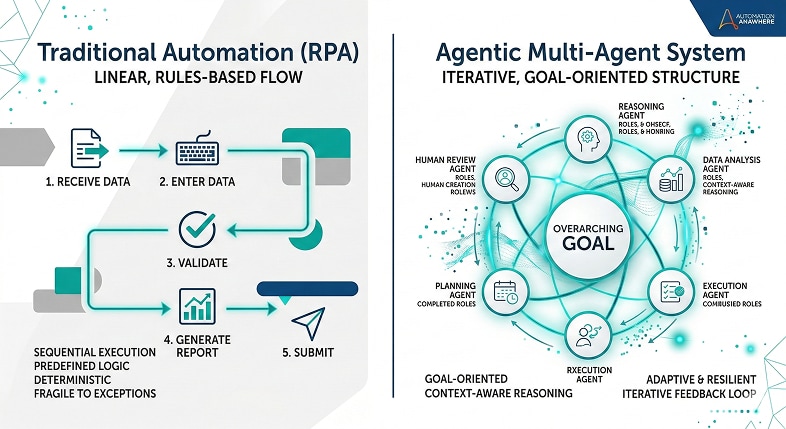
Traditional automation is built around known paths. Logic is predefined, and execution follows the sequence designed at build time. This works for stable, high-volume repetitive tasks, but it creates brittleness when conditions change.
Agentic workflows are designed to pursue a goal, determining how to get there based on the context available at runtime. They can handle variability without breaking, progress through processes that evolve, and attempt to resolve exceptions before escalating.
| Attribute | Traditional workflows | Agentic workflows | |
| 1 | Execution model | Predefined, path-driven | Goal-driven, resolved at runtime |
| 2 | Exception Handling | Halts or reroutes to humans | Attempts resolution autonomously |
| 3 | Adaptability | No - requires reprogramming | Yes - adjusts based on context |
| 4 | Suited to | Stable, high-volume, predictable tasks | Dynamic, judgment-heavy, multi-step processes |
| 5 | Logic Basis | Predefined rules | Natural language reasoning |
| 6 | Primary Use | Repetitive tasks | Complex tasks & judgment |
The role of multi-agent systems (MAS) in agentic workflows
A critical evolution in agentic automation is the move toward multi-agent systems. Instead of one monolithic agent, organizations use multi-agent collaboration to solve complex problems.
In a multi-agent environment:
- Specialized agents: One agent may be a coding agent, while another is a data analysis specialist.
- Collaboration: Agents communicate to delegate tasks, pass work onward or execute in parallel, and verify each other's outputs to reach a shared goal. For example, a "Reviewer Agent" might check the agent output of a "Worker Agent" to ensure it meets compliance requirements.
- Scalability: Work is distributed across other agents, preventing bottlenecks and providing the ability to handle greater complexity and volume than a single agent could manage alone
This multi-agent approach is often supported by frameworks developed by Microsoft Research, which highlight how decentralized intelligent agents can outperform a single model on complex tasks.
Benefits of agentic workflows
Within the defined boundaries of agentic workflows, agents can make decisions and execute tasks autonomously, freeing teams from coordination overhead that slows down complex work. The operational outcomes reflect that shift directly.
Autonomous execution:
Agents take action end-to-end reasoning, deciding, and completing tasks across systems without waiting for human direction at each step.
Faster resolution of complex work:
Rather than stalling at exception points, agents gather missing information and progress the case, compressing cycle times.
Enhanced decision-making:
Agents evaluate each case against current data, relevant policies, and historical context more consistently than human judgment applied under volume or time pressure.
Reduced operational friction:
Agentic workflows coordinate across systems automatically, removing manual handoffs.
Scalability without proportional headcount growth:
Agents distribute work intelligently, handling demand spikes and growth without workflow redesigns or added staff.
Human-agent collaboration:
For complex work, agents handle retrieval, coordination, and execution, enabling human staff to focus where they add the most value.
Resilience:
Agents adjust their actions based on what is actually happening, making workflows more reliable in environments where the unexpected is routine.
Agentic workflows use cases and industry examples
Knowing where to apply agentic AI workflows is as important as the technology itself. The strongest candidates are long-running processes where conditions change over time.

Human resources (HR)
Recruiting and onboarding are rarely linear. An agentic workflow in HR can coordinate across an ATS, HRIS, and payroll system. When a candidate advances, agents proactively schedule assessments and flag gaps in documentation. Administrative tasks that once consumed hours are handled by enabling AI agents to manage the back-and-forth communication.

Finance and banking
In finance, agentic workflows excel in investigation-driven processes like invoice exceptions or audit preparation. When an invoice doesn't match a PO, the agent investigates contract terms and historical payment patterns. It determines the resolution path based on what the investigation finds, only escalating for human review when a threshold is met.

Customer support
A support case often requires data from multiple existing systems. An agentic workflow reviews account history, checks system status, and initiates a resolution such as a refund or a password reset through automated processes. This shifts the human role from data gathering to high-level empathy and decision-making.

Healthcare
In healthcare, agentic workflows can manage patient scheduling and follow-up. Agents analyze patient data to provide personalized after-care instructions and monitor for anomalies that require a doctor's attention, directly impacting patient outcomes.
Security, governance, and risks of agentic workflows
Deploying agentic workflows requires a robust approach to risk. Unlike rules-based software, AI agents can behave in unexpected ways.
- Runaway execution: A misconfigured goal can cause an agent to loop or execute tasks incorrectly. Clear execution limits and progress tracking are essential.
- Hallucination: Agents might misinterpret a policy. This is mitigated by grounding the agent in a verified knowledge base and requiring explicit approval for high-risk actions.
- Data security and privacy: Agentic workflows operate across large volumes of sensitive data, creating exposure to breaches, adversarial attacks, and unauthorized access. Role-based permissions, least-privilege access, and reasoning-level audit logs are non-negotiable
- Bias and transparency: Agents reflect the data and logic on which they are built. In high-stakes processes hiring, lending, patient care transparency into agent reasoning is essential for identifying and correcting bias before it compounds.
- Network isolation: For sensitive business processes, running agents in a sandboxed execution environment with network isolation prevents data leakage.
Why these challenges point to infrastructure, not avoidance
None of these challenges undermines the value of agentic workflows; they argue for deploying them on a foundation that addresses them by design.
The organizations seeing the most reliable results from agentic workflows are those that treat orchestration, governance, and monitoring as core infrastructure.
Implementing agentic workflows: A roadmap
To move from technical preview to production, follow these steps:
- Identify suitable processes: Select tasks that are data-intensive, require judgment, or are currently stalled by manual handoffs.
- Choose AI tools: Ensure your stack supports large language models, orchestration, and GitHub Actions if you are in a dev environment.
- Conduct pilot projects: Test the agentic workflows create value in a controlled sandbox.
- Establish human oversight: Define exactly where a human must step in for explicit approval.
- Scale and deploy incrementally: Refine the agent's prompts and tools based on feedback from the pilot.

Unifying capabilities with agentic process automation (APA)
Each of these components is necessary; none is sufficient on its own. Agentic process automation (APA) is designed to unify these layers into a single execution system, providing the agent framework, orchestration, integrations, human-in-the-loop controls, and governance infrastructure that agentic workflows require to operate reliably at enterprise scale.
For organizations moving from early experimentation to production deployment, the question is less whether to build these capabilities and more whether to assemble them piecemeal or adopt a platform where they are already integrated.

How agentic workflows enable autonomous operations
Autonomous operations, in practical terms, mean business processes can interpret goals, make decisions, and execute across systems without requiring human involvement at every step.
With agentic process automation infrastructure in place, this isn’t a distant aspiration. Organizations are achieving it today in specific processes with the boundaries of what runs autonomously and what involves human oversight, designed and defined deliberately.
Most organizations still begin with task automation individual, repetitive steps handled by rules-based tools. From there, assisted workflows bring AI into the loop to support human decision-making without replacing it. Agentic workflows represent the next step: end-to-end process execution where orchestrated AI agents handle judgment, coordination, and exception resolution within governed boundaries.
Autonomous operations is what this looks like at scale processes running continuously and consistently, with humans involved where their judgment is genuinely required, versus at every transition point.
What this produces in practice is observable:
- Processes that previously required human coordination at each handoff are complete without manual intervention.
- Exception rates that filled queues are resolved before escalation.
- Cycle times that stretched across days compress to hours.
These are the real outcomes organizations report when agentic workflows are running in production on a platform that unifies reasoning, execution, and governance.
That last point is important. Autonomous operations are not an outcome of deploying AI agents in isolation. They require the full capability stack described above orchestration to coordinate execution, deterministic automation to carry out actions reliably, human-in-the-loop controls to maintain oversight where it counts, and governance infrastructure to ensure every action is traceable and compliant.
Governance and human oversight are not constraints on autonomous operations they’re what make it sustainable. The goal is not to remove humans from the process but to concentrate their involvement where it adds the most value: consequential decisions, new situations, and continuous improvement of the workflows themselves.
Agentic process automation (APA) provides this as an integrated system, which is what allows autonomy to be expanded deliberately and safely as confidence in the workflow grows. To see how this works for your organization, request a demo today.
Agentic Workflows FAQs
Can you explain what an agentic workflow is in simple terms?
An agentic workflow is an enterprise process in which an orchestration layer coordinates multiple forms of execution — AI agents, deterministic automations, APIs, and human steps — to complete work end-to-end. The agent isn't running the process; it's one execution model the orchestration layer calls on where reasoning and judgment add value, alongside automation, systems, and people.
What are the main benefits of using agentic workflows in AI development?
The benefit isn't autonomy for its own sake; it's better business execution. Orchestrating agents, deterministic automation, APIs, and humans as peer execution models lets each part of a process run the way it's best suited: rules-based steps stay fast and predictable, while AI reasoning handles ambiguity, exceptions, and judgment calls, all under shared governance, state, and handoffs.
What are core components of agentic workflow?
Core components: an orchestration layer (coordinates dependencies, state, governance, and handoffs across the whole process); execution models the orchestration layer draws on — deterministic automation/RPA, AI agents, APIs, and human approvals; and a reasoning/decision layer — for example, Automation Anywhere's Process Reasoning Engine and Context Intelligence Graph (CIG) — that can determine which execution model should handle each step. Agent tool-calling happens within a step; orchestration coordinates the process.
Which industries can benefit most from agentic workflows?
Financial services (procure-to-pay, accounting), healthcare (claims, prior authorization), IT/ITSM (incident triage), and HR (onboarding, case management) are particularly well suited. These processes combine high-volume deterministic steps with exception-heavy, judgment-based ones — exactly the mix that benefits from orchestrating automation and AI reasoning together rather than relying on either alone.
What are examples of agentic workflows in AI?
An invoice process where deterministic automation extracts and validates line items against a PO, and an AI agent is invoked only to interpret ambiguous discrepancies before routing for human approval. A claims workflow where automation handles standard intake and an agent reasons through non-standard prior-authorization requests against policy. In both, orchestration, not the agent, governs the sequence, state, and handoffs.
What are the best agentic workflow frameworks?
The differentiator isn't agent capability alone — it's a platform that treats deterministic automation and AI agents as peer execution models, each applied where it's strongest: automation for repeatable, rules-based steps, AI reasoning for exceptions and judgment calls. Automation Anywhere's Agentic Process Automation (APA) platform is built around this combination, coordinated under shared orchestration and governance rather than one model replacing the other.
How does orchestration differ from an AI agent calling a tool or API?
Tool-calling is an agent invoking a single action — an API, a bot, or an application — within one step. Orchestration operates at the process level: it manages dependencies, state, governance, and handoffs across every step, whether that step is run by an agent, a deterministic automation, or a person. Conflating the two understates what enterprise-grade process execution requires.