

- Login
- Search

- Contact Us

-
Have a question? Our team is here to help guide you on your automation journey.
-
Explore support plans designed to match your business requirements.
-
How can we help you?
-


English
Close
- Resources
Featured
 Named a 2026 Gartner® Magic Quadrant™ Leader for RPA.Recognized as a Leader for the Eighth Year in a Row Download report Download report
Why ITSM Must Automate Now
ITSM operations are a necessary reality for almost all large-scale enterprises, bringing structure, accountability, and governance to technology support. But as digital environments have expanded, the traditional ticket-centric model has a scaling problem.
And most IT leaders are now facing the same challenge: Demand for support is growing faster than the resources available to deliver it. More applications, more employees, and more business services create more requests, while budgets and headcount remain constrained.
The challenge is not that IT teams are ineffective. In fact, many organizations have invested heavily in AI, resulting in automation, self-service portals, virtual agents, and chatbots. Yet despite these investments, ticket volumes continue to rise, service desks remain overwhelmed, and costs continue to climb.
Why? Because most automation initiatives focus on managing tickets more efficiently rather than eliminating the work behind them. Over the past several years, many organizations have measured success through metrics such as ticket deflection and chatbot containment. A virtual agent answers a question. A knowledge article is surfaced. A ticket is avoided.
On paper, the interaction appears successful. Yet, there is often work to be done. The employee may still need software installed. The password may still need resetting. The access request may still require fulfillment. The question is no longer whether ITSM processes are effective; it’s whether the current operating model can continue to scale economically.
This chapter examines the forces driving that challenge, how leaders can quantify their organization's current level of service automation and operational efficiency, and what steps they can take to move toward a more autonomous service delivery model focused on outcomes rather than ticket volume.
Quantifying the SaaS tax
Every CIO understands technology costs.
What is often harder to see is how — or where — support costs scale over time.
The company grows. More employees are hired. New business units are added. Additional applications are deployed. The digital workplace expands. As this growth occurs, support demand increases alongside it.
Every new employee generates common requests like for software access, password resets, network access, and more. On the surface, these seem like routine operational activities. Collectively, they create an enormous volume of work.
Organizations typically respond by adding more resources.
The result is not only increased headcount, but a support model whose costs grow exponentially alongside the business. This is the SaaS tax.
Unlike a software subscription fee, the SaaS tax is not a single budget line item. It’s the cumulative cost of managing increasing volumes of work through people, tickets, workflows, approvals, and coordination.
The larger an organization becomes, the more pronounced the problem gets. Yet many organizations discover that support costs continue climbing because the underlying operating model assumes human intervention for every request.
The issue is scale. Traditional ITSM systems were designed to manage work, not eliminate it. That distinction has become increasingly important.
The hidden cost of modern IT support
To quantify scale, it’s important to not just look at tickets, but everything behind them.
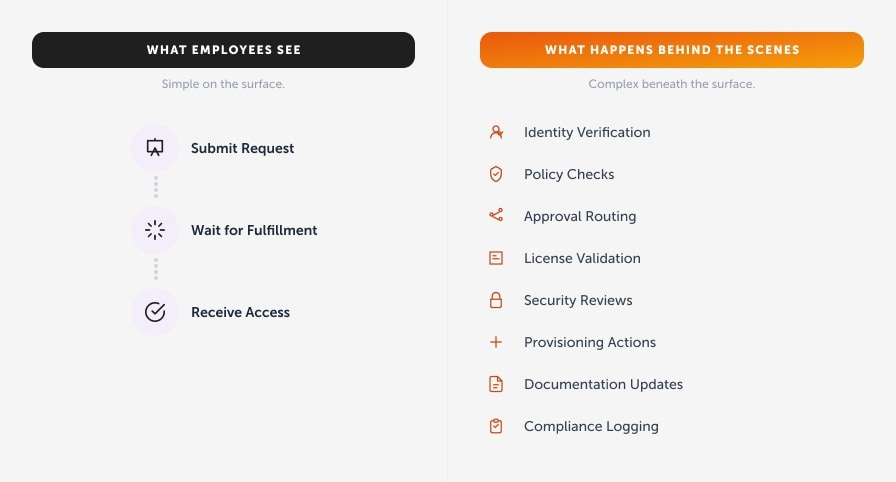
From an employee's perspective, requesting software appears straightforward. Submit a request. Wait for fulfillment. Receive access. Behind the scenes, however, a significant amount of work may occur.
The request may involve:
- identity verification
- policy checks
- approval routing
- license validation
- security reviews
- provisioning actions
- documentation updates
- compliance logging
Simple on the surface, but these often require coordination across multiple teams and systems. This dynamic exists across virtually every major IT function. As organizations adopt more SaaS applications, cloud infrastructure, and hybrid work models, the workload beneath the surface continues to expand.
The automation ceiling
Faced with increasing demand, many organizations turned to automation. Workflows, self-service portals, and virtual agents were implemented. These investments created meaningful improvements.
But while most traditional automation systems were designed around predefined workflows and structured processes, they struggle when requests become more dynamic. As a result, many organizations encounter what can best be described as an automation ceiling.
Despite years of investment, automation still depends heavily on human fulfillment because it typically focuses on routing work rather than completing work. The underlying task often still requires human involvement.
This is why organizations frequently report that automation has improved efficiency without significantly reducing workload. The ticket is moving faster, but the work still exists. The automation ceiling emerges when organizations realize they can no longer achieve meaningful gains through workflow optimization alone.
The next stage requires a different approach.
Deflection is not resolution
One of the most important concepts in modern ITSM is understanding the difference between deflection and resolution.
For years, vendors and organizations have celebrated metrics such as deflection rates, chatbot containment, and self-service adoption.
These metrics can be misleading. A deflected ticket simply means a ticket wasn't created. It means a user read a knowledge article, a chatbot answered a question, and a conversation ends without escalation.
Those outcomes may reduce contact volume, but they don’t necessarily resolve the issue. This distinction matters because organizations often mistake reduced interactions for reduced work. Deflection improves metrics, but resolution improves actual outcomes. Auto-resolution means a request is completed without human intervention.
Employees simply state what they need:
"I need access to Adobe."
"My laptop isn't connecting to VPN."
"I need a replacement device."
The system reasons through the request, executes the necessary actions, and delivers the outcome. This shift fundamentally changes the economics of ITSM. Instead of improving ticket metrics, they eliminate tickets altogether.
This is why auto-resolution has emerged as one of the most important metrics in modern service delivery. It measures outcomes.
The cost of standing still
The risks of maintaining the status quo are significant. Organizations that continue relying exclusively on ticket-centric service models face mounting challenges:
- rising labor costs
- growing licensing expenses
- increasing ticket backlogs
- longer resolution times
- employee frustration
- service desk burnout
- difficulty scaling operations
This is the growing SaaS tax created by a support model that requires more people, more licenses, and more spending to manage increasing demand. Traditional automation approaches have improved efficiency but often stop short of eliminating work. As organizations hit the automation ceiling, the focus is shifting from ticket management to auto-resolution.
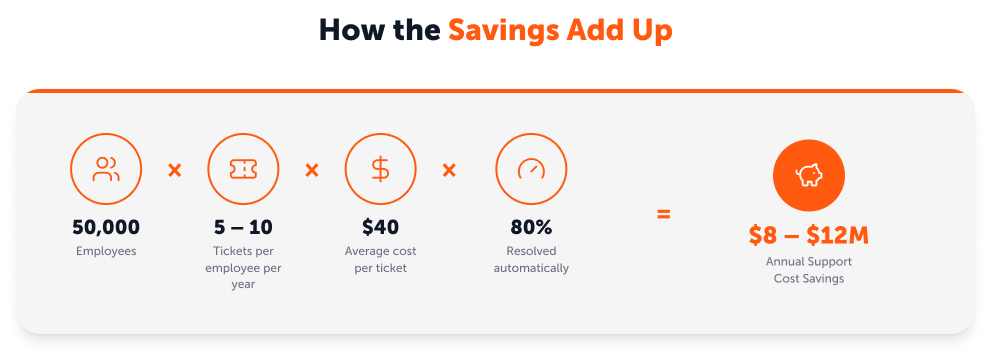
The financial impact is substantial: for example, if a 50,000-employee enterprise organization resolved 80% of tickets automatically, it could benefit from an annual support cost savings of $8-12 million (assuming each employee submits 5-10 tickets per year at an average cost of $40 per ticket).
Chapters
-
Chapter 1
The Agentic Advantage for ITSM -
Chapter 2
Why ITSM Must Automate Now -
Chapter 3
Building the Case for Business Automation -
Chapter 4
Use Case Selection & Prioritization -
Chapter 5
Best Practices for Implementing Agentic Execution -
Chapter 6
From Service Desk to Autonomous Service Delivery -
Chapter 7
Moving Beyond the Ticket
Previous: The Agentic Advantage for ITSM
Go to chapter 1Next: Building the Case for Business Automation
Go to chapter 3
Sign up to get exclusive access to the playbook.
 Explore now
Try


For Students & Developers
Start automating instantly with FREE access to full-featured automation with Cloud Community Edition.
