

- Login
- Search

- Contact Us

-
Have a question? Our team is here to help guide you on your automation journey.
-
Explore support plans designed to match your business requirements.
-
How can we help you?
-


English
Close
- Resources
Featured
 Named a 2026 Gartner® Magic Quadrant™ Leader for RPA.Recognized as a Leader for the Eighth Year in a Row Download report Download report
Building the Case for Business Automation
Most IT leaders understand they have a cost problem. What many don't realize is where those costs actually come from. When organizations evaluate ITSM investments, they typically focus on visible line items such as platform licensing, service desk headcount, and managed services contracts. These are easy to measure because they appear in budgets, renewal discussions, and procurement reviews.
This is the visible layer of the SaaS tax.
The larger challenge is that much of the cost associated with IT service delivery is hidden inside the process itself. Every request requires coordination. Every coordination point requires time. Every handoff introduces delay. Every delay consumes labor. And every labor-intensive process requires more people, more licenses, and more spending to sustain. This isn’t a single line item. It is the cumulative cost of operating a support model built around tickets, queues, approvals, and human fulfillment.
For many organizations, the SaaS tax grows gradually over time until it becomes accepted as a normal cost of doing business. This chapter challenges that assumption.
Why most organizations underestimate the SaaS tax
Most organizations know exactly how much they're paying for their ITSM platform, but they aren’t accurately quantifying the true cost of delivering a service request.
Take something as simple as a software access request. A user submits a request. The request is reviewed. An approval is generated. The approval sits in someone's inbox. The request is routed to another team. The software is provisioned. The ticket is updated. The ticket is closed.
Collectively, these steps consume significant time and resources.
The SaaS tax is embedded in approvals, ticket routing, escalations, and manual fulfillment. And because these activities have existed for decades, many organizations simply assume they are unavoidable.
Following the cost trail
One of the most useful exercises for CIOs is mapping the complete lifecycle of a common request. For example: A password reset appears trivial. In reality, the process often involves:
- employee downtime
- authentication verification
- service desk interaction
- system updates
- ticket documentation
- audit requirements
Software access is another example. The process may involve:
- request creation
- entitlement checks
- manager approval
- budget validation
- license assignment
- identity updates
- security review
- documentation
A request that takes an employee 30 seconds to describe can easily consume 10-15 minutes of organizational effort. This may not appear costly in isolation. Now multiply that process by thousands — or hundreds of thousands — of requests per year. The result is a support model where organizations spend enormous amounts of money managing work rather than completing it.
Organizations aren’t paying for software provisioning. They are paying for the people, systems, approvals, and processes required to coordinate software provisioning.
The three layers of the SaaS tax
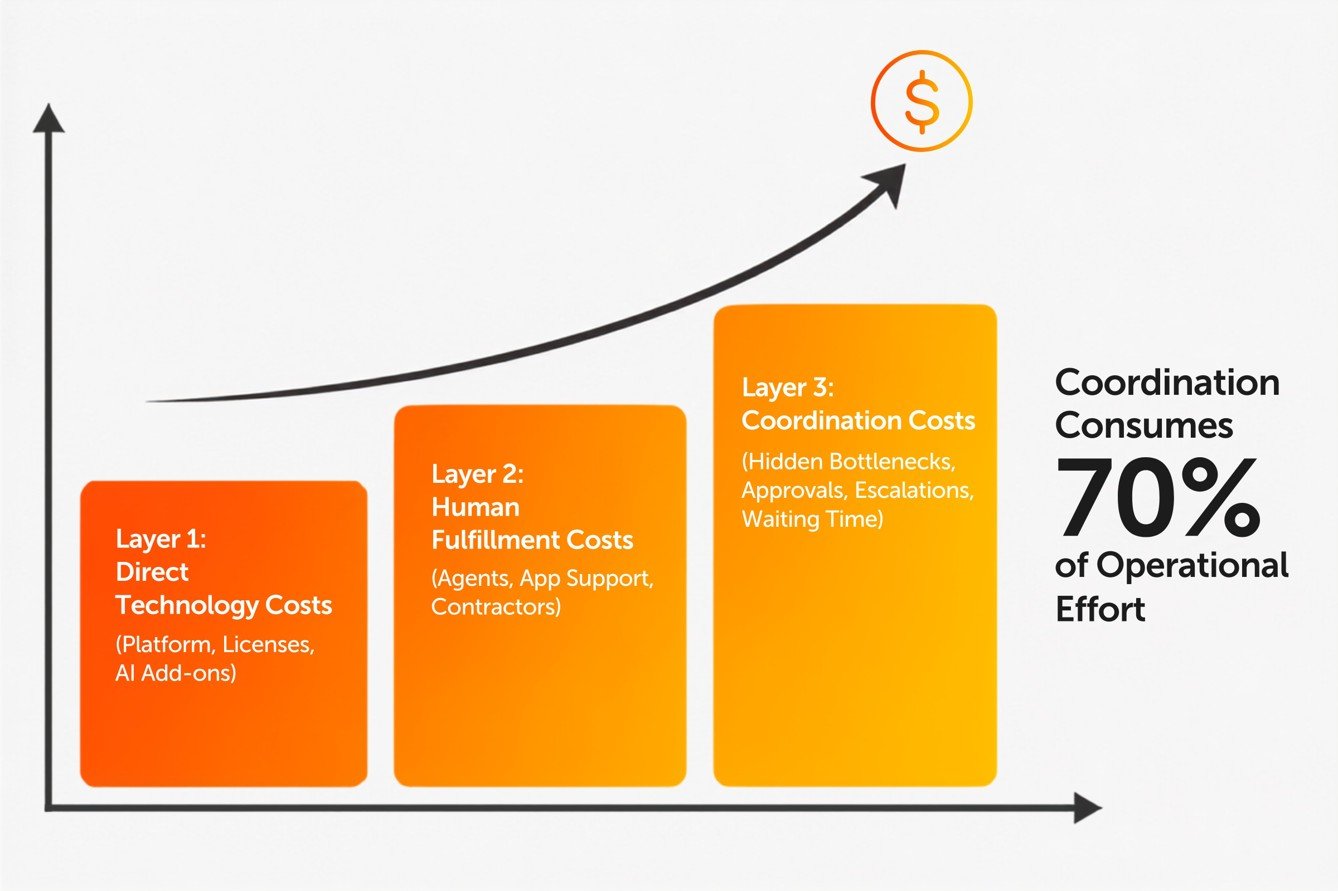
The SaaS tax typically appears in three forms.
Layer 1: Direct technology costs
These are easiest to identify. Examples include:
- ITSM platform licenses
- fulfiller licenses
- virtual agent licenses
- AI add-ons
- managed services contracts
Most organizations already track these expenses.
Layer 2: Human fulfillment costs
This includes the people required to keep the system running. Examples include:
- service-desk agents
- application support teams
- identity administrators
- endpoint specialists
- contractors
- outsourced support resources
As ticket volume increases, these costs increase alongside it. This is why many organizations find themselves hiring additional personnel every year despite years of automation investments.
Layer 3: Coordination costs
This is the least visible — and often the largest — portion of the SaaS tax. Examples include:
- ticket routing
- approval workflows
- escalations
- follow-up communications
- status updates
- rework
- duplicate effort
- waiting time
Coordination work creates no customer value. Its only purpose is moving requests through the system. Yet many IT organizations spend more time coordinating work than performing the work itself. This is one of the strongest arguments for autonomous service delivery.
Measuring the right outcomes
Historically, IT organizations have relied on metrics such as ticket volume, tickets closed, handle time, and deflection rate.
While useful, these metrics were designed for managing service desks, not evaluating autonomous service delivery. The next generation of ITSM requires a different set of measurements.
Auto-resolution rate
This may become the most important metric in modern ITSM. Unlike deflection, auto-resolution measures whether work was actually completed, such as a password reset completed, software installed, or a device configured.
Deflection measures conversations. Auto-resolution measures outcomes.
Cost per resolution
Organizations should understand:
- What does a password reset cost today?
- What does a software request cost today?
- What does onboarding cost today?
Only then can they determine the value of autonomous fulfillment.
License dependency
A useful question for CIOs is: How much of our support model depends on licensed human intervention? As autonomous resolution increases, license dependency should decline.
Employee productivity
Many business cases underestimate the value of employee time. A five-minute delay multiplied across thousands of requests quickly becomes significant. Reducing friction has measurable business value.
Building a credible business case
One of the most common mistakes organizations make is positioning agentic AI as an AI project. Successful business cases focus on overall economics. The strongest arguments typically center on four areas:
Cost reduction: Reducing service desk labor. Reducing contractor dependence. Reducing licensing growth. Reducing operational overhead.
Scalability: Supporting growth without proportional increases in staff. This is one of the clearest ways to demonstrate value.
Employee productivity: Faster fulfillment means less waiting and less disruption. This creates benefits that extend beyond IT.
Risk reduction: Standardized execution reduces variability, improves compliance, and creates more consistent outcomes.
The build vs. buy reality check
Many organizations initially assume they can build autonomous service delivery capabilities internally. After all, they already have an ITSM platform, automation tools, integration frameworks, and increasingly, access to AI technologies. On paper, assembling these components into an autonomous service experience can seem achievable. In practice, however, the challenge is far more complex.
Autonomous service delivery requires much more than deploying AI models or creating workflows. It demands deep integration across systems, endpoint management platforms, SaaS applications, security controls, knowledge repositories, and operational processes. It also requires continuous optimization, governance, monitoring, and adaptation as technologies and business requirements evolve.
Organizations that attempt to build these capabilities themselves often encounter several realities:
- Integration efforts take significantly longer than expected.
- AI models require ongoing tuning and maintenance.
- Security and compliance requirements introduce additional complexity.
- Internal teams must balance innovation projects against day-to-day operational responsibilities.
- Custom-built solutions can become difficult and expensive to maintain over time.
Industry experience provides strong evidence for these challenges. Large-scale enterprise automation initiatives frequently take years to mature, while many organizations struggle to move beyond pilot programs into broad production adoption. A significant percentage of AI and automation projects fail to achieve their intended business outcomes due to integration, governance, and operationalization challenges.
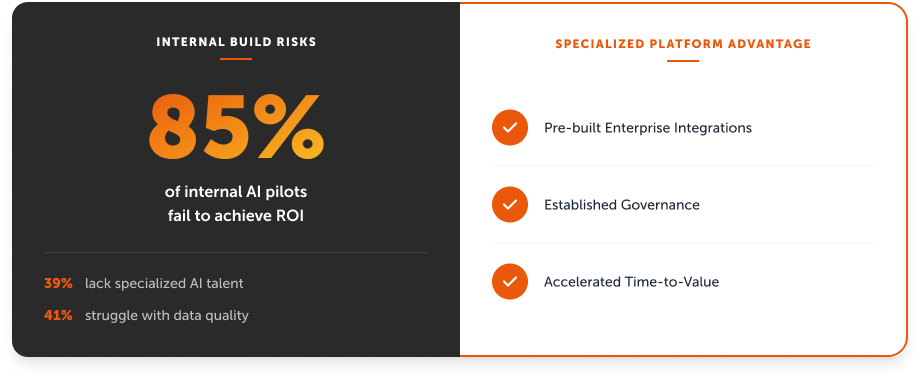
In fact, 85% of enterprise AI pilots fail, according to an MIT study. Models underperform and adoption falls short due to 39% of organizations lacking the necessary in-house talent and 41% struggling with data quality. Only 7% have clear rules and owners and 8% make those rules part of everyday build-and-release, introducing unnecessary risk. The bottom line, 95% of organizations show no measurable return on investment from AI pilots.
Partnering with a company that specializes in autonomous service delivery can dramatically reduce these risks.
Specialized providers bring proven architectures, prebuilt integrations, established governance frameworks, and operational expertise gained from supporting multiple enterprise environments. Rather than starting from scratch, organizations can leverage capabilities that have already been tested, refined, and scaled.
The benefits extend beyond faster deployment:
- Accelerated time-to-value through proven implementation approaches
- Reduced development and maintenance costs
- Access to specialized AI, automation, and service management expertise
- Lower operational risk through established security and compliance practices
- Faster realization of productivity gains and cost savings
- Continuous innovation without requiring large internal development teams
Perhaps most importantly, partnering allows organizations to focus on business outcomes rather than technology construction. Internal teams can concentrate on improving employee experiences, increasing productivity, and supporting strategic initiatives instead of spending years building foundational capabilities.
The question is not whether autonomous service delivery can be built internally. In many cases, it can. The more important question is whether building it is the fastest, lowest-risk, and most cost-effective path to achieving the outcomes the business expects. For most organizations, the answer increasingly points toward partnership rather than construction.
A new economic model for ITSM
The traditional service desk model is built around managing work. The emerging model is built around eliminating work. That distinction changes everything.
When organizations reduce the amount of work requiring human fulfillment, they begin breaking the seat-based cost curve. Costs stop scaling directly with ticket volume. Growth stops requiring proportional increases in licenses and headcount.
Support organizations become more efficient without asking employees to wait longer or accept lower service levels. This is ultimately why the SaaS tax matters. Organizations that can reduce their dependence on ticket-centric service delivery will be better positioned to support growth, improve employee experiences, and operate more efficiently in the years ahead.
Chapters
-
Chapter 1
The Agentic Advantage for ITSM -
Chapter 2
Why ITSM Must Automate Now -
Chapter 3
Building the Case for Business Automation -
Chapter 4
Use Case Selection & Prioritization -
Chapter 5
Best Practices for Implementing Agentic Execution -
Chapter 6
From Service Desk to Autonomous Service Delivery -
Chapter 7
Moving Beyond the Ticket
Previous: Why ITSM Must Automate Now
Go to chapter 2Next: Use Case Selection & Prioritization
Go to chapter 4
Sign up to get exclusive access to the playbook.
 Explore now
Try


For Students & Developers
Start automating instantly with FREE access to full-featured automation with Cloud Community Edition.
