

- Login
- Search

- Contact Us

-
Have a question? Our team is here to help guide you on your automation journey.
-
Explore support plans designed to match your business requirements.
-
How can we help you?
-


English
Close
- Resources
Featured
 Named a 2026 Gartner® Magic Quadrant™ Leader for RPA.Recognized as a Leader for the Eighth Year in a Row Download report Download report
Best Practices for Implementing Agentic Execution
By the time organizations reach the implementation phase of an agentic ITSM initiative, they have usually answered two important questions. First, they understand why change is necessary. Second, they have identified the use cases that offer the greatest opportunity to reduce the SaaS tax.
The next challenge is execution. This is where many promising AI initiatives struggle. The business case makes sense, and the use cases are clear. The technology works. Yet projects stall, pilots fail to scale, and adoption slows. In most cases, the problem isn't the AI.
Organizations frequently underestimate the operational, organizational, and governance changes required to move from traditional service delivery to autonomous service delivery. Successful organizations recognize that agentic execution is not simply a technology deployment. It is an operating model transformation.
Organizational readiness: The most overlooked success factor
Many organizations assume that successful implementation begins with selecting the right platform, identifying use cases, and launching pilot programs. That overlooks a crucial first step: readiness.
One theme appears consistently: Organizations are often more prepared technologically than they are operationally. Before launching an agentic execution initiative, CIOs should evaluate three areas:
Skills readiness
Agentic AI introduces new responsibilities that many organizations have never managed before. Most organizations already have expertise in service management. Far fewer have established processes for governing autonomous systems.
Questions to consider include:
- Who owns AI governance?
- Who monitors performance?
- Who evaluates outcomes?
- Who manages risk?
- Who approves autonomous actions?
As AI adoption expands, these capabilities become increasingly important.
Data readiness
AI can only reason using the information available to it. This raises important questions:
- Is CMDB data accurate?
- Are asset inventories current?
- Are knowledge articles up to date?
- Are service catalogs maintained?
- Are workflows properly documented?
AI amplifies existing processes. If runbooks are incomplete, documentation is outdated, or workflows are inconsistent, AI will inherit those problems. Garbage in, garbage out. Agentic systems do not magically fix bad data. Strong outcomes depend on strong foundations.
Process readiness
Organizations often focus heavily on technology readiness while overlooking process maturity. Yet AI inherits the strengths and weaknesses of existing operations. If workflows are inconsistent, approvals are poorly defined, or responsibilities are unclear, autonomous systems will encounter the same challenges as human teams.
Before introducing automation, organizations should evaluate:
- Service catalog quality
- Workflow consistency
- Escalation procedures
- Approval structures
- Policy documentation
The goal is establishing enough operational clarity for autonomous execution to succeed.
Coexisting with your existing ITSM platform
A big question CIOs ask is whether moving toward autonomous service delivery means replacing their existing ITSM platform.
It doesn't. Autonomous Service Desk is designed for the opposite. Most enterprises have spent years building mature ITSM environments that include service catalogs, approval workflows, reporting, governance frameworks, and integrations with countless business systems. Those investments remain valuable and continue to serve an important role within the enterprise.
The opportunity isn't to replace your ITSM platform. It's to make it more valuable.
Traditional platforms like ServiceNow, Jira Service Management, and BMC Helix excel at capturing incidents, changes, requests, assets, approvals, and operational history. But modern service delivery rarely begins and ends inside a single platform. A software request might originate in ServiceNow, require identity verification through Okta, validate licensing in another application, notify the employee in Microsoft Teams, and document the outcome back inside the ITSM platform.
Autonomous Service Desk introduces an execution layer that operates across that environment. Rather than replacing your existing ITSM investment, it orchestrates work between the platforms you already own, allowing each system to do what it does best while eliminating the manual coordination that exists between them.
This architecture provides what Automation Anywhere calls an agnostic advantage. Organizations don't need to standardize on a single technology vendor or force every process into one ecosystem. Existing platform investments continue to operate as they do today. Autonomous Service Desk connects them, reasons across them, and executes work between them.
This distinction becomes increasingly important as organizations evaluate platform-native AI capabilities. Most enterprise software vendors now offer AI assistants and embedded agents. These capabilities can be effective when work remains inside that platform but breaks down when it exits.
Ask a few simple questions:
- Where does work leave your ITSM platform?
- Which requests require employees to switch between multiple applications?
- Where are people still copying information from one system into another?
- Which processes rely on emails, spreadsheets, PDFs, or homegrown applications to move work forward?
- Where do platform-native agents stop because the next step happens outside their ecosystem?
Those transition points are where most enterprise work slows down. They're also where the SaaS tax accumulates.
For CIOs, this reduces implementation risk. There is no need for a rip-and-replace project or a wholesale migration away from existing ITSM investments. Organizations can modernize incrementally, introducing autonomous resolution for high-volume use cases while preserving existing governance, service management processes, reporting, and compliance.
Your ITSM platform remains the enterprise system of record, preserving visibility, auditability, and processes, while Autonomous Service Desk increasingly becomes the system of execution without rebuilding the operational foundation you've spent years creating.
Moving beyond the technology conversation
One of the biggest mistakes organizations make is treating agentic AI solely as a technology project focused on isolated topics such as LLMs, prompts, and infrastructure.
While these topics matter, they are rarely what determines success. Once organizations have a baseline of where they stand and readiness is addressed, the most successful deployments begin with a different question:
What business outcome are we trying to achieve?
Organizations that focus exclusively on technology often build impressive demonstrations that fail to generate meaningful business value. Organizations that focus on outcomes tend to achieve faster adoption and stronger ROI.
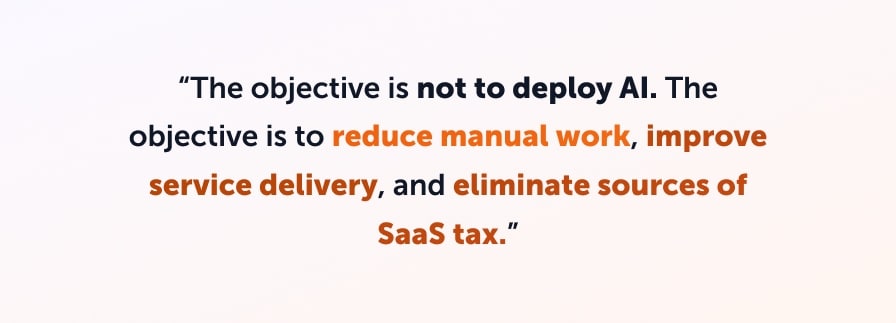
The objective is not to deploy AI. The objective is to reduce manual work, improve service delivery, and eliminate sources of SaaS tax. Technology is simply the mechanism.
Build around auto-resolution
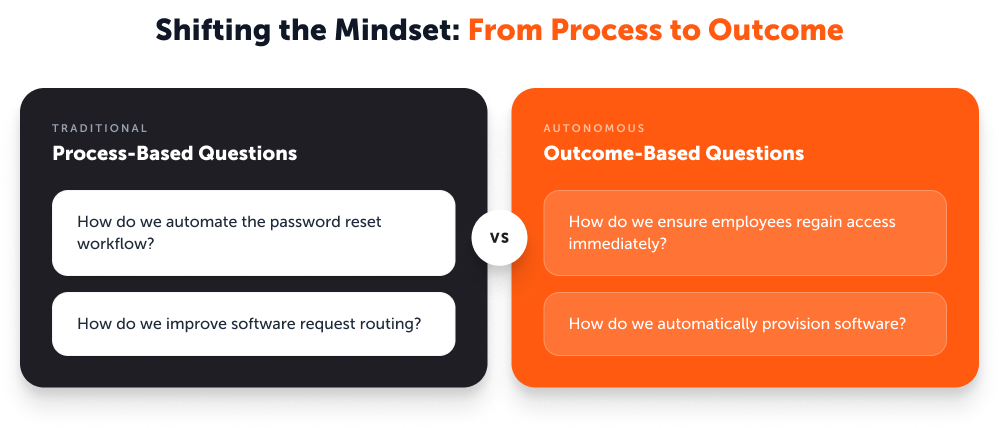
Traditional automation initiatives often focus on improving workflows. Agentic execution focuses on improving outcomes. This shift changes how organizations design services.
Historically, many projects have been measured by faster routing, improved workflow efficiency, or reduced handle times.
These improvements still assume the ticket remains the center of the process. Agentic execution starts somewhere else. The desired outcome becomes the design point. For example:
Instead of asking: "How do we automate the password reset workflow?"
Ask: "How do we ensure employees regain access immediately?"
Instead of asking: "How do we improve software request routing?"
Ask: "How do we automatically provision software?"
This outcome-first mindset helps teams avoid simply digitizing existing inefficiencies.
Start small, scale fast
One of the strongest lessons emerging from successful deployments is that organizations rarely begin with enterprise-wide transformation. Instead, they focus on a handful of carefully selected use cases. This approach delivers several benefits, allowing organizations to:
- Demonstrate value quickly
- Refine governance models
- Build organizational confidence
- Establish operational practices
- Reduce implementation risk
Most successful programs follow a phased progression:
Phase 1: Pilot
Select three to five high-volume use cases. Examples might include:
- Password resets
- Account lockouts
- Software requests
- Distribution list management
Focus on proving measurable outcomes.
Phase 2: Expansion
Extend automation into adjacent processes. Increase coverage across service desk operations. Begin measuring broader operational impact.
Phase 3: Enterprise scale
Expand into:
- HR
- Facilities
- Finance
- Procurement
- Enterprise service management
At this stage, organizations begin realizing the full benefits of autonomous service delivery. Success rarely comes from trying to automate everything at once. Success comes from proving value and repeating.
Governance and security must exist from Day 1
As organizations increase autonomy, governance becomes increasingly important. One of the most common concerns among CIOs is not whether autonomous systems can perform tasks. It is whether they can be trusted to perform tasks safely.
Autonomous systems may:
- Grant access
- Provision software
- Modify records
- Execute workflows
- Trigger actions across multiple systems
These capabilities create tremendous value. They also create responsibility. Governance should be established before scaling begins.
Key areas include:
Human-in-the-loop controls
Not every action should be fully autonomous.
Organizations should clearly define:
- What actions agents can execute independently
- What actions require approval
- What actions should always remain human-controlled
The objective is not eliminating oversight. It is applying oversight where it matters most.
Role-based access controls
Agents should operate within clearly defined permissions. The principle is simple: Agents should never have more authority than the individuals they represent.
Auditability
Every autonomous action should be traceable.
Organizations should be able to answer:
- What happened?
- Why did it happen?
- What systems were involved?
- Who approved it?
Transparency builds trust. Trust enables scale.
Avoiding the pilot graveyard
The technology industry has a long history of successful demonstrations that never become successful deployments. Agentic AI is no exception. Many organizations achieve promising pilot results and then struggle to move beyond them. Several patterns appear repeatedly.
Mistake No. 1: Focusing on technology instead of outcomes
AI projects should be tied directly to business objectives. Without measurable outcomes, executive support fades quickly.
Mistake No. 2: Measuring deflection instead of resolution
A chatbot conversation is not a business outcome. Organizations should measure completed work, not avoided interactions.
Mistake No. 3: Choosing low-impact use cases
Not all automation creates value. The strongest pilots target areas with meaningful operational impact.
Mistake No. 4: Ignoring governance until later
Governance becomes more difficult to implement after adoption begins. Organizations should establish policies early.
Mistake No. 5: Trying to transform everything at once
Large-scale transformation sounds attractive. Incremental success scales more reliably. The organizations seeing the fastest results are deploying AI where it matters most and scaling from there.
Building executive alignment
Successful implementations require support beyond the service desk.
Stakeholders include:
- CIOs
- IT operations leaders
- Security teams
- Risk and compliance teams
- HR leaders
- Finance leaders
Each group evaluates success differently. The CIO may focus on operational efficiency. Security teams may focus on governance. Finance leaders may focus on cost reduction. Employees may focus on experience.
Strong programs connect autonomous service delivery to each of these priorities. This creates organizational alignment around a shared outcome: Business value. This is a new operating model for service delivery, one capable of reducing the SaaS tax, eliminating routine work, and laying the foundation for autonomous service delivery at enterprise scale.
Chapters
-
Chapter 1
The Agentic Advantage for ITSM -
Chapter 2
Why ITSM Must Automate Now -
Chapter 3
Building the Case for Business Automation -
Chapter 4
Use Case Selection & Prioritization -
Chapter 5
Best Practices for Implementing Agentic Execution -
Chapter 6
From Service Desk to Autonomous Service Delivery -
Chapter 7
Moving Beyond the Ticket
Previous: Use Case Selection & Prioritization
Go to chapter 4Next: From Service Desk to Autonomous Service Delivery
Go to chapter 6
Sign up to get exclusive access to the playbook.
 Explore now
Try


For Students & Developers
Start automating instantly with FREE access to full-featured automation with Cloud Community Edition.
