

- Login
- Search

- Contact Us

-
Have a question? Our team is here to help guide you on your automation journey.
-
Explore support plans designed to match your business requirements.
-
How can we help you?
-


English
Close
- Resources
Featured
 Named a 2026 Gartner® Magic Quadrant™ Leader for RPA.Recognized as a Leader for the Eighth Year in a Row Download report Download report
Context Intelligence Graph
Deliver Precise Context to Every Process Step
Ground agentic execution in trusted, role-based context delivered seamlessly across systems, models, and platforms.

Drive accuracy higher
Ground agents and automations in your unique business rules and data to boost decision accuracy compared to generic context.
Unify process consistency
Make sure every agent, automation, and human decision point shares the same context, streamlining handoffs and reducing errors and escalations.
Cut rework and escalations
Deliver the right context at the right moment to handle edge cases autonomously and block unsafe actions with built-in guardrails.
Deliver context to any agent
Feed any AI model, any enterprise system, and any agent with precise context. No vendor boundaries.
Achieve context-driven accuracy and control.
- Connect your systems of record, policies, SOPs, and knowledge bases to deliver context exactly where and when it’s needed, without noise or data dumps.
- Expand your enterprise-specific context with the global process reasoning engine (PRE) foundation, enriching automation intelligence with your unique business rules.
- Apply consistent context across process design, orchestration, and agent execution to unify intelligence and governance.
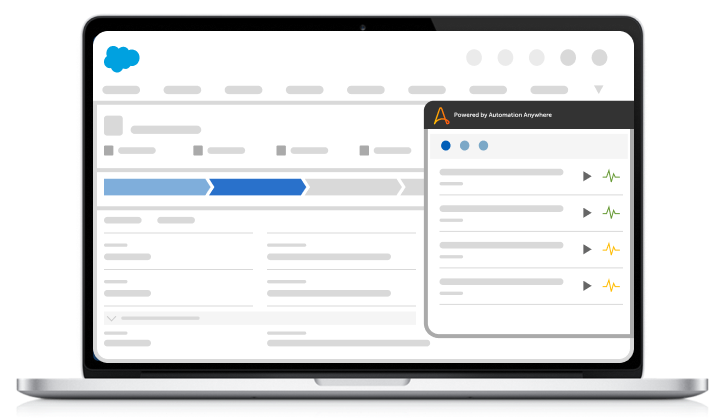
AI that knows your business.
Why precision context matters
| Challenge | Other solutions | How Context Intelligence Graph delivers precision context | |
|---|---|---|---|
| 1 | Protecting sensitive information | Everyone accesses broad data pools regardless of role | Role-based access ensures teams see only relevant, authorized context |
| 2 | Understanding complex documents | Treats documents as unstructured text, missing key details | Reads documents like a person—capturing tables, forms, and layout for accurate insights |
| 3 | Integrating knowledge and automation | Separate tools for retrieving information versus driving workflows | One unified foundation that answers questions and powers automation seamlessly |
| 4 | Keeping knowledge current and relevant | Static knowledge bases that require manual updates | A living context graph that continuously learns and improves from every process execution |
| 5 | Avoiding vendor lock-in | Context tied to specific platforms or agents | Context feeds any AI model, system, or agent, ensuring flexibility and scalability |
Context Intelligence Graph FAQs
What problem does Context Intelligence Graph solve?
Context Intelligence Graph solves the precision problem in complex processes — ensuring each step gets exactly the context it needs. Too much context floods steps with noise and latency; too little leads to bad decisions. Context Intelligence Graph balances relevance and precision across your automation.
Who should use Context Intelligence Graph?
Context Intelligence Graph benefits enterprises seeking to improve automation accuracy and governance across agents, automations, and human workflows by grounding processes in their unique business data, policies, and execution history.
How does Context Intelligence Graph integrate with existing systems?
Context Intelligence Graph connects directly to your systems of record, policy repositories, and knowledge bases, normalizing and delivering context seamlessly across your automation estate.
How is Context Intelligence Graph different from PRE?
Context Intelligence Graph expands PRE. PRE provides global process intelligence based on 400M million automations annually and Context Intelligence Graph adds your specific business context, policies, and execution history for precision at every step.
How are Context Intelligence Graph and RAG different?
RAG retrieves relevant information from external sources to support a response or workflow step. A Context Intelligence Graph goes further by structuring relationships between data, processes, users, systems, and decisions so each step receives the most relevant context in the right form. In short, RAG helps find information; Context Intelligence Graph helps determine what context matters, when, and why.
Does Context Intelligence Graph replace PRE?
No. Context Intelligence Graph builds on PRE’s global automation intelligence foundation, adding enterprise context grounding and a self-learning context graph to enhance accuracy and intelligence.
Get precision context for every automation
Ground every process step in exactly the context it needs to reduce errors, improve accuracy, and build a smarter, self-learning automation foundation.


Try


For Students & Developers
Start automating instantly with FREE access to full-featured automation with Cloud Community Edition.
