

- Login
- Search

- Contact Us

-
Have a question? Our team is here to help guide you on your automation journey.
-
Explore support plans designed to match your business requirements.
-
How can we help you?
-


English
Close
- Resources
Featured
 Named a 2026 Gartner® Magic Quadrant™ Leader for RPA.Recognized as a Leader for the Eighth Year in a Row Download report Download report


- Key Takeaways
- What is AI in manufacturing?
- Role of artificial intelligence in smart manufacturing
- 4 Key benefits of AI in manufacturing
- What are real-world examples of AI in manufacturing?
- 7 Key types of industrial AI applications
- The evolution toward agentic AI: Solving the coordination problem
- How agentic process automation (APA) addresses the coordination gap
- Risk, limitations, and responsible AI practices
- Implementing AI in manufacturing: A strategic roadmap
- Data, governance, and security for industrial AI
- How Automation Anywhere operationalizes AI in manufacturing
- AI in manufacturing FAQs
Move beyond predictive maintenance. Learn how AI in manufacturing is evolving into agentic orchestration to bridge the gap between ERP, MES, and business operations.
Key Takeaways
- AI in manufacturing applies machine learning, computer vision, and AI agents to predict failures, inspect quality, and orchestrate supply chain management workflows.
- According to McKinsey, AI-based predictive maintenance can reduce machine downtime by up to 50% and extend machine life by up to 40%.
- Agentic process automation (APA) closes the coordination gap between ERP, MES, PLM, and QMS systems that shop-floor automation alone cannot solve.
- Automation Anywhere customers report results such as 500,000 hours saved at Mars and an 85% efficiency gain at Mantrac.
- As of 2026, the leading approach is a phased roadmap: start with low-risk pilots, ensure data readiness, then scale to cross-system orchestration.
What is AI in manufacturing?
Think of AI in manufacturing as machine learning, computer vision, and AI agents working together to improve production, quality, and supply chain management decisions across the enterprise. Too often it stays confined to machine-level optimization through robotics and programmable logic controllers (PLCs). The bigger payoff now lies in end-to-end process optimization.
This evolution addresses the common challenges of fragmented systems and manual coordination that have long plagued even the most advanced factories. At the heart of this shift is agentic automation in manufacturing, powered by advanced agentic process automation (APA) platforms, which are emerging as the pivotal technologies for bridging critical operational gaps.
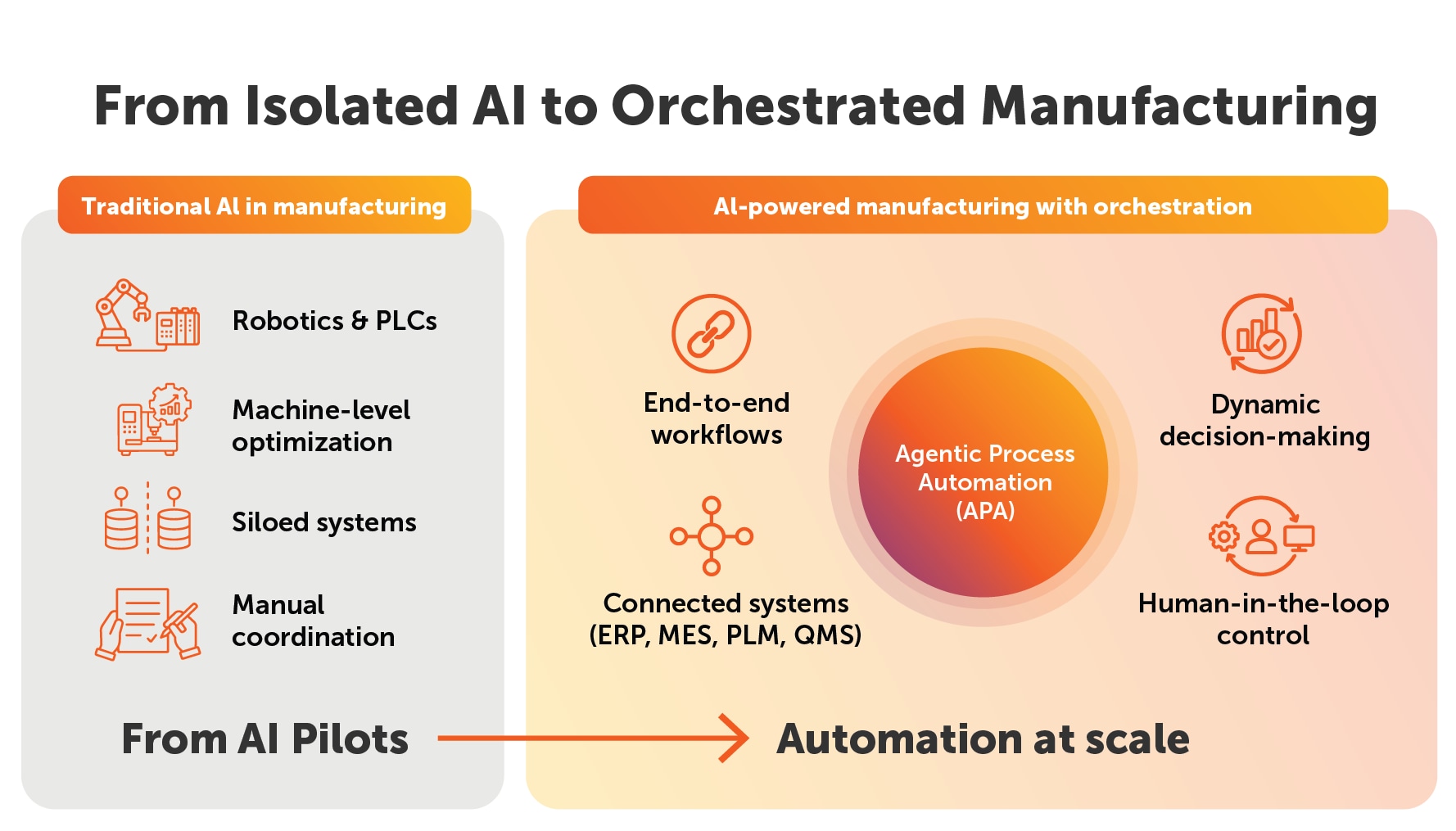
Today’s intelligent agents don't just move data; they proactively manage complex workflows, making dynamic decisions and maintaining process state across siloed systems like ERP, MES, PLM, and quality management systems (QMS). Your priority is now to move beyond isolated AI pilots to unlock manufacturing automation at scale.
This guide provides a blueprint for leveraging APA to navigate this next wave of industrial innovation, offering a strategic approach to orchestrating work with built-in auditability and robust human-in-the-loop (HITL) controls.
Role of artificial intelligence in smart manufacturing
Artificial intelligence in smart manufacturing is the engine behind intelligent automation and dynamic decision-making. It goes well beyond data analytics.
It also gives C-suite leaders a way to strategically automate manufacturing operations. By combining APA, including AI agents, robotic process automation (RPA), and guardrails, you change how your organization runs critical processes, from the shop floor to supply chain management.
The investment is already underway. According to Deloitte's 2025 Smart Manufacturing survey, 78% of manufacturers allocate more than 20% of their improvement budgets to smart manufacturing initiatives.
In this video, Thiago Pereira from Integer Holdings explains how Agentic AI transforms manufacturing. Learn how to overcome unstructured data challenges, scale automation through effective pilot programs, and maintain human-in-the-loop oversight to ensure high-quality, life-saving medical device production.
4 Key benefits of AI in manufacturing
The four key benefits of AI in manufacturing are increased efficiency, lower costs, improved product quality, and enhanced safety.
1. Increased efficiency & productivity
AI automates the bottlenecks between departments and systems, such as data entry, report generation, and cross-system validation. Workers are freed for higher-value activities that demand creativity and problem-solving.
2. Lower costs & reduced waste
Precise demand forecasting and supply chain management reduce overproduction, storage costs, and obsolescence. AI quality control reduces scrap, and predictive maintenance minimizes emergency repairs and expedited parts.
3. Improved product quality
Real-time inspection, continuous process monitoring, and anomaly detection hold products to stringent standards. They also reduce the long-term costs of poor quality.
4. Enhanced safety
AI-guided robots take on dangerous tasks, and collaborative robots react to human presence to prevent accidents. Both support compliance with safety regulations.
What are real-world examples of AI in manufacturing?
Real-world examples include predictive maintenance on production lines, computer vision inspection, AI-driven supply chain management and demand forecasting, and agentic automation across ERP and MES. Mars saved 500,000 hours through 475 agentic automations, and Mantrac achieved an 85% efficiency gain with zero errors.
7 Key types of industrial AI applications
Industrial AI applications fall into seven types: predictive maintenance, quality control, supply chain optimization, digital twins, generative design, robotics, and energy management.
Application | Primary AI technique | Core business outcome |
|---|---|---|
Predictive maintenance | Machine learning on sensor data | Fewer unplanned breakdowns, lower repair costs |
Quality control | Computer vision | Faster, more consistent defect detection |
Supply chain optimization | Demand forecasting models, AI agents | Balanced inventory, fewer stockouts |
Digital twins and simulation | Real-time data analysis, simulation | Risk-free "what-if" process testing |
Generative design | Generative algorithms | Lighter, stronger, cost-efficient components |
Process automation and robotics | Sensor-driven learning, robotic vision | Handling variability and greater task complexity |
Energy management | Predictive analytics, AI agents | Lower utility costs and reduced emissions |
Predictive maintenance
Predictive maintenance uses AI algorithms to analyze sensor data from physical assets and forecast equipment breakdowns before they happen. McKinsey reports that it can cut machine downtime by up to 50%.
Manufacturers can then schedule maintenance exactly when it is needed, instead of following rigid preventive maintenance schedules or reacting after a failure.
Quality control and computer vision
Computer vision systems powered by AI identify product defects faster and more consistently than human inspectors. Models trained on flawless and defective items detect microscopic flaws, classify defect types, and pinpoint where in the production process they originate.
Supply chain optimization
AI-driven supply chain management uses machine learning (ML) models to analyze historical demand, market trends, and supplier performance and produce accurate forecasts. Manufacturers can then balance stockout avoidance against carrying costs.
Modern AI agents for supply chain management automate raw-material procurement and flag shortages early, improving visibility across the entire supply chain.
Digital twins and simulation
Digital twins are virtual replicas of factories. They let manufacturers simulate "what-if" scenarios with real-time data, supporting troubleshooting and process optimization without disrupting physical production.
Generative design
Generative design uses AI algorithms to produce designs that meet material and performance constraints, optimizing the bill of materials (BOM) for cost and efficiency.
Process automation & robotics
AI-powered robots perceive their environment, learn from new data, and adapt in real time. That lets them handle variability, such as picking irregularly shaped objects or assembling intricate components.
Energy management
AI energy management analyzes usage patterns, production schedules, and energy rates to optimize HVAC, lighting, and machinery. It also predicts peak-demand periods so plants can avoid surcharges.
The evolution toward agentic AI: Solving the coordination problem
Shop floors run at machine speed. Planning, procurement, logistics, quality checks, and financial reconciliation often don't, because of manual handoffs and fragmented systems. Agentic AI solves this coordination problem by autonomously executing multi-step workflows across systems that humans otherwise connect by hand.
The difference from a copilot is autonomoy. Copilots act as assistants, providing insights or completing tasks on request, but the human stays in the driver's seat.
Agents are given high-level objectives and autonomously execute multi-step workflows, handle exceptions, and deliver outcomes across systems and departments.
Agents understand context, maintain state across long-running processes, and coordinate actions across disparate systems. Slow, human-mediated workflows become self-managing operations.
How agentic process automation (APA) addresses the coordination gap
Agentic Automation offers a blueprint for bridging the gap between isolated systems and human-driven coordination.
Maintaining state across business processes
Agents “follow” a process from initiation to completion, maintaining context and orchestrating tasks across multiple systems (such as ERP and MES) over days or weeks. This ensures continuity where traditional, fragmented, or vendor-specific automation often fails.
Coordinating across siloed systems
Acting as connective tissue, AI agents in manufacturing integrate disparate systems, such as PLM, QMS, and Finance, ensuring that critical documents, such as the BOM, are consistent across all systems. They also enable seamless data flow and action, eliminating manual data re-entry and operational delays.
Handling exceptions and adapting to volatility
When a supply delay occurs, AI agents can autonomously detect the disruption. They can then either find an alternate supplier, adjust production schedules, or alert a human worker with specific, actionable recommendations to avert delays.
Governance and traceability
Every action taken by an AI agent is meticulously logged to create an immutable audit trail. This built-in traceability is crucial for meeting ISO standards, regulatory compliance, and internal governance requirements.
Risk, limitations, and responsible AI practices
While AI offers immense potential in manufacturing, you must address fundamental AI risks to ensure responsible deployment. These include model drift, where AI models lose accuracy over time; bias in data leading to unfair or incorrect decisions; and data sovereignty concerns arising from regional regulations and data processing rules, especially with cloud-based AI.
To mitigate AI risks and instill responsible AI governance and related practices, continuously monitor AI performance, regularly retrain models, and establish clear rules, guardrails, and policies.
Implementing AI in manufacturing: A strategic roadmap
Your journey to harnessing the benefits of AI in manufacturing should follow a phased approach to maximize impact and mitigate risk.
Phase 1: Start with high-value, low-risk pilots.
Begin with specific, well-defined processes, such as purchase order (PO) processing or document assembly. Focus on processes that are:
- Repetitive and rule-based: Ideal for demonstrating the automation capabilities of RPA.
- Data-intensive: Where AI can quickly process large volumes of information.
- Prone to human error: Where automation can improve accuracy.
- Non-critical path: To minimize risk if unexpected challenges arise.
Automated PO processing, for example, where AI extracts data from invoices and reconciles it with POs in the ERP system; automated document assembly, such as generating compliance reports or quality certifications; or even basic customer inquiry routing in a service center.
The key here is to select projects that offer clear, measurable benefits in a contained environment. This phase is less about transforming the entire factory and more about learning, iterating, and proving the value proposition of AI in a controlled, manageable way.
Phase 2: Next, ensure data readiness and develop a sensor integration strategy.
As you move beyond initial pilots, the focus shifts to foundational data and connectivity. AI needs clean, trusted data, making data readiness a paramount concern. This phase involves:
- Data quality and cleansing: Implementing processes to ensure data is accurate, complete, and consistent across all sources.
- Establishing data lakes and/or warehouses: Building robust infrastructure for collecting, storing, and processing vast amounts of operational data from diverse sources.
- Sensor integration strategy: For more advanced AI applications, particularly those involving real-time monitoring and predictive capabilities, a comprehensive strategy for integrating internet of things (IoT) sensors is essential.
This phase also involves developing an ethical AI framework, ensuring data privacy and security, and setting guidelines for agent development and deployment. Without a solid data foundation and a clear strategy for integrating relevant physical and operational data, scaling AI efforts will be severely limited.
Phase 3: Scale to cross-system orchestration (the “smart factory”).
With pilot project success and a robust data infrastructure in place, you can then scale to cross-system orchestration and the vision of the “smart factory.” This phase involves deploying AI agents to manage complex business processes that span multiple departments and technology silos. Focus on:
- Process redesign: Re-evaluating existing business processes for agentic orchestration, moving beyond isolated tasks to holistic workflow automation.
- Cross-functional collaboration: Fostering deep collaboration between IT, Operations, Engineering, and business units to design and deploy AI solutions.
- Continuous optimization: Implementing continuous feedback loops where AI agents and models learn from new data, adapt to changing conditions, and drive ongoing process improvements.
The smart factory vision isn't just about automation; it's about creating an intelligent, interconnected, and adaptive manufacturing ecosystem. Here, AI agents manage the operations that connect machines to enterprise systems, enabling unprecedented levels of efficiency, responsiveness, and operational autonomy.
Data, governance, and security for industrial AI
Successful industrial AI implementation hinges on a strong foundation of data management, governance, and security. You must emphasize high-quality data collection, accurate labeling, and the role of HITL processes for mission-critical decisions.
Enterprise-grade security protocols and robust auditability are also required to protect sensitive manufacturing data and ensure the integrity of AI-driven operations.
How Automation Anywhere operationalizes AI in manufacturing
Automation Anywhere provides the process discovery, agent deployment, and agentic orchestration layers that connect your existing systems and empower AI agents to manage complex manufacturing workflows.
- Automation Anywhere’s Process Discovery identifies and captures automation opportunities.
- AI Agent Studio allows you to build and manage safe, secure AI agents to automate any process.
- Automation Co-Pilot assists operators in generating, building, and deploying automations inside manufacturing workflows.
Ready to explore how APA can transform your manufacturing operations? Schedule a demo to see Automation Anywhere’s APA in action and discover your path to manufacturing autonomy.
AI in manufacturing FAQs
What is AI in manufacturing?
AI in manufacturing is the use of machine learning, computer vision, and generative AI on production data to predict equipment failures, inspect quality, plan supply chains, and optimize operations. It lets manufacturers move from reactive, manual decisions to data-driven ones across the plant and the enterprise.
How is AI being used in manufacturing today?
AI in manufacturing today centers on four core areas: predictive maintenance that forecasts equipment failures, computer vision that inspects quality, demand forecasting and supplier planning, and generative design. Collaborative robots also take on hazardous tasks, and agents increasingly coordinate work across ERP and MES systems.
What are the benefits of AI in manufacturing?
The benefits of AI in manufacturing include lower operating costs, less scrap and unplanned downtime, higher throughput, improved worker safety, and longer equipment life. Predictive maintenance, AI inspection, and demand forecasting are common sources of these gains, though results depend on data quality.
What are real-world examples of AI in manufacturing?
BMW Group uses AI visual inspection in vehicle assembly and applies NVIDIA digital twin simulation to plan its factories. The digital twin lets planners test layouts and workflows virtually before changing the physical plant, limiting disruption to production.
What are the challenges of adopting AI in manufacturing?
The main challenges of AI in manufacturing are poor data quality and silos, legacy system integration, skills gaps, cost, and cybersecurity risk in connected plants. Starting with a low-risk pilot and cleaning data first helps manage these risks.
Will AI replace manufacturing jobs?
AI is more likely to augment manufacturing workers than replace them, though some roles will change. It handles repetitive and hazardous tasks, shifting people toward oversight, analysis, and exception handling. Workforce augmentation works best with upskilling, so manufacturers should train operators and engineers to work alongside AI systems.
Stay up to date:
 Subscribe to the blog

Try


For Students & Developers
Start automating instantly with FREE access to full-featured automation with Cloud Community Edition.
