


RPA handles the foundation of repetitive, rule-based tasks. IPA adds artificial intelligence (AI) technologies, enabling the automation of tasks that involve unstructured data and basic decision-making. Agentic process automation (APA) is adaptive, featuring goal-based AI agents that orchestrate decision-making for complex, dynamic workflows.
This article breaks down what RPA, IPA, and APA do individually, how they relate to each other, and how they work together in a unified architecture.
What is RPA?
Robotic process automation (RPA) is software designed to automate repetitive, rule-based tasks that typically require human effort. By using software robots, or "bots," RPA mimics human actions within digital systems, streamlining workflows without altering existing infrastructure.
RPA excels at handling high-volume, low-complexity tasks based on structured data that follow clear rules and logic. It automates processes like data entry, form filling, and invoice processing, improving accuracy and efficiency while reducing human error.
RPA improves operational efficiency by speeding up processes and increasing output. It also reduces human error, as RPA automations perform tasks consistently and accurately. And, RPA can be deployed quickly without changes to existing systems.
Key features of RPA
- Rule-based automation: RPA follows predefined rules to perform tasks consistently.
- Ease of implementation: RPA follows the user interface (UI) path to execute tasks, making it non-invasive and non-disruptive. It smoothly integrates with existing systems without extensive coding.
- Integration with existing systems: RPA works seamlessly across enterprise platforms and systems, interacting with applications just like a human user.
Common use cases
- Data extraction from structured sources
- Data entry and transfer of data between systems
- Processing invoices
- Simplifying HR processes by automating administrative tasks
- Keeping CRM customer information up-to-date with minimal manual intervention
- Compiling data from multiple sources to create reports
Limitations of RPA
Despite its benefits, RPA has limitations. While RPA can deliver rapid efficiency gains for straightforward tasks, it is not suitable for every scenario, particularly those that involve variability or nuance. RPA is not designed for handling unstructured data or complex decision-making processes. It operates best in static environments where tasks are well-defined and consistent.
What is IPA?
Intelligent process automation (IPA), also known as Intelligent Automation, elevates RPA by integrating AI technologies. The combination of RPA and AI enables automating end-to-end workflows that require basic decision-making, pattern recognition, and handling unstructured data.
IPA systems harness AI technologies such as computer vision, natural language processing (NLP), machine learning (ML), and generative AI to work in concert with RPA to execute process steps.
Unlike RPA's focus on rule-based tasks, IPA can understand human language, interpret large amounts of data, and make informed decisions, supporting the automation of more complex business processes.
Key features of IPA
- Cognitive abilities: IPA incorporates AI technologies that enable it to learn from data and make decisions based on patterns rather than just following predefined rules.
- Handling unstructured data: Unlike RPA, which is limited to structured data, IPA can process and analyze unstructured information.
- Improved adaptability: IPA systems can adapt to changing conditions and improve performance over time by learning from new data inputs.
Common use cases
- Customer service chatbots that can understand and respond to customer inquiries in natural language.
- Processing unstructured documents, like extracting relevant information from emails, contracts, and images, and transforming them into structured data.
- Analyzing large datasets to provide insights and recommendations to inform business decisions and automate data-analysis processes like fraud detection.
Limitations of IPA
While IPA offers significant advantages over stand-alone RPA, its increased capabilities can make implementation more complex, often requiring specialized skills and a deeper understanding of AI technologies. Additionally, effective IPA relies on access to quality data to train AI models, making data management a factor in successful deployment.
What is APA?
Agentic process automation (APA) represents an evolution in Intelligent Automation, leveraging AI agents that work independently to achieve predefined goals. AI agents can execute complex, multi-step processes that require planning and decision-making. The result is adaptive, responsive, autonomous workflows.
APA systems operate autonomously, learning from data and adjusting to new situations with minimal human intervention. This makes it the right approach for complex tasks in dynamic environments that require real-time decision-making.
Key features of APA
- Autonomy: APA makes informed decisions and takes appropriate action without predefined rules.
- Adaptability: APA analyzes data as it happens to make context-aware decisions and effectively navigate unpredictable environments, optimizing processes in real time.
- End-to-end process management: APA is designed to manage entire workflows from start to finish, integrating seamlessly with business applications and systems. It orchestrates multiple tasks, coordinates resources, and adapts workflows based on real-time conditions.
- Governance and compliance: APA provides real-time monitoring, end-to-end audit trails, AI governance guardrails for safe execution, and policy controls that define agent behavior. It also supports PII masking and secure handling of sensitive data.
Common use cases
- IT system maintenance and updates: APA can schedule and execute updates during optimal times, analyze the impact of changes, and roll back if necessary—all in real time—minimizing disruptions and enhancing overall system reliability.
- Demand forecasting in supply chain management: Agentic systems can predict demand to determine inventory management workflows where AI agents optimize inventory levels and stock allocation.
- Marketing campaign optimization: APA can monitor campaign performance metrics and adjust strategies in real time to maintain effectiveness as market conditions change.
- Customer service agent support: APA works alongside human agents, autonomously executing repetitive tasks—like updating customer records or processing refunds—while surfacing expert-level guidance for human agents while a customer is on the line.
- Regulatory compliance and audit management: APA continuously monitors transactions and processes against regulatory requirements, automatically generating audit trails, flagging potential compliance issues, and ensuring governance policies are enforced across all automated workflows.
Challenges with APA
APA solutions and the field of agentic AI are rapidly evolving, which can present a barrier to entry; realizing the benefits of this transformative technology requires a commitment to innovation.
Enterprise APA deployment considerations include the need to coordinate multiple agents to prevent conflicts and redundancy, managing computational costs as agent complexity increases, establishing accountability frameworks for agent decisions, and maintaining agent performance consistency over time through ongoing monitoring and adjustment. That means organizations must carefully consider governance frameworks and establish clear policies for agent behavior, particularly in regulated industries where compliance and auditability are paramount.
Comparing RPA, IPA, and APA: Key differences.
While RPA, IPA, and APA each have distinct characteristics, they are not mutually exclusive automation methods; in fact, they collectively form the foundation of comprehensive enterprise automation solutions.
Each approach offers unique strengths and capabilities to the table, allowing for tailored automation strategies to meet specific operational needs and challenges. Enterprises can blend types of automation to meet a wide variety of real-world business process needs, combining the strengths of each approach to create a more comprehensive automation strategy that enhances efficiency, decision-making, and adaptability across operations.
RPA excels at automating repetitive, rule-based tasks, providing a quick return on investment and efficiency gains. IPA builds on this foundation by integrating AI and machine learning, enabling better decision-making and handling more complex processes and data.
APA takes automation a step further by introducing autonomous agents capable of dynamic decision-making and real-time adaptability, making it ideal for intricate workflows that require high levels of intelligence.
Combining these methodologies is what defines a robust enterprise automation ecosystem.

Level of intelligence
- RPA: Operates on predefined rules and scripts, lacking the ability to learn or adapt.
- IPA: Incorporates elements of artificial intelligence and machine learning, allowing for improved decision-making based on historical data.
- APA: Utilizes advanced AI agents that can learn from data, adapt to new inputs, make high-level decisions, and take action to execute decisions autonomously, all within governed parameters that ensure compliance and auditability.

Data handling capabilities
- RPA: Primarily handles structured data from specific applications and databases.
- IPA: Can process both structured and unstructured data, using AI for better data interpretation.
- APA: Excels at handling diverse data in real time, integrating disparate data sources to provide comprehensive insights.

Decision-making abilities
- RPA: Executes tasks based on static rules without the capacity for decision-making.
- IPA: Introduces decision-making through AI, allowing for more dynamic responses based on data analysis.
- APA: Capable of autonomous decision-making, applying real-time data and context to adapt workflows dynamically.

Scalability
- RPA: Scales well for repetitive, rule-based tasks but can face challenges in complex environments.
- IPA: Offers improved scalability by handling more complex tasks and integrating AI capabilities.
- APA: Highly scalable, can manage increasing workloads and adapt to evolving needs seamlessly.

Flexibility and adaptability
- RPA: Limited flexibility, as it follows predefined rules and workflows.
- IPA: More adaptable than RPA, with some ability to respond to changing conditions, in particular when integrating generative AI.
- APA: Highly flexible and adaptive, able to adjust processes in real time based on unpredictable changes.

Human intervention required
- RPA: Requires significant human oversight for exceptions and complex scenarios.
- IPA: Reduces the need for human intervention but still relies on human input for certain tasks.
- APA: Minimizes human intervention, with agents capable of operating autonomously in most situations, while maintaining human oversight through governance frameworks and exception escalation protocols.

Typical use cases
- RPA: Best suited for repetitive tasks like data entry, invoice processing, and report generation.
- IPA: Commonly used for processes that require a blend of automation and intelligence, such as customer service improvements and data analytics.
- APA: Enables automating complex workflows that involve dynamic decision-making, like predictive maintenance and autonomous customer support.

Implementation complexity
- RPA: Generally straightforward to implement due to its rule-based nature.
- IPA: More complex than RPA, requiring integration of AI technologies and possibly more substantial changes to existing processes.
- APA: Most complex to implement due to the need for advanced AI infrastructure and integration with diverse data sources. However, comprehensive APA platforms include advanced AI infrastructure and pre-built integrations that simplify and streamline the implementation process.

Cost considerations
- RPA: Typically lower initial costs, making it highly accessible.
- IPA: Higher costs than RPA due to the integration of AI and machine learning capabilities.
- APA: Similar to IPA when implementing APA through a cloud-based APA platform. For a proprietary solution, there is significant up-front investment required for development and infrastructure.

ROI Potential
- RPA: Quick returns on investment through immediate efficiency gains in simple tasks.
- IPA: Offers improved ROI over time as processes become more intelligent and efficient.
- APA: High ROI potential in the long term by transforming complex workflows and enhancing decision-making capabilities.
Comparison table: RPA vs. IPA vs. APA features and capabilities
| Feature/Capability | ||
| RPA | IPA | APA |
| Intelligence | ||
| Low | Medium | High |
| Data Handling | ||
| Structured data only | Structured and unstructured data | Dynamic, real-time data and diverse data types |
| Decision-Making Capability | ||
| None. Requires predefined rules | Basic decision-making with AI insights | Independent and adaptive |
| Context and Reasoning | ||
| None | Pattern-based AI models | Goal-driven reasoning via AI agents |
| Scalability | ||
| Limited | Moderate | High |
| Flexibility/Adaptability | ||
| Low | Medium | High |
| Level of Human Oversight | ||
| Significant | Reduced | Minimal |
| Governance and Compliance | ||
| Event logging and audit trails | Monitoring with AI-driven anomaly detection | Comprehensive governance framework with real-time compliance monitoring, policy enforcement, and automated risk management |
| Best-Fit Use Cases | ||
| Repetitive tasks | Business processes | Complex workflows |
| Implementation complexity | ||
| Low | Medium | Medium *with APA platform |
| Cost | ||
| Low | Moderate | High |
| ROI potential | ||
| Quick | Improved over time | High long-term |
How RPA, IPA, and APA complement each other.
The value of a comprehensive automation strategy is that it combines the strengths of multiple automation technologies to improve accuracy, adaptability, and resilience.
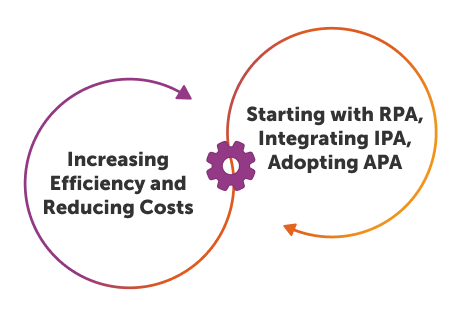
- Starting with RPA: Automate high-volume, rule-based tasks that improve efficiency and consistency.
- Integrating IPA: Use AI models to classify documents, handle unstructured data, and support more complex processes.
- Adopting APA: Introduce goal-driven AI agents that analyze inputs, plan next steps, and orchestrate actions across systems and applications.
Together, RPA, IPA, and APA become an integrated automation architecture that allows scaling automation across a much wider set of use cases while maintaining control, safety, and traceability.

Progressive automation strategy
Organizations can expand automation by building progressively from RPA to IPA and ultimately to APA. RPA delivers immediate efficiency gains for repetitive tasks and IPA adds intelligence by extracting and validating unstructured data, making it easier to automate more complex workflows.
APA builds on these layers with AI agents that coordinate processes that span multiple systems, data types, and decision points. Agentic AI enables business operations to auto-adapt to change and supports resilient, end-to-end automation.
Building a unified automation system with RPA, IPA, and APA
Effective enterprise automation requires all three layers working together. The question is how to structure them as an integrated system where each component plays the right role.
The right combination of automation methods — RPA, IPA, and APA — depends on each specific business process scenario, operational goals, and the complexity of the task at hand.

RPA for task execution
RPA is an ideal choice for repetitive, rules-driven processes with minimal need for decision-making. For example, organizations that handle large volumes of data entry, invoice processing, or report generation can benefit significantly from RPA right away. These tasks are often time-consuming and prone to human error, making them perfect candidates for automation. However, enterprise-scale RPA requires governance, maintenance, and infrastructure planning.
- Automating repetitive, rule-based tasks
- Working with structured data
Choose RPA when:
Example: A retail company automates inventory data entry to reduce errors and free up staff time.

IPA for intelligence and unstructured data
Processes that handle unstructured data and/or support decision-driven tasks are a match for IPA. For example, document processing workflows that involve extracting relevant information from content in diverse formats. IPA is a solution for improving existing processes while maintaining necessary human oversight and flexibility.
- Handling unstructured data
- Workflows require basic decision-making
- Phasing in automation starting with simpler tasks before progressing to more complex workflows
- Looking for incremental improvements to existing processes
Choose IPA when:
Example: A bank uses IPA to process loan applications, analyzing documents and making initial approval decisions.

APA for orchestration and complexity
APA is uniquely suited for complex workflows that demand a high degree of adaptability and real-time decision-making. Processes that require predictive capabilities or include customer interaction are top candidates for APA.
APA supports risk-managed automation with policy controls, audit trails, and AI governance guardrails that ensure traceability for agentic decisions. This makes APA particularly valuable for regulated industries like financial services, healthcare, and energy.
- Needing systems that adapt to real-time changes on their own
- Requiring robust governance, compliance monitoring, and audit capabilities for regulated operations
- Managing process environments with dynamic data
- Automating complex workflows that involve many interconnected tasks across multiple systems.
Choose APA when:
Example: A financial services firm applies APA to detect fraudulent transactions in real time and initiate appropriate responses that must follow strict governance boundaries, such as freezing accounts or alerting compliance teams.
Ultimately, while businesses may opt to choose a specific automation tool to address immediate needs, enterprise operations require applying automation technologies in concert.
An integrated automation platform encompassing RPA through APA allows organizations to scale automation efforts, optimize operations with the right toolkit for each task, and evolve quickly to address change.
Why organizations evolve from RPA to IPA to APA
Organizations evolve from RPA and IPA to APA because it represents a shift from automating tasks to enabling strategic agility. APA doesn't replace RPA and IPA; it orchestrates them, making existing RPA and IPA investments more valuable as components within flexible, end-to-end workflows with autonomous decision-making and continuous adaptation.
Simplifying automation with a unified platform
The automation journey is not a linear exercise starting with RPA for quick wins, switching to IPA, and eventually adopting APA. The most effective automation strategies don't force a choice between RPA, IPA, or APA — they combine them.
Enterprise-scale automation requires a flexible and resilient approach that includes RPA and IPA alongside APA, with all three layers working together in a unified architecture. Combining all three automation methods enables organizations to address the full range of existing enterprise processes, from simple to dynamic and complex, as well as adapt and prepare for future challenges and opportunities.
Automation Anywhere offers a unified platform that integrates RPA, IPA, and APA, simplifying and centralizing reasoning, orchestration, and data handling — and future-proofing automation efforts. This approach enables automation of the widest range of processes while simultaneously reducing the complexity of managing multiple tools and technologies and expanding the value of automation beyond efficiency into expanded capability and value creation.
To experience firsthand how a unified automation platform can empower your business to achieve greater efficiency and innovation, request a personalized demo today.