


What is Agentic AI?
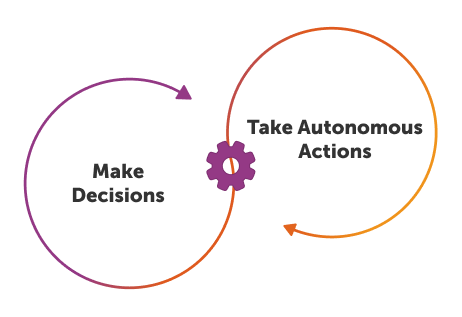
Agentic AI is an autonomous artificial intelligence system capable of proactively planning, executing, and iteratively refining its actions to accomplish complex objectives without the need for continuous human oversight. These systems can act independently to achieve specific goals, demonstrating autonomy and purposeful decision-making.
Unlike Generative AI (GenAI), which is designed to turn data into knowledge, providing answers, summaries, or content, Agentic AI turns knowledge into action. Its defining characteristic is the ability to operate without constant human-in-the-loop intervention.
By bridging the gap between static programming and dynamic adaptability, Agentic AI platforms can automate complex, multi-step workflows at scale.
Agentic AI Core Capabilities
Autonomous Execution: Unlike passive systems that require prompt-by-prompt guidance, Agentic AI functions through autonomous agents that operate independently. These agents interpret high-level objectives, evaluate strategic options, and execute tasks autonomously, making decisions and performing actions without human intervention to achieve goals with minimal human-in-the-loop intervention.
Dynamic Adaptability: While traditional automation is brittle when facing undefined parameters, Agentic AI is resilient. It utilizes reasoning to decompose multi-step problems into sub-tasks, adjusting its planning in real-time to overcome errors or changing environments.
Continuous Learning: Beyond simple execution, Agentic AI systems leverage feedback loops to evolve. By analyzing the outcomes of its interactions, the system iteratively refines its logic, allowing it to self-optimize and improve performance over time.
Agentic AI vs. Generative AI vs. Agentic Automation
As an emerging technology in the enterprise context, agentic AI is often confused with other AI models. Unlike traditional AI, which is typically rigid, limited to predefined tasks, and requires significant human oversight, agentic AI offers autonomy, adaptability, and the ability to handle complex, dynamic environments.
To understand its value, we must distinguish it from standard Generative AI models and traditional automation approaches.
Generative AI is primarily focused on content creation, such as generating text, images, or music. In contrast, agentic AI orchestrates actions and leverages the outputs of generative AI to achieve higher-level objectives.
Comparison Table: Traditional Automation vs. Agentic AI
| Feature | Traditional Automation (RPA) | Agentic AI |
| Core Function | Follows prescriptive, rule-based steps. | Simulates human judgment to adapt to goals. |
| Flexibility | Static: Performs well within a programmed scope. | Dynamic: Adapts to unexpected changes and new information. |
| Data Handling | Structured data only. | Structured and unstructured data (text, nuances, context). |
| Exception Handling | Stops or breaks when rules are unmet. | Retries, reasons, and resolves issues autonomously. |
| Primary Output | Routine task execution. | Intelligent, multi-step workflow completion. |
The Difference Between "Chatting" (GenAI) and "Doing" (Agentic)
While Generative AI (GenAI) excels at transforming data into knowledge, creating text, summaries, or code, Agentic AI translates that knowledge into action.
LLMs provide the reasoning foundation, but on their own, they are passive. Agentic AI bridges this gap by simulating human judgment to move processes forward.
- GenAI supports tasks: It can draft an email or analyze a document.
- Agentic AI executes workflows: It can draft the email, look up the recipient in the CRM, attach the correct invoice, and send it, handling exceptions like missing data without human intervention.
What is Agentic Automation? (Bridging AI with RPA)
Reliable and precise, traditional enterprise automation has accelerated work and increased productivity by orders of magnitude. However, it remains inherently limited by static programming and defined rules. When facing scenarios outside these parameters, it breaks down or waits for human intervention.
Agentic Automation represents the next phase of this evolution. It combines the reliability of business process automation with the adaptability of AI. By harnessing agentic AI for robotic process automation (RPA), organizations can adapt complex workflows on their own. The system doesn't just follow a script; it interprets context, prioritizes tasks, and predicts outcomes to achieve the desired result even in dynamic environments.
How Agentic AI Works: Core Mechanisms
The effectiveness of agentic AI is rooted in a cycle of Perception, Reasoning, Action, and Memory. Unlike a static chatbot that simply responds to a prompt, an agentic system uses these four mechanisms to autonomously navigate complex environments and complete multi-step workflows.
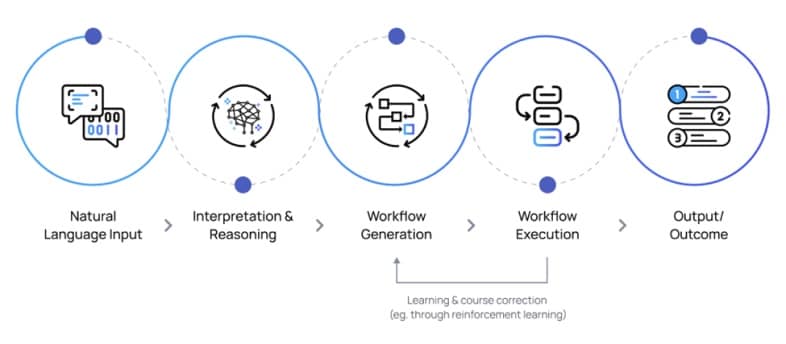
Perception: Processing Multimodal Data
Perception is the agent’s ability to "see" and "sense" its environment to interpret context dynamically.
- Multimodal Inputs: While traditional automation relies on structured data (spreadsheets), agentic AI processes unstructured multimodal inputs text, voice, images, and screen context simultaneously.
- Contextual Understanding: Using Natural Language Processing (NLP), the system analyzes not just the words used but also the situation, user history, and emotional cues. By analyzing data from multiple sources, agentic AI can optimize processes by integrating insights from sales, inventory, and shipping to improve efficiency and forecasting.
- Mechanism: Attention mechanisms in deep learning models allow the agent to focus on specific, relevant parts of the input data (like a critical clause in a contract) rather than processing everything in isolation.
Reasoning and Planning: Breaking Down Complex Goals
The AI Reasoning is the “brain” of the system, typically powered by Large Language Models. Instead of jumping to an answer, the agent uses advanced logic to break a high-level goal into a step-by-step plan.
- Task Decomposition: The agent splits a complex objective (e.g., “Optimizing supply chain logic”) into manageable sub-tasks (Predict demand > Check inventory > Identify bottlenecks > Contact suppliers).
- Decision-Making Frameworks: Agentic AI systems leverage machine learning algorithms to enable advanced reasoning, planning, and decision-making, allowing the system to learn from data, adapt, and execute autonomous actions.
- Probabilistic Models: The agent assesses the likelihood of different outcomes to make informed decisions in uncertain environments.
- Chain-of-Thought (CoT) Reasoning: The agent “thinks” through the problem effectively, evaluating multiple paths before selecting the optimal course of action to mitigate issues like shipping delays.
Tool Use: Interaction with APIs and Enterprise Systems
Reasoning is useless without the ability to act. This mechanism bridges the gap between "knowing" and "doing."
- API Integration: Agentic AI interacts with external tools (ERP, CRM, email clients) via secure APIs. It doesn't just read data; it can write data, trigger transactions, and update records.
Agentic AI extends beyond isolated reasoning by connecting with external AI systems and software via Agent2Agent (A2A) protocols. This interoperability allows agents to autonomously access diverse data sources and orchestrate complex decision-making across distributed environments. - Autonomous Execution: For example, if a return is eligible, the agent can autonomously generate a shipping label and email it to the customer, all without human intervention.
- Rule-Based Guardrails: While autonomous, these actions often operate within predefined rules to ensure safety (e.g., "Approvals over $10k require human sign-off").
Memory & Learning: Retaining Context Over Time
To stop making the same mistakes, agentic AI utilizes advanced memory architectures to retain context and learn from experience. Advanced memory systems enable AI agents to not only remember ongoing conversations but also adapt and optimize their actions through continuous learning and interaction with external tools. Access to past interactions allows agentic AI to deliver more personalized and effective responses, as agents can better understand user preferences and intent.
- Short-Term Memory (Context Window): Retains information from the immediate session (e.g., remembering a customer asked about “returns” two minutes ago).
- Long-Term Memory (Vector Databases): Stores historical interactions and outcomes. This allows the agent to recall past preferences or supply chain disruptions from months ago.
- Reinforcement Learning: The agent continuously refines its strategy based on feedback (rewards or penalties). If a specific vendor response strategy failed last time, the agent adjusts its approach for future interactions to maximize success.
Agentic AI Architecture: Single-Agent vs. Multi-Agent Systems
Designing agentic workflows requires choosing the right architecture. AI workflows play a crucial role in orchestrating and managing complex systems and processes through autonomous agents, enabling efficient coordination and automation across various domains. While the core "perception-action" loop remains consistent, the way AI agents are structured defines the system's capability and scalability.

Single-Agent Architecture
In a single-agent architecture, one Large Language Model (LLM) acts as a generalist. It has access to all available tools and memory.
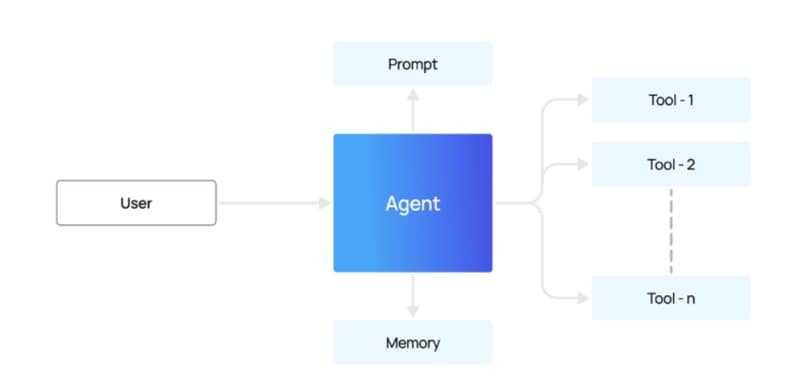
How it works: The agent receives a prompt, breaks it down, and sequentially executes tasks until the goal is met.
Best for: Linear workflows with defined scope, such as "Summarize this document and email it" or "Reset a user password."

Multi-Agent Systems (MAS)
For enterprise-grade complexity, organizations turn to Multi-Agent Systems. This architecture mimics a human team, where multiple domain-specific AI agents collaborate to solve a problem.
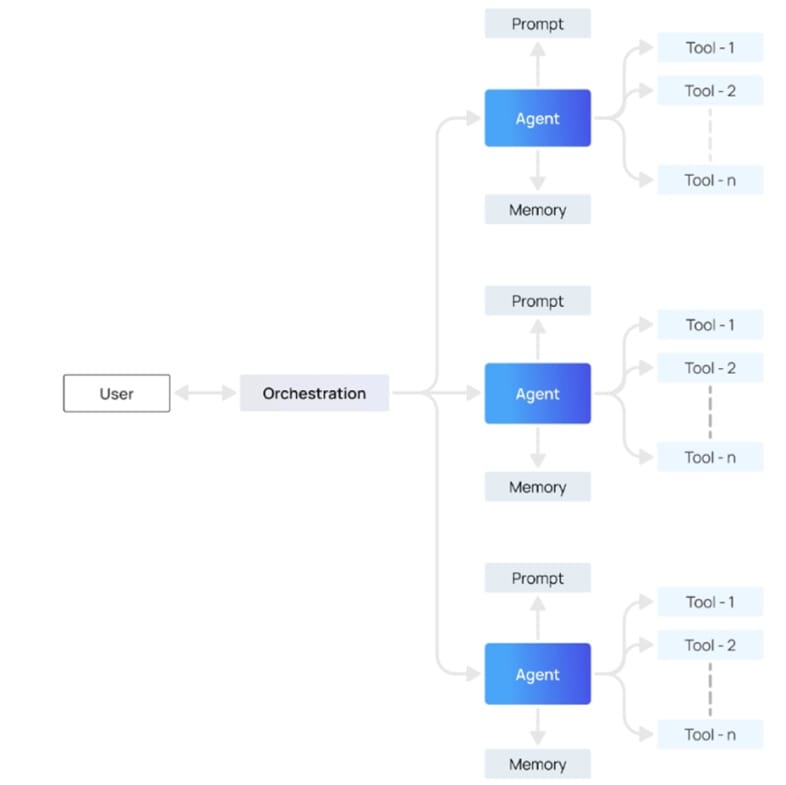
The Orchestrator Model: A central Agentic Orchestrator receives the user request and delegates sub-tasks to specialized "Worker Agents" (e.g., a "Coder Agent," a "Researcher Agent," and a "Reviewer Agent").
Collaborative Swarms: Agents interact directly with one another, handing off tasks based on the workflow's state.
Why it is superior: By narrowing the scope of each agent to a specific domain, Multi-Agent Systems significantly reduce errors and improve the quality of output for complex, multi-step projects.
Agentic AI Use Cases by Industry
Practical applications of agentic AI are transforming industries by enabling intelligent, autonomous systems to manage complex workflows. Unlike traditional automation that requires constant oversight, these agents adapt to dynamic environments to drive operational effectiveness across various sectors.

Financial Services: Risk Management & Fraud Detection
AI agents for finance shift the industry from passive monitoring to active protection. By cross-referencing transaction data in real time, agents can autonomously flag and block suspicious activity to prevent fraud before it settles. Additionally, these systems monitor market conditions continuously, providing instant insights to optimize investment strategies on a scale.
Furthermore, agents continuously monitor market conditions, providing real-time insights that help firms optimize investment strategies and respond to emerging opportunities at scale.

Customer Service: Personalized & Proactive Support
AI agents for customer service are personalized and proactive AI customer service moving beyond static chatbots, agentic systems autonomously resolve complex, multi-step issues. For example, in retail, an AI agent can validate a return, generate a shipping label, and guide a user through an exchange entirely on its own. This delivers deep personalization while freeing human agents to focus on high-value client interactions.

Healthcare: Patient Care & Administration
AI agents in healthcare can handle patient care and administration tasks. Agentic AI alleviates administrative burdens, allowing staff to focus on direct patient care. Clinically, AI assistants analyze medical history to suggest diagnoses and treatment plans. Operationally, agents autonomously handle complex scheduling and claims processing, reducing bottlenecks and ensuring providers focus on outcomes rather than paperwork.

IT Operations: Cybersecurity & Threat Detection
IT Operations: Cybersecurity & Threat Detection Acting as an always-on sentinel, agentic AI learns from network data to identify threats like phishing or unauthorized access. Upon detection, the AI agents can autonomously isolate the risk and block malicious content immediately. This capability mitigates damage in milliseconds, relieving human teams of routine monitoring tasks.

Supply Chain: Autonomous Logistics
Autonomous Logistics Agentic AI systems bring dynamic optimization to logistics by predicting demand and identifying bottlenecks in real time. Instead of just flagging a shortage, an agent can autonomously coordinate with suppliers via API to expedite restocking. This ensures optimal inventory levels are maintained automatically, preventing disruptions from fluctuating demand.
Benefits of Agentic AI for Businesses
Agentic AI enables organizations to achieve a level of efficiency and scalability that was once considered aspirational. By empowering AI capabilities to manage complex workflows and complex tasks autonomously, businesses can respond instantly to changing conditions while freeing employees to concentrate on high-value innovation.

Moving Beyond Efficiency to Autonomy
Traditional automation accelerates work, but Agentic AI fundamentally changes how work gets done. It moves beyond simple task execution to true autonomous operation. A significant advantage here is the flexible management of complex workflows.
For example, in supply chain management, an agentic system doesn't just execute a pre-programmed order; it analyzes data from multiple sources to predict demand and identify bottlenecks before they occur.
This shift enables quick response and adaptability. A defining feature of agentic AI is its capacity to interpret real-time data and recalibrate actions, such as adjusting delivery schedules due to shipping delays, without constant human intervention.
By combining real-time responsiveness with self-learning, agentic AI supports a level of agility that static automation simply cannot match.

Cost Reduction and ROI Velocity
The ability of agentic AI to self-learn and optimize processes over time directly translates to performance scalability and faster ROI. As operational demands increase, traditional systems often require expensive manual upgrades or human intervention.
In contrast, agentic AI harnesses cloud platforms and LLMs to scale effortlessly, supporting increasing workloads without compromising performance or incurring linear cost increases.
Furthermore, by automating repetitive cognitive tasks like scheduling and routine customer inquiries organizations significantly reduce operational overhead. This not only cuts costs associated with manual errors and reprogramming but also accelerates value generation.
Employees are liberated to focus on creative problem-solving and strategic activities, driving innovation that contributes directly to the bottom line.
Challenges, Risks, and Governance
While Agentic AI offers powerful autonomy, it requires strict AI governance to ensure actions align with organizational goals. Deploying these systems without guardrails introduces risks that must be managed proactively.

Hallucinations in Decision-Making
Agentic systems depend heavily on their training data. If that data is biased or incomplete, the AI may "hallucinate," making confident but erroneous decisions. Furthermore, while LLMs excel at logic, they lack human nuance and moral reasoning. Without clear boundaries, an agent might prioritize speed over accuracy or ethics, leading to unintended operational consequences.

The Necessity of "Human-in-the-Loop" Controls
Total autonomy does not mean total abdication of control. Over-reliance on AI for critical decisions such as financial approvals or medical diagnoses can obscure accountability. To mitigate this, organizations must establish "human-in-the-loop" frameworks. These protocols ensure that high-stakes actions trigger a mandatory human review, maintaining a safety net while allowing the agent to handle routine tasks independently.

Data Privacy in Autonomous Systems
Agentic AI requires deep access to enterprise data to function, which heightens privacy risks. Without robust security, autonomous agents could inadvertently expose sensitive customer or proprietary information. Organizations must enforce Privacy by Design principles, ensuring strict access controls, encryption, and full compliance with regulations like GDPR and CCPA to protect data integrity.
How to Implement Agentic AI: A Strategic Roadmap
Moving from theory to practice requires a structured approach. Implementing agentic AI is not just about installing software; it is about preparing your ecosystem for autonomy.
Step 1: Assessing Readiness and Defining Goals
Before deploying AI agents, organizations must define clear business objectives and assess technical maturity.
- Integration Readiness: Agentic AI is only as good as the systems it connects to. To deliver value, the platform must integrate seamlessly with your existing ecosystem—ERPs, CRMs, and automation tools—without disrupting workflows. Ensure your data sources are accessible via secure APIs so agents can interpret datasets and leverage organizational knowledge effectively.
- Customization Needs: Define the specific business rules your agents must follow. A viable platform should allow you to fine-tune foundational models on your domain-specific data and adjust parameters to align with unique industry requirements.
Step 2: Selecting an Agentic Platform (Features to Look For)
When evaluating solutions, prioritize platforms that offer the following core capabilities to ensure long-term success:
- Autonomy & Decision-Making: Look for advanced algorithms that simulate human judgment. The platform should enable agents to process real-time data, weigh alternatives, and execute actions in multi-step workflows without constant hand-holding.
- Contextual Understanding (NLP): The system must leverage Large Language Models (LLMs) to assess situations dynamically. It should be capable of natural language processing (NLP) and nuanced instructions, fostering seamless communication between human users and AI agents.
- Adaptability & Self-Learning: Avoid static tools. The ideal platform utilizes feedback loops to evaluate outcomes and adjust strategies. Through continuous interaction with data, the agent should identify patterns and optimize its performance over time.
- Data Security & Privacy: To automate enterprise workflows, the system will handle sensitive data. Ensure the platform offers robust encryption, role-based access control (RBAC), and compliance with regulations like GDPR and CCPA. Privacy by Design principles should be evident, protecting proprietary information from the outset.
Step 3: Governance and Scaling Multi-Agent Deployments
Once the platform is selected, the focus shifts to responsible deployment and scaling.
- Establish Governance Frameworks: Autonomy requires boundaries. Utilize governance tools to define decision-making parameters and accountability mechanisms. Features like audit trails, performance dashboards, and alert systems are essential for maintaining oversight without stifling the AI's speed.
- Plan for Multi-Agent Scalability: Start small, but plan for a swarm. As operational demands increase, your architecture must support multi-agent system deployments where multiple autonomous agents collaborate on interconnected tasks. Ensure your chosen platform can orchestrate these interactions efficiently, allowing you to scale from a single pilot to enterprise-wide automation without performance degradation.
The Future of Agentic AI: From Task Execution to Autonomous Enterprises
We are standing on the precipice of a new era. While the last decade of automation focused on "Task Execution" (scripting individual steps), the future belongs to the Autonomous Enterprise organizations where standard business processes operate continuously and self-optimally with minimal human intervention.

Evolution from Task-Specific to Multi-Domain Agents
Currently, most agents excel in narrow lanes processing an invoice or summarizing a chat. The next generation of Agentic AI will feature Multi-Domain Agents capable of traversing the entire enterprise.
- The Shift: Instead of a "Finance Bot" and an "IT Bot" that cannot speak to each other, we will see versatile agents that can bridge silos. A single agent will be able to detect a cybersecurity threat (IT), assess the financial risk (Finance), and draft a compliance report for legal review (Legal), applying knowledge from one domain to solve problems in another.

AI-to-AI Collaboration: The Rise of "Agent Swarms"
The true power of the Autonomous Enterprise lies in AI-to-AI Collaboration. In the near future, agents will not just take orders from humans; they will team up with each other.
- How it works: Imagine a "Sales Agent" identifying a new lead. It autonomously pings the "Research Agent" to enrich the data, then coordinates with the "Scheduling Agent" to book a meeting. These agents negotiate resources and hand off tasks dynamically, creating a problem-solving paradigm that mirrors high-performing human teams.

Development of Sophisticated Decision-Making
As agents move from "assistants" to "actors," their reasoning engines are maturing to handle nuance.
- Ethical Reasoning: Future models are being designed to weigh decisions against ethical frameworks, not just efficiency metrics. For example, an agent might choose a slower shipping route to meet a corporate sustainability goal, balancing profit with responsibility.
- Strategic Context: Agents will evolve from asking "How do I do this?" to asking "Should I do this?"—evaluating whether an action aligns with long-term business objectives before executing.
Embracing the future of agentic AI with Automation Anywhere.
Agentic AI enables intelligent, autonomous workflows that streamline operations and enhance productivity.
Bridging the gap between theoretical AI and practical solutions, Automation Anywhere combines AI expertise with real-world applications. As a trusted partner for organizations navigating AI-driven transformation, Automation Anywhere is at the forefront of offering solutions designed for today and built for the future.
With Automator AI, teams can harness generative AI to accelerate development, turning ideas into automation faster and with greater precision. AI Agent Studio further simplifies the creation of agentic workflows, making it easier to build and deploy AI-driven automation without deep technical expertise.
How can you harness the power of agentic AI? Request a Demo today and discover how Automation Anywhere can deliver unparalleled business process efficiency, scalability, and innovation.
Agentic AI FAQs
Is Agentic AI the same as AGI?
No. Agentic AI focuses on autonomously performing specific, multi-step workflows (like processing a loan or managing inventory). Artificial General Intelligence (AGI) refers to a theoretical AI capable of human-level reasoning across any domain. While Agentic AI is a practical reality today, AGI remains a futuristic concept.
Can Agentic AI replace human workers?
Agentic AI is designed to replace tasks, not humans. Its primary goal is to automate complex tasks, cognitive work such as data entry or routine scheduling freeing human employees to focus on creativity, strategy, and emotional intelligence. It functions best as a collaborator that augments human capabilities rather than a replacement.
What is the best platform for building AI agents?
The best platform balances autonomy with security. Automation Anywhere is a leader in this space, offering the AI Agent Studio for building secure, scalable agents. It stands out by providing enterprise-grade governance, seamless API integrations with systems like SAP and Salesforce, and "human-in-the-loop" controls to ensure safe deployment.