

- Login
- Search

- Contact Us

-
Have a question? Our team is here to help guide you on your automation journey.
-
Explore support plans designed to match your business requirements.
-
How can we help you?
-


English
Close
- Resources
Featured
 Named a 2026 Gartner® Magic Quadrant™ Leader for RPA.Recognized as a Leader for the Eighth Year in a Row Download report Download report
Use Case Selection & Prioritization
Step 1: Target high-friction process segments
One of the most common questions finance leaders ask is where to begin. The instinct is often to look for the simplest use case or the most visible inefficiency. In practice, the most effective starting point is neither.
The right place to start is where volume and variability intersect.
Processes such as accounts payable and accounts receivable provide a clear example. They operate at scale, with large volumes of transactions moving through structured systems. At the same time, they are heavily impacted by exceptions — non-standard invoices, payment discrepancies, disputes — that require interpretation and coordination. These are not edge cases; they are central to how the process operates.
This combination makes them ideal candidates for transformation. They offer clear opportunities for measurable impact, whether through faster cash application, reduced cycle times, or improved accuracy. They also provide a realistic test of whether a solution can handle the complexity of real-world finance work.
Focus on the areas where breakdown is most visible:
Procure-to-Pay (P2P):
- Manual invoice processing
- Approval delays
- Exception-heavy matching
Order-to-Cash (O2C):
- Billing errors
- Disputes and deductions
- Aged receivables
Record-to-Report (R2R):
- Manual reconciliations
- Late journal entries
- Compressed close timelines
Plan & Analyze:
- Spreadsheet-driven reporting
- Conflicting data sources
- Long forecasting cycles
Control & Audit:
- Limited audit coverage
- Manual documentation
- Subjective risk assessment
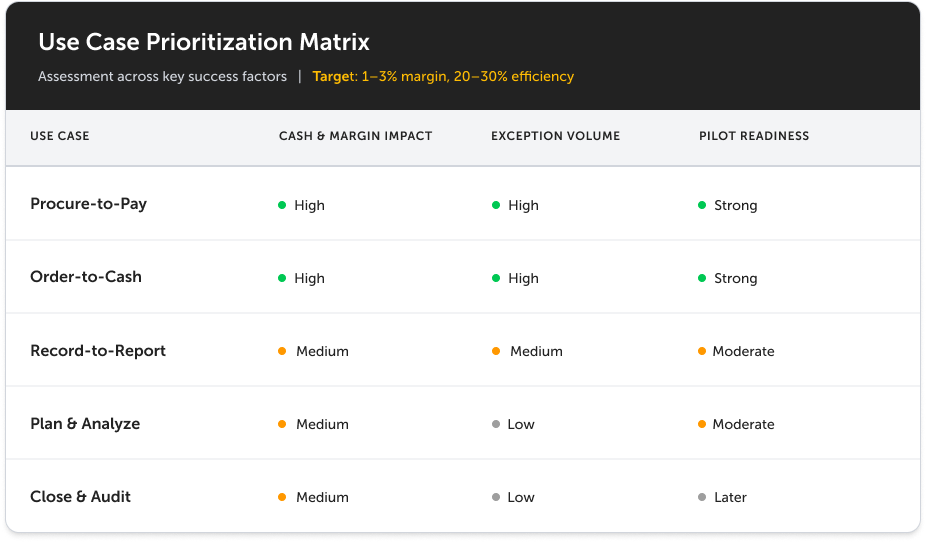
Step 2: Prioritize based on financial impact
Importantly, use case selection must be grounded in financial outcomes. While cost reduction remains an important consideration, it is no longer sufficient on its own. Finance leaders increasingly evaluate initiatives based on their impact on cash flow, working capital, and risk. Improvements in days sales outstanding, faster close cycles, and reduced error rates provide tangible evidence of value. They also create a stronger foundation for scaling.
Organizations typically approach this starting point from one of two positions. Some are early in their automation journey, with significant manual effort still embedded in core processes. Others have already invested in RPA and are now facing the limitations of task-based automation. In both cases, the goal is the same: move beyond isolated efficiency gains and address the full lifecycle of the process.
Move forward if the use case impacts:
- Cash flow (DSO, DPO)
- Margin (error reduction, leakage prevention)
- Cycle time (close, billing, collections)
- Risk exposure
Agentic automation should directly contribute to:
- 1–3% margin improvement
- 20–30% operational efficiency gains
Step 3: Select a cross-system pilot
A common mistake is attempting to solve the entire problem at once. Enterprise-wide initiatives can stall under their own complexity, particularly when they require coordination across multiple systems and stakeholders.
In contrast, focused deployments that target a high-impact segment of a process that is breaking down in a specific area are more likely to deliver results quickly. These early wins are critical for not only demonstrating value, but also for building use-case confidence. It proves agentic automation’s value in orchestration, not simply automation.
Your first use case should:
- Span across two systems
- Include exception handling
- Require coordination across roles
Chapters
-
Chapter 1
The Agentic Advantage for Finance Leaders -
Chapter 2
Why Finance Must Automate Now -
Chapter 3
Use Case Selection & Prioritization -
Chapter 4
Best Practices in Implementing Agentic Execution -
Chapter 5
Building the ROI Case & Driving Alignment -
Chapter 6
Transformation Defined by Execution, Not Adoption
Previous: Why Finance Must Automate Now
Go to chapter 2Next: Best Practices in Implementing Agentic Execution
Go to chapter 4
Sign up to get exclusive access to the playbook.
 Explore now
Try


For Students & Developers
Start automating instantly with FREE access to full-featured automation with Cloud Community Edition.
