

- Login
- Search

- Contact Us

-
Have a question? Our team is here to help guide you on your automation journey.
-
Explore support plans designed to match your business requirements.
-
How can we help you?
-


English
Close
- Resources
Featured
 Named a 2026 Gartner® Magic Quadrant™ Leader for RPA.Recognized as a Leader for the Eighth Year in a Row Download report Download report
Building the ROI Case & Driving Alignment
In many organizations, the primary barrier to progress is not a lack of ideas, but a lack of execution capability.
Finance teams consistently identify high-value opportunities to improve performance yet struggle to move those ideas into production. Governance requirements, integration complexity, and limited internal expertise create friction at every stage. Without a structured approach, initiatives stall in pilot phases and fail to scale.
Here’s a step-by-step process to bring decision makers on board:
Step 1: Build a CFO-level business case
The most effective programs begin by reframing how the business case is constructed. Rather than leading with efficiency alone, successful finance leaders anchor their case in outcomes that matter at the CFO level:
- Cash acceleration
- Margin improvement
- Risk reduction
- Operational scalability
This shift elevates the conversation from incremental cost savings to enterprise value creation.
Step 2: Align cross-functional stakeholders
From there, alignment becomes critical. Early engagement across key stakeholders ensures that the initiative is positioned as a coordinated transformation rather than a siloed effort. Successful organizations secure alignment across:
- Finance
- IT
- Audit and compliance
- Operations
Each group must see its priorities reflected in the approach, control preserved, complexity reduced, and measurable value delivered. Without this alignment, even strong use cases can be delayed or blocked.
Step 3: Launch and prove value quickly
Momentum is established by proving value quickly. High-performing teams identify a focused pilot tied to a measurable outcome, typically an improvement in cash flow or close cycle performance. These pilots are designed to demonstrate more than technical capability. They prove that cross-system orchestration works in practice and that exceptions can be resolved with context and speed.
The most effective pilots share three characteristics:
- They directly impact cash flow or financial cycle times
- They demonstrate coordination across systems, not just within one
- They produce measurable, defensible outcomes
Step 4: Expand across the finance value chain
From there, scale becomes the priority. Leading organizations move beyond isolated pilots to build a structured pipeline of initiatives, expanding across the finance value chain:
- Procure-to-pay (P2P)
- Order-to-cash (O2C)
- Record-to-report (R2R)
- Financial planning and analysis (FP&A)
- Audit and compliance
As they scale, they standardize the elements that make execution repeatable:
- Governance models
- Execution frameworks
- Performance metrics (KPIs)
At every stage, the lesson holds: technology enables capability, but structured execution determines whether value is realized.
Pricing and investment model
Investment decisions in finance begin with cost, but it’s crucial to extend those questions beyond a simple savings driver.
Labor savings and efficiency gains remain a familiar entry point. They are easy to quantify and align with traditional budgeting models. However, organizations that focus solely on headcount reduction often miss the broader opportunity.
Here’s how you can frame agentic automation in scalability and strategic improvements:
Step 1: Align cost to business outcomes
Leading finance teams instead align cost to business outcomes. Rather than evaluating value based on roles replaced, they focus on how effectively work is executed:
- Transactions processed
- Exceptions resolved
- End-to-end processes completed
This reframing ensures that investment is tied to performance, not just effort.
Step 2: Avoid fragmented cost structures
At the same time, many organizations face a growing challenge: fragmentation. Over time, point solutions accumulate across finance operations, each addressing a specific need but introducing additional layers of cost and complexity. This often results in:
- Redundant costs across overlapping tools
- Increased integration overhead
- Expanded governance and maintenance requirements
What begins as local optimization can quickly become global inefficiency.
Step 3: Invest in scalable architecture
To address this, organizations must shift their focus from individual tools to scalable architecture. Agentic automation enables a model in which core capabilities — such as classification, matching, reasoning, and orchestration — are reusable across processes rather than siloed within applications.
This approach creates structural advantages:
- Cost scales linearly with transaction volume
- Error reduction directly improves margins
- Faster execution has a measurable impact on cash flow
The result is a more resilient investment model, one where cost and value remain aligned as the organization grows.
The operating model shift
At its core, the transition to agentic automation represents a fundamental shift in how finance operates.
Today’s finance organizations are defined by complexity. Execution is coordinated across numerous roles and systems, each responsible for a portion of the process but none owning it end to end. In many cases, more than a dozen roles interact across dozens of systems to complete a single workflow. Manual processes are used to bridge the gaps, creating inefficiency and risk.
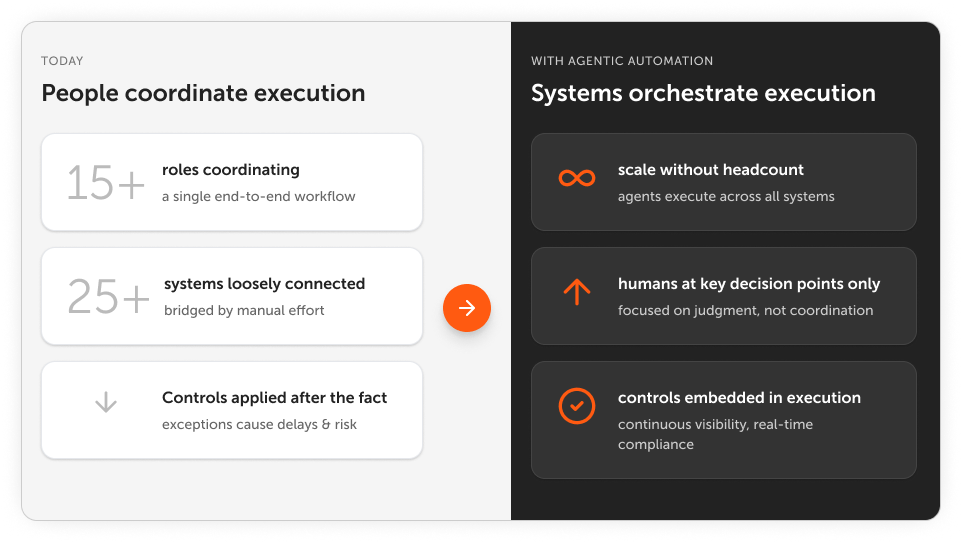
This current state is characterized by:
- 15+ roles coordinating execution
- 25+ systems loosely connected
- Manual processes bridging system gaps
- High cost, long cycle times, and limited visibility
In this model, exceptions are disruptive. Each deviation from the expected workflow introduces delay, requires investigation, and increases the likelihood of error. Control is typically applied after execution, rather than during it.
The emerging model operates differently. Instead of relying on people to coordinate execution, systems take on that responsibility. Workflows are managed continuously, and decisions are made in context.
In this execution-driven model:
- Autonomous agents execute workflows across systems
- Humans are engaged only at key decision points
- End-to-end processes are continuously managed
- Controls are embedded directly into execution
This shift transforms finance from a reactive function into one that operates with continuous visibility and control.
What CFOs should expect
For finance leaders, the benefits of this shift are both immediate and compounding.
As execution improves, processes become faster and more predictable. Bottlenecks are identified and resolved earlier, leading to measurable improvements in cash flow and cycle times. Financial operations move with greater consistency, reducing variability and increasing confidence in outcomes.
At the same time, operational burden decreases. Manual effort is reduced not by removing human involvement, but by focusing it where it adds the most value. Teams spend less time coordinating work and more time analyzing and acting on it.
This translates into tangible outcomes:
- Real-time visibility into cash position and risk exposure
- Faster, more predictable financial cycles
- Reduced operational cost and error rates
- Improved compliance and audit readiness
- Scalable finance operations without proportional headcount growth
Over time, these improvements enable a broader shift. Finance moves beyond its traditional role of reporting on performance and begins to shape it — leveraging better execution, deeper insight, and stronger control to drive business outcomes.
Chapters
-
Chapter 1
The Agentic Advantage for Finance Leaders -
Chapter 2
Why Finance Must Automate Now -
Chapter 3
Use Case Selection & Prioritization -
Chapter 4
Best Practices in Implementing Agentic Execution -
Chapter 5
Building the ROI Case & Driving Alignment -
Chapter 6
Transformation Defined by Execution, Not Adoption
Previous: Best Practices in Implementing Agentic Execution
Go to chapter 4Next: Transformation Defined by Execution, Not Adoption
Go to chapter 6
Sign up to get exclusive access to the playbook.
 Explore now
Try


For Students & Developers
Start automating instantly with FREE access to full-featured automation with Cloud Community Edition.
