

- Login
- Search

- Contact Us

-
Have a question? Our team is here to help guide you on your automation journey.
-
Explore support plans designed to match your business requirements.
-
How can we help you?
-


English
Close
- Resources
Featured
 Named a 2026 Gartner® Magic Quadrant™ Leader for RPA.Recognized as a Leader for the Eighth Year in a Row Download report Download report


Introduction to AI in medical billing
The 2026 “RCM crisis,” driven by denial rates approaching 12% coupled with severe staffing shortages in healthcare billing departments, has healthcare organizations looking to AI in medical billing as the primary cure. To cope, the healthcare industry is rapidly moving beyond simple robotic process automation (RPA) to using artificial intelligence agents that reason alongside deterministic validations and human reviewers.
These advanced systems use machine learning to recognize patterns in the entire claim lifecycle, providing a robust solution to the complex challenges faced by revenue cycle management (RCM) professionals today.
Fueling this strategic shift away from traditional billing processes is the desire to eliminate the “coordination tax,” where billing teams spend an inordinate amount of time on manual data entry rather than on core medical coding.
By deploying AI medical billing solutions, organizations are bridging the gap between disparate electronic health record (EHR) systems and payer portals. This evolution pushes human workers into higher-level roles as auditors, where medical billing AI becomes a partner to ensure revenue integrity.
The goal, in 2026, is to orchestrate agents, deterministic automations, and human workers to collaboratively manage claims from inception to final payment.
How AI is used in medical billing and coding
AI in medical billing and coding autonomously executes complex tasks across fragmented systems, reasoning and making decisions related to billing tasks and processes.
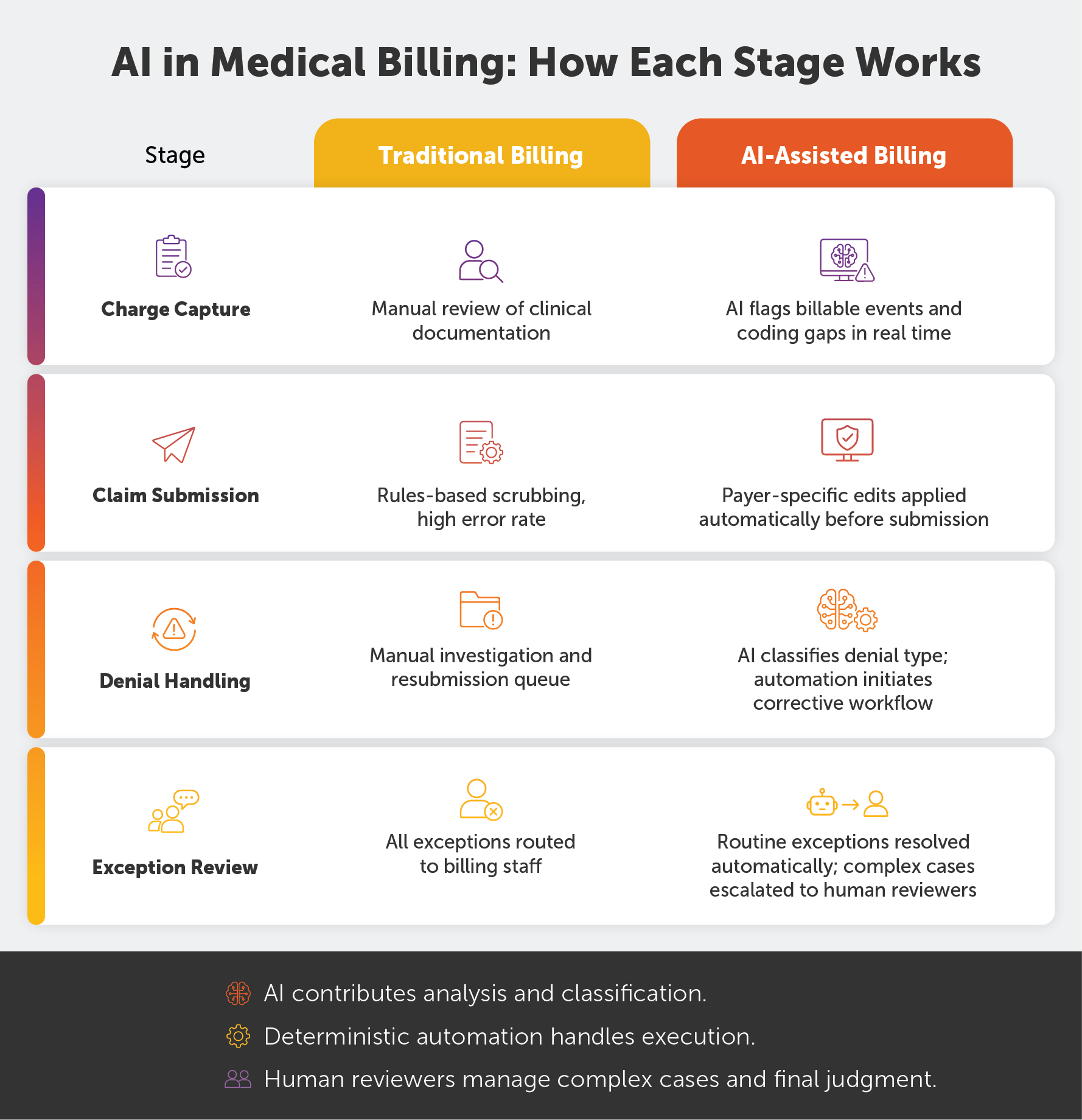
Modern approaches apply AI alongside other systems to proactively manage the entire revenue cycle, significantly reducing claim denials and improving billing accuracy to near-perfect levels. This approach leverages AI-powered automation that can learn, adapt, and make decisions to reason and adapt to dynamic medical records and payer rules.
Autonomous charge capture and revenue integrity
AI-assisted medical billing systems analyze clinical documentation in real time, flagging potentially billable events, coding opportunities, or missing documentation for review and augmenting traditional rules-based workflows.
AI agent-assisted revenue integrity tools integrate directly with electronic health records tools and billing workflows to flag missed charges, documentation gaps, and coding issues before claims are submitted. By combining automation, rules-based checks, and human review, these systems reduce revenue leakage and improve financial performance.
End-to-end denial orchestration
Typical billing software merely flags denials for human follow-up. Modern AI-assisted solutions combine autonomous agents, deterministic validation, and human oversight to accelerate processes to investigate the root causes of denied claims and initiate the necessary rework. This is similar to insurance automation solutions that orchestrate complex claims processes across payers.
The combined system then aims to analyze billing errors, identify common patterns, and automatically resubmit corrected claims. Scaling this concept up in a different industry, AI agents are a competitive imperative in insurance by transforming claims workflows. The result is a significantly reduced administrative burden and faster reimbursement.
AI medical billing and coding examples
AI medical billing technologies streamline billing processes by leveraging data extraction and enhancing claim accuracy, often through natural language processing (NLP) and API integrations. These AI systems utilize large language models (LLMs) to understand complex medical terminology, further improving the speed of billing operations.
Insurance verification and patient intake
AI agents in healthcare perform insurance verification and eligibility checks in real time through direct integration with payer portals. Agentic AI systems can eliminate manual calls and portal navigation, drastically accelerating the patient intake process and ensuring that correct insurance information is on file from the outset.
Automated verification also reduces front-desk administrative tasks and minimizes future claim denials due to eligibility issues.
NLP-driven data extraction and coding accuracy
NLP performs sophisticated data extraction from documents and EHRs, identifying key clinical information to suggest accurate ICD-11/CPT codes. This significantly improves coding accuracy by analyzing and correlating physician notes, operative reports, and diagnostic results, forming a core capability in broader hyperautomation initiatives that combine AI and automation.
NLP also enables technologies that reduce the cognitive load on human coders, allowing them to focus on complex cases while the AI handles routine coding, leading to fewer errors and better compliance.
Automated claim processing and submission
AI-assisted claim processing applies payer-specific edits and cross-references patient data against coding guidelines to catch inconsistencies before submission — helping organizations reach the industry benchmark of a 98% clean claim rate, as defined by HFMA. The result is fewer rejections, faster reimbursement, and reduced rework cost across the revenue cycle.=
Key benefits: Quantifying ROI and efficiency
Quantifying ROI and efficiency for AI in medical billing involves analyzing key financial and operational metrics to show substantial cost reductions and improved healthcare revenue cycle performance.
Agentic AI-assisted solutions for healthcare offer a clear business case for CFOs by providing data-driven insights into administrative savings, labor cost reductions, and accelerated cash flow. AI-driven automation is proven to directly impact financial health by pushing RCM beyond the limitations of legacy billing systems.
- Financial outcomes: According to McKinsey, AI and automation could reduce administrative costs by 13–25% for healthcare payers, with revenue cycle management identified as one of the highest-impact areas. By automating repetitive billing tasks, healthcare organizations can reallocate resources more effectively, reduce rework costs, and improve financial predictability across the revenue cycle.
- Operational speed: Reductions in “days in A/R” and reimbursement cycles are achieved through 24/7 autonomous monitoring and processing. The improved operational agility also allows healthcare providers to respond more quickly to patient demands and maintain healthier financial reserves.
- Accuracy & compliance: AI-assisted workflows reduce human error and provide a “reasoning trace” for audits, maintaining accurate coding and compliance with complex regulatory standards. The transparency of AI’s decision-making process offers an unparalleled level of accountability. This audit-ready functionality mitigates compliance risks and protects organizations from potential penalties.
Limitations and challenges of AI in medical billing processes
Implementing AI in medical billing processes presents technical and strategic hurdles, primarily around integration with legacy systems and managing the “30% rule,” a strategic framework for AI deployments stating that AI can automate the roughly 70% of processes that are repetitive while human workers manage the remaining 30%.
Overcoming these challenges requires a thoughtful deployment strategy that balances automation with human oversight to ensure optimal performance. Organizations must prepare for complex data migration and the potential for AI models to misinterpret nuanced clinical data, which is where the combination of agents, human-in-the-loop (HITL) oversight, and deterministic validations becomes critical.
The 30% rule for AI deployment
Revenue cycle management leaders should first fully automate the “repetitive 70%” of billing processes, such as status checks and insurance verification.
This focuses medical coders on the remaining 30% of cases requiring nuanced human judgment. By segmenting routine tasks from cognitive ones, healthcare billing departments achieve immediate ROI.
Integration friction with electronic health records
Connecting modern billing software to legacy electronic health records often creates friction. This technical debt can hinder data extraction and increase the risk of errors in complex medical records. A robust data analysis strategy is essential to ensure billing accuracy across all ai systems.
Future: Regulations, ethics, and the evolving workforce
The future of healthcare billing will see significant shifts in regulations, ethical considerations, and the evolving role of the workforce, particularly as AI becomes more embedded in daily operations. Coding professionals must adapt to stay relevant in an AI-driven landscape, transitioning from data-entry roles to oversight and exception management. Understanding these trends provides unique value and prepares organizations for the advancements of 2026 and beyond.
- The 2026 regulatory landscape: Regulations like CA AB 3030, which mandates disclosure for AI-driven processes, and the rise of “audit-ready AI” with transparent reasoning trails for all billing data, will drive discussions in the near term. These regulatory shifts demand greater accountability and explainability from AI systems. Organizations must ensure their AI solutions provide comprehensive, traceable records to meet stringent audit and compliance requirements.
- Defensive AI: Providers will increasingly use “defensive AI” to counter the aggressive, automated audit tools deployed by insurance payers. This involves leveraging AI to proactively identify and rectify potential claim issues before submission, thereby minimizing denials. Defensive AI acts as a strategic shield, ensuring claims are robust and compliant against sophisticated payer scrutiny.
- The role of coding professionals: Coding professionals will evolve into “exception managers” and “quality assurance leads” who oversee AI output, focusing on complex cases and strategic decision-making. Their expertise will be crucial in validating AI-generated codes and addressing any anomalies. This shift transforms their role from transactional to supervisory, enhancing job value but requiring new skill sets.
To learn how Automation Anywhere's agentic AI solutions improve, accelerate, and enhance medical billing, book a demo today.
FAQs
Is AI replacing medical billing?
No. It is replacing manual data entry. In 2026, the human role has shifted to “Exception Management,” where coding professionals oversee AI outputs and handle high-complexity appeals that require human clinical judgment.
What is the role of AI in medical billing?
AI works alongside deterministic automations and human reviewers. It handles the “coordination tax” by performing data extraction from clinical notes, verifying insurance in real-time, and auto-correcting claims before they are denied.
What is the 30% rule for AI?
The 30% rule is a strategic framework: organizations should fully automate the most repetitive 70% of their billing processes (like status checks and claim submissions) to achieve immediate ROI, while retaining experts for the 30% of judgment-heavy tasks.
What are the top 5 denials in medical billing?
As of 2026, the most common denial codes are:
- CO 11: Diagnosis Inconsistent with Procedure (Medical Necessity).
- CO 16: Claim Lacks Information/Missing Documentation.
- CO 18: Duplicate Claim or Service.
- CO 22: Coordination of Benefits (COB) Conflicts.
- CO 29: Timely Filing Limit Exceeded.
Stay up to date:
 Subscribe to the blog

Try


For Students & Developers
Start automating instantly with FREE access to full-featured automation with Cloud Community Edition.
