

- Login
- Search

- Contact Us

-
Have a question? Our team is here to help guide you on your automation journey.
-
Explore support plans designed to match your business requirements.
-
How can we help you?
-


English
Close
- Resources
Featured
 Named a 2026 Gartner® Magic Quadrant™ Leader for RPA.Recognized as a Leader for the Eighth Year in a Row Download report Download report
How to Define an APA Maturity Model
The promise of APA is generally understood at the leadership and automation center of excellence (CoE) level, but they need direction. Without that roadmap, teams reactively default to one-off automations or agent solutions. That never leads to enterprise value.
A maturity model gives organizations enterprise-level structure. It defines specific capabilities, governance practices, and architectural shifts needed at each stage of the evolution. It also helps CoEs prioritize what to build, identify gaps, and align stakeholders around a vision for how automation and AI should operate holistically.
This is the roadmap as you move from deterministic task automation to orchestrated, agentic workflows that operate reliably at scale. The most effective entry point is transforming a single deterministic workflow to APA. Start where it is brittle or exception heavy. Build, launch, and validate using your data and process flow. Then scale organization-wide to create a true agentic enterprise.
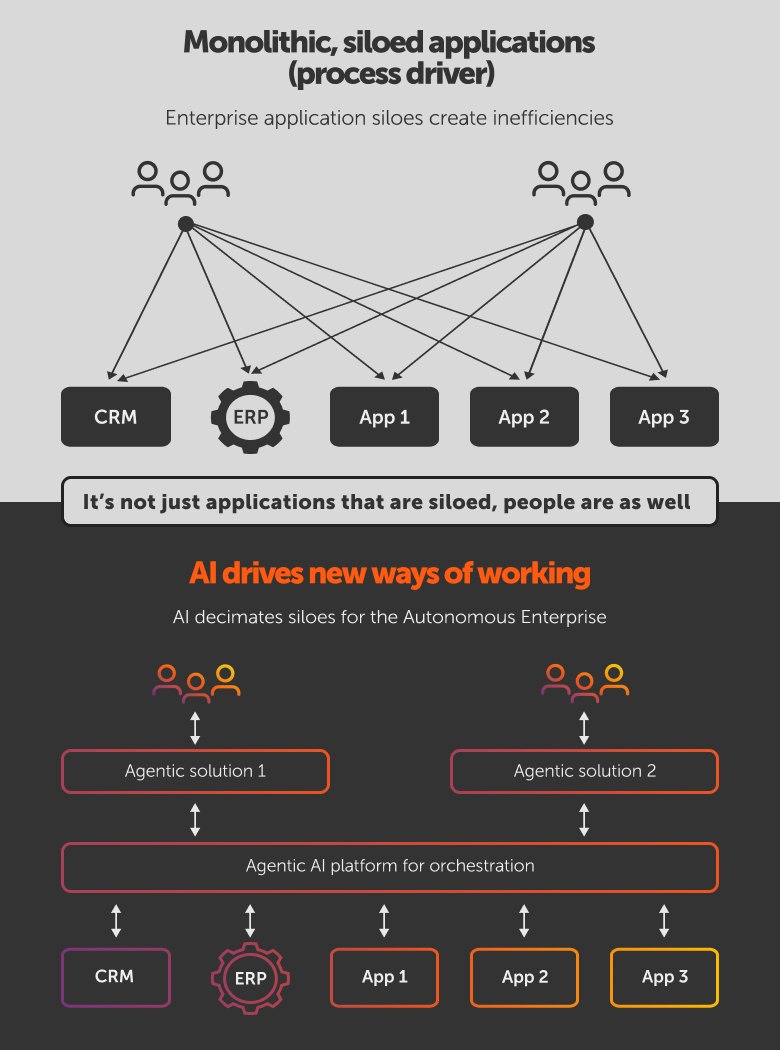
The following breaks the APA journey into five stages:
1. Define strategic objectives
Your AI investments have been reactionary. Teams are chasing tools, vendors, or trends instead of solving real business bottlenecks. This step is about turning “we want AI” into a measurable, outcome-driven strategy.
To make the transformation:
- Set KPIs and baseline metrics so APA impact can be measured.
- Rank processes based on their strategic value, variability, and impact on customer or employee experience.
- Create a decision matrix to determine when to use agents, when to use deterministic automation, and when to keep humans in the loop.
- Define the business outcomes APA must influence (accuracy, CX, speed, compliance).
- Align leadership and COE on which workflows will be the first APA candidates.
Now your APA initiatives are tied directly to business outcomes. You have a list of KPIs to target and evaluation criteria.
2. Assess and align
The reality is that most organizations have automated tasks, not outcomes. They are scattered, brittle, and disconnected. There’s no visibility into which processes break, where exceptions spike, or where automation stops short.
To make the transformation:
- Conduct a cross-functional automation audit for the KPI workflows.
- Sync with frontline teams to uncover hidden friction and siloed knowledge that often derails automation efforts.
- Create a governance starter framework.
Now you have a clear, shared understanding of where APA can deliver real value. Everyone agrees on priorities, gaps, and what success should look like.
3. Design the orchestration model
Automation is siloed. Bots are doing one thing, humans another, and AI experiments are floating in isolation. Nothing fits together. This step is the turning point from automating steps to orchestrating outcomes.
To make the transformation:
- Map the end-to-end workflow with all systems, handoffs, decisions, and exceptions.
- Assign the right worker (agent, bot, human) to each task based on reasoning, precision, and judgment.
- Define guardrails for agents — what they should do and what they must not do.
- Design fallback logic for failure points, exceptions, or uncertain AI decisions.
- Document integration points across legacy systems, APIs, SaaS, email, documents, and third-party agents.
- Define observability requirements (audits, controls, tracking).
You’ve now designed a unified operating model where agents, bots, and humans each own parts of the workflow they’re best suited for — brought together by orchestration.
4. Build, pilot, validate
You’ve had proof of concepts, but they never scale. AI experiments are proving they have potential, but they’re not surviving real-world variation or enterprise constraints. This step is where your concepts turn into working automation solutions at the IT level — where poorly planned AI agents have usually failed.
To make the transformation:
- Select one high-friction workflow that represents meaningful impact and clear variation patterns.
- Build the APA proof using your real systems and data.
- Test agent reasoning paths in controlled environments with human oversight.
- Validate orchestration logic across bots, agents, and humans under multiple conditions.
- Measure performance improvements: cycle time, accuracy, exception reduction, throughput, human effort.
- Document governance including audit logs, guardrail adherence, and fallback execution.
- Share results broadly to build momentum and executive buy-in.
Now a functioning APA workflow pilot is deployed using your real data, systems, and exceptions. You have agent behavior validation, performance measurement, and governance checkpoints in one workflow.
5. Scale and operationalize
Scaling automation was slow and inconsistent. This step is where your APA model becomes repeating — not just a one-off project.
To make the transformation:
- Turn your successful pilot into a reusable template for other workflows.
- Create playbooks for design, build, validation, deployment, and maintenance.
- Formalize governance policies for agent usage, AI decisioning, approvals, and auditing.
- Train teams across your enterprise on how to build and manage APA workflows.
- Expand automation standards for new lines of business, functions, and process owners.
- Implement a continuous improvement loop using analytics and pattern insights.
- Develop mutli-agent workflows for long-running, cross-functional use cases.
You’ve now operationalized APA as a capability your enterprise can scale with confidence. New multi-agent workflows follow a repeatable pattern created with adoption playbooks and continuous measurement. The COE enforces governance and standards, and automation scales efficiently across the business.
Chapters
-
Chapter 1
The Agentic Advantage: A Practical Playbook for Enterprise-Ready Automation -
Chapter 2
Ask Yourself: Are You Solving Problems or Just Chasing AI? -
Chapter 3
How to Define an APA Maturity Model -
Chapter 4
How to Make Your Business Case for APA Investment -
Chapter 5
4 Misconceptions to Avoid and Why These Stall Your Automation Strategy -
Chapter 6
How to Fit APA Into Your Current Stack -
Chapter 7
How to Solve the APA Puzzle By Applying Orchestration
Previous: Ask Yourself: Are You Solving Problems or Just Chasing AI?
Go to chapter 2Next: How to Make Your Business Case for APA Investment
Go to chapter 4
Sign up to get exclusive access to the playbook.
 Explore now
Try


For Students & Developers
Start automating instantly with FREE access to full-featured automation with Cloud Community Edition.
