

- Login
- Search

- Contact Us

-
Have a question? Our team is here to help guide you on your automation journey.
-
Explore support plans designed to match your business requirements.
-
How can we help you?
-


English
Close
- Resources
Featured
 Named a 2026 Gartner® Magic Quadrant™ Leader for RPA.Recognized as a Leader for the Eighth Year in a Row Download report Download report


- Introduction to Enterprise Automation
- What is enterprise automation?
- 4 Types of enterprise automation
- Why enterprise automation matters
- Core attributes of true enterprise automation
- How to build an enterprise automation foundation
- Common challenges that prevent enterprise automation
- From task automation to autonomous operations
- Orchestrating humans, AI agents, and automation in the enterprise
- How Automation Anywhere enables enterprise automation
- FAQs
Introduction to Enterprise Automation
In the modern digital landscape, Enterprise Automation has become the defining factor between organizations that scale and those stuck on an "automation plateau." While robotic process automation (RPA) successfully handles repetitive tasks and rule-based tasks, the most complex, cross-functional, and mission-critical business processes remain manual and fragmented without a cohesive enterprise automation strategy.
A key reason is that investments in native automation and Enterprise AI built into customer relationship management (CRM), enterprise resource planning (ERP), and other departmental solutions fail to interoperate. This creates integration chaos that breaks automated workflows and blocks scalability.
In this post, business leaders aiming to rise above the automation plateau will:
- Understand enterprise automation use cases in practice today
- Learn how to progress from rules-based workflows to AI-enhanced automation
- See how a unified automation platform compresses progress from years to weeks
- Discover how a platform approach enables cross-functional, governed automations that scale securely and reliably
We’ll further explore why treating automation as an integrated system rather than a collection of tools is the key to unlocking truly transformative business outcomes.
What is enterprise automation?
Enterprise Automation is the holistic integration of software, artificial intelligence, and robotic process automation (RPA) to execute end-to-end business processes across an organization. Unlike isolated task automation, it synchronizes systems, departments, and data to drive operational efficiency, reduce repetitive tasks, and enable autonomous decision-making through a unified automation platform.
Here’s how these core building blocks work together to enable enterprise automation:
- Plan and design - Tools to author, model, and configure processes and agents before execution.
- Connect - Integrations, APIs, and protocols that enable information to flow to and from external systems and data.
- Build - Executable bots, API tasks, AI skills, agents, and other automation and agentic components that are dropped into workflows.
- Run and interact - Runtime orchestration and operational interactions to coordinate agents and human workers.
- Govern and observe - Policies, enforcement, dashboards, measurements, audits, security and compliance frameworks, and more that are used to analyze performance, discover improvement opportunities, and manage governance efforts.
- Intelligence and context - Semantic understanding and knowledge grounding that makes agents context-aware through meaning, memory, and reasoning.
To help push beyond the automation plateau, enterprise automation builds on existing RPA investments by adding orchestration, contextual awareness, and cognitive capabilities that cover the spectrum between task automation and enterprise-wide automation, extending the value of robotic process automation across the enterprise.
With a unified approach that treats automation as an integrated system rather than a collection of disconnected tools, organizations can achieve the scalability, reliability, and impact that isolated automations simply cannot deliver. The result is a foundation for the autonomous enterprise, where processes run intelligently, adapt to exceptions, and optimize outcomes without the need for human intervention.
4 Types of enterprise automation
To move beyond a collection of disconnected automation tools, organizations must understand the four primary types of enterprise automation that define the journey to becoming an autonomous enterprise:
- Basic Automation: Streamlines simple, routine tasks like data entry and automated responses within a single department or silo.
- Robotic Process Automation (RPA): Deploys software robots to handle rule-based tasks and automate repetitive activities across multiple applications.
- Intelligent Process Automation (IPA): Integrates artificial intelligence (AI) and machine learning to manage complex tasks that require data analysis and cognitive context, helping organizations choose the right mix across RPA, IPA, and APA approaches.
- Agentic Process Automation (APA): The most advanced stage, where autonomous agents identify automation opportunities and streamline business processes with minimal human intervention, often delivered through enterprise agentic AI platforms.
See how Automation Anywhere scales enterprise automation with over 3.5 million production-ready AI agent executions. Watch now to learn how to orchestrate cognitive agents and bridge the gap to a truly autonomous enterprise.
Why enterprise automation matters
Enterprise automation software transforms organizations by delivering measurable business impact across efficiency, agility, and productivity. By streamlining processes in supply chain management and inventory management, organizations achieve a unified workflow that removes the friction of cross-functional handoffs, especially when they adopt a comprehensive enterprise automation software stack.
Improving accuracy, reliability, and decision quality
Enterprise automation ensures process steps execute consistently every time, eliminating variability and errors inherent in manual work. When workflows are orchestrated across systems, data validation and standardization happen automatically, reducing inconsistencies that compound as more people and departments are involved. Automated handoffs between teams eliminate delays and miscommunications, ensuring that critical information transfers accurately and completely. Reliability at this level is especially valuable in complex processes involving multiple stakeholders, where a single missed step or data error can cascade into a much larger and more expensive business impact.
Enabling real-time responsiveness
Event-driven workflows allow businesses to respond instantly to triggers such as customer actions, system changes, or shifting business conditions. Instead of waiting for daily batch processes or manual reviews, automated systems can detect conditions and initiate responses immediately. This real-time capability improves customer experiences with faster service and enhances operations by highlighting and addressing issues before they escalate. Organizations move from a reactive to a proactive stance, anticipating needs and optimizing workflows based on real-time data and informed decisions.
Boosting employee productivity and satisfaction
Enterprise automation offloads repetitive, time-consuming tasks that drain employee energy and limit strategic contribution. Employees freed from manual data entry, routine status updates, and rote processing can instead focus on problem-solving, relationship building, and innovation. Along with more time for creative and strategic work that drives growth and improves competitiveness, job satisfaction improves and burnout falls as workers engage in more meaningful efforts that leverage their cognitive and reasoning capabilities.
Creating a scalable framework for digital transformation
Unified automation supports sustainable business growth across regions, teams, and technologies without requiring proportional increases in workforces, resources, or investments. Organizations that plateau at task-level RPA can break through with processes orchestrated end-to-end to handle increased volumes, complexity, languages, currencies, and more. This scalable framework becomes the backbone for advanced automation initiatives such as AI-driven insights, predictive analytics, and hyperautomation across the enterprise that define modern enterprise expectations and competitive advantages.
Core attributes of true enterprise automation
Simply deploying RPA doesn't mean an organization is then ready for enterprise automation. True enterprise-wide automation requires a cohesive platform-driven foundation where systems, AI agents, workflows, governance, and people work together as a unified system. Missing any one of these attributes, or attempting a fragmented approach, limits scalability, reliability, and eventual impact.
Here’s why these attributes matter:
Attribute | Why It Matters |
|---|---|
Seamless system integration | Connects data and workflows across all systems, reducing manual work. |
End-to-end workflow orchestration | Coordinates multi-step processes across departments, providing the connective glue. |
Intelligent decision support | Uses AI to prioritize, recommend, and route tasks, accelerating scalability. |
Enterprise-level governance | Ensures consistent policies, security, and compliance efforts are centralized for easier adherence. |
Scalability across workloads | Supports growth in volume, complexity, and geography, ensuring reliability. |
Let’s dig a little deeper into each attribute.
Seamless system integration
Connecting data and workflows across systems is the backbone of enterprise automation because it enables automations to work as humans work across different applications. Integration eliminates manual data transfers and re-entry, reduces the need for swivel-chair manual work between applications, and overcomes the system fragmentation that breaks automated processes.
End-to-end workflow orchestration
Orchestration coordinates human workers, automations, and AI agents during multi-step processes that naturally span departments and systems. It acts as the glue that connects processes and enables them to run autonomously from start to finish, regardless of how many systems, agents, or teams are involved. For example, Automation Anywhere’s APA Platform unifies AI, data, and automation, using orchestration to coordinate how those elements work together to achieve goals across an enterprise’s infrastructure and operations.
Intelligent decision support
Machine learning and other enterprise AI can enhance, improve, and accelerate automation by prioritizing tasks, recommending actions, and routing work based on context, business rules, and cognitive decision-making. Intelligence scales impact by making processes adaptive, and it builds on solid workflow foundations to ensure processes operate as expected.
Enterprise-level governance, compliance, and security
Automation at scale requires consistent policies, auditability, access controls, and security standards. Centralized governance ensures that automated processes meet regulatory requirements and organizational standards while maintaining the structured oversight necessary for secure, compliant enterprise operations.
Scalability across workloads and teams
Enterprise automation is the modern catalyst of growth. It enables new processes, increased volumes, multi-region deployments, and the ability to effectively meet varying business demands. Scalability ensures that automation remains reliable and cost-effective as organizations expand deployments into broader areas of the business.
How to build an enterprise automation foundation
Scaling enterprise automation is a gradual journey where people, processes, and technology must first be aligned in a strategic sequence. Organizations can't jump directly from manual operations to fully autonomous processes. Instead, enterprise automation success requires methodical progression from task automations to advanced orchestration and intelligent decision-making in mission-critical processes.
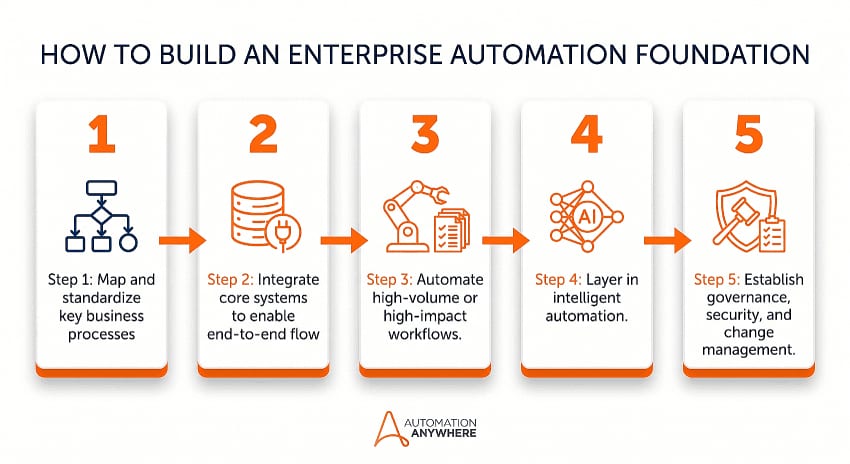
Here are five steps for building an enterprise automation foundation that supports automation at scale for organizations of any size:
Step 1: Map and standardize key business processes
Organizations can't automate what they don't understand. Process mapping reveals true steps, bottlenecks, redundancies, and manual dependencies that would otherwise derail automations. This discovery phase also identifies which processes deliver the highest value when automated (and are top priority for automation!) and which require standardization or optimization before automation is feasible.
Step 2: Integrate core systems to enable end-to-end flow
Integrated systems eliminate the manual work that can fragment and limit automation efforts. When data flows seamlessly between applications, automated processes can span entire business functions end-to-end rather than stopping at system or functional boundaries. Integrations also prevent the common "islands of automation" that limit impact to specific departments or processes.
Step 3: Automate high-volume or high-impact workflows first
Starting with processes that handle significant volume or deliver clear business value builds momentum and demonstrates ROI quickly. These early wins, which become obvious in step one when processes are mapped, create organizational buy-in and justify funding for more complex automation initiatives while establishing proven patterns that teams can replicate.
Step 4: Layer in intelligent automation where it adds value
AI and agentic AI enhance automations by handling exceptions, making routing decisions, adapting to changing conditions, and offering repeatability that increases scalability through agentic workflows that coordinate complex tasks. However, intelligence works best when added to stable, well-orchestrated processes rather than as a replacement or bandage for existing but unoptimized workflows. This approach prepares organizations for advanced capabilities, like agentic process automation (APA), where agentic AI coordinates entire processes.
Step 5: Establish governance, security, and change management
Consistent frameworks across all automated processes reduce risk and complexity while enabling repeatability and sustainable growth. Standardized governance ensures that automation efforts align with business objectives and regulatory requirements, and prevents the technical debt, fragmentation, and ROI-sapping inconsistencies that come from uncoordinated growth.
Common challenges that prevent enterprise automation
Many enterprises struggle with automation not because of inadequate tools, but because embedded processes and systems were never designed to work together autonomously. These structural challenges create barriers that prevent automation from scaling beyond individual tasks into true enterprise-wide impact.
Below are the most common obstacles organizations face, and how agentic process automation (APA) helps overcome them.
Siloed systems and departmental automations
When teams automate independently, they often create redundant solutions and incompatible workflows that cannot communicate with one another. This results in disconnected “islands of automation” that increase operational complexity and limit business impact.
APA addresses this challenge through orchestration. By coordinating dependencies, decisions, and handoffs across applications, AI agents, and human workers, orchestration enables processes to operate as unified workflows rather than fragmented departmental tasks.
Lack of process visibility
Unclear or undocumented processes make effective automation impossible because teams can't identify what to automate or how workflows connect. Without process transparency, automation efforts target disconnected tasks rather than the root causes of operational inefficiency.
APA introduces process reasoning and real-time monitoring to create transparency across workflows. This allows organizations to understand process behavior, identify bottlenecks, and continuously optimize automation performance as conditions change.
Data quality and consistency issues
Inconsistent or inaccurate data reduces automation reliability and can cause cascading errors across connected processes. Poor data quality forces organizations to add manual validation steps that reduce automation ROI.
Through intelligent orchestration, APA validates, standardizes, and synchronizes data across systems and documents, ensuring that automated processes operate on consistent and trusted information at every stage.
Legacy systems that don't connect easily
Older systems often lack modern APIs or integration capabilities, creating bottlenecks that slow automation execution and progress. These systems require specialized integration strategies and often become a limiting factor in end-to-end process automation.
APA helps bridge these environments using integration automation and API orchestration, allowing organizations to connect legacy platforms with modern cloud applications and automation layers without requiring large-scale system replacements.
Challenges scaling automation equitably across teams
Without effective governance, enterprise automation expands unevenly and becomes difficult to manage, creating a patchwork of incompatible automations that make scaling more expensive than just continuing with manual processes.
APA centralizes governance, reuse, and oversight so automations can scale consistently across teams and regions. This shared foundation simplifies management, enforces enterprise standards, and enables sustainable growth without sacrificing control or compliance.
From task automation to autonomous operations
Enterprise automation represents a capability maturity journey that progresses through distinct stages:
- Task automation (RPA executing discrete steps)
- Process automation (connected workflows)
- Orchestrated automation (coordinated cross-system processes)
- Autonomous operations (AI agents reasoning about and adapting processes)
This advancing maturity moves organizations from simple if-then automations to intelligent, context-aware, and reasoning AI-driven automations that understand intent, coordinate execution across systems, and adapt to exceptions without human intervention. APA drives this enterprise architectural shift, building on existing RPA investments by adding the orchestration and reasoning layers that enable an autonomous enterprise.
Organizations that scale task-level bots without orchestration create "automation debt", similar to technical debt in a software context, that eventually requires refactoring to achieve enterprise-wide impact. APA overcomes this challenge with a unified platform that doesn't require starting over, instead enhancing existing automation investments through orchestration.
APA allows organizations to evolve gradually from manual operations to autonomous processes while maintaining the value of their current automation portfolio and avoiding the costly rip-and-replace scenarios that derail many automation initiatives.
Orchestrating humans, AI agents, and automation in the enterprise
Automation’s value increases when it’s used to augment human effort, not replace it. Modern enterprise automation enhances collaboration between people, AI agents, and systems. This three-layer approach assigns work based on complexity and context:
- AI agents make decisions and work together as guided by orchestration tools,
- RPA executes repetitive tasks with speed and consistency, and
- Human workers handle strategic decisions and complex exceptions that require creativity or judgment.
This collaboration shifts human work from "keeping operations running" to "improving and innovating operations," elevating human workers from routine execution to continuous value improvement.
APA enables this orchestration by routing tasks to the appropriate resource, RPA, agent, or human, while maintaining real-time monitoring, audit trails, and governance that ensures control and oversight while enabling automation. APA further supports citizen development, where business users advance from requesting automations to designing processes within safe, compliant guardrails. This model scales more effectively than pure human execution or pure automation because it combines human adaptability with automation speed and consistency to grow alongside organizational complexity and business demands.
How Automation Anywhere enables enterprise automation
Automation Anywhere’s Agentic Process Automation System combines goal-driven AI agents, RPA, APIs, and human expertise in one unified platform to deliver a complete foundation for enterprise automation.
- Agnostic orchestration with Mozart Orchestrator connects and orchestrates automation components across any system, tool, or interface, regardless of vendor, for universal management of end-to-end workflows.
- Global process intelligence from the Process Reasoning Engine (PRE) understands goals and arrives at solutions based on proven logic, AI-powered reasoning, and decision-making capabilities.
- Enterprise-grade governance through AI Governance delivers comprehensive observability, controls, and guardrails across the platform for safe, compliance AI and automation at enterprise scale.
Automation Anywhere's architecture also supports organizations at any stage of the automation journey, easily enabling early, rules-based task automation and supporting maturity growth into advanced agentic automation, all while providing the security, scalability, and governance necessary for sustainable success.
Ready to see how enterprise automation can transform your operations? Request a demo to explore how the APA Platform can make every enterprise automation vision a reality.
FAQs
How can enterprises evaluate their automation maturity?
Organizations can assess their automation maturity by determining what percentage of their processes run end-to-end without manual effort, how well automated processes connect across systems, and the existence of centralized governance for automation efforts. Although 73% of companies have increased automation spend in the past year, many plateau at task-level RPA because they lack orchestration capabilities. More mature organizations have automated cross-functional workflows, use AI agents for intelligent decision-making, and have standardized on a unified platform that scales reliably across departments.
What types of workflows are best to automate first?
Enterprises are advised to start automation efforts by focusing on high-volume, rules-based processes that involve multiple systems or departments, such as invoice processing, employee onboarding, and customer service routing. These workflows deliver clear ROI while establishing integration patterns that support more complex automation later, and offerings like Automation Anywhere’s Agentic Solutions help automate these common processes in days. Avoid starting with highly variable or exception-heavy processes until you have solid orchestration foundations in place.
How can organizations scale automation across departments?
Successfully scaling automation requires mapping processes, integrating core systems, building on task-level automations, enabling agentic automation, and establishing centralized governance. Standardized tools, reusable components, and consistent policies are also critical before expanding automation efforts. Solutions like Automation Anywhere’s APA Platform enable this approach with foundational capabilities across the automation, agentic AI, and governance spectrum.
How do workflow automation, RPA, and intelligent automation fit together?
RPA automates individual tasks within systems, workflow automation connects and orchestrates those tasks into processes, and intelligent automation adds AI-driven decision-making and adaptation. With a unified platform, these elements work together seamlessly to prevent the fragmentation that occurs when organizations treat each capability as a separate tool, or when departments embark on siloed automation efforts.
What governance processes are required to support enterprise automation?
Enterprise automation requires policies for security, compliance, change management, and performance monitoring that apply consistently across all automated processes. Establish approval workflows for new automations, audit trails for regulatory compliance, and standardized development practices for scalability. Centralized oversight should balance control with agility, while always maintaining enterprise standards.
How will automation evolve over the next several years?
In the coming years, enterprises will evolve automation efforts from task execution to autonomous operations where AI agents reason about processes, adapt to exceptions, and coordinate complex workflows without human intervention. APA enables this evolution by leveraging existing RPA investments with intelligent orchestration that understands business intent. Enterprises will move from managing individual task automations to orchestrating autonomous business processes that continuously optimize themselves based on real-time conditions and outcomes.
Stay up to date:
 Subscribe to the blog

Try


For Students & Developers
Start automating instantly with FREE access to full-featured automation with Cloud Community Edition.
