

- Login
- Search

- Contact Us

-
Have a question? Our team is here to help guide you on your automation journey.
-
Explore support plans designed to match your business requirements.
-
How can we help you?
-


English
Close
- Resources
Featured
 Named a 2026 Gartner® Magic Quadrant™ Leader for RPA.Recognized as a Leader for the Eighth Year in a Row Download report Download report

- Introduction to multilingual support
- What is multilingual IT support?
- Why multilingual support is a competitive advantage
- How AI is empowering multilingual support at scale
- Enterprise use cases for multilingual AI support
- Top multilingual IT support platforms for 2026
- How to choose and implement the right multilingual solution
- The Automation Anywhere difference: Agentic multilingual support
- Conclusion: Making global feel local
- Multilingual Support FAQs
Introduction to multilingual support
In 2026, language has moved from a business impediment to simply another data point. Concurrently, tech support has evolved from human-led resolution to agentic resolution, where artificial intelligence (AI) and AI agents understand language and translation nuances to resolve issues across linguistic divides.
However, global companies and enterprises struggle to provide consistent, high-quality multilingual customer support to a diverse, dispersed workforce. The traditional, human-led, or English-first IT model simply creates too much latency and operational overhead for support teams. What’s more, Chief Information Officers (CIOs) overseeing IT support operations without multilingual capabilities face operational challenges. These include higher costs from longer resolution times and specialized staffing needs, compromised productivity and innovation from slower support, and increased security and compliance risks from misunderstood issues and related delays.
The goal is now language agnosticism that moves past mere translation. The user’s different languages must not impact the speed, accuracy, or efficacy of delivering support because the “translation tax”, delays, misinterpretations, and human intervention, costs IT departments and hinders employee satisfaction. It’s time for IT leaders to shift language from a barrier into a seamless operational layer to eliminate this tax.
What is multilingual IT support?
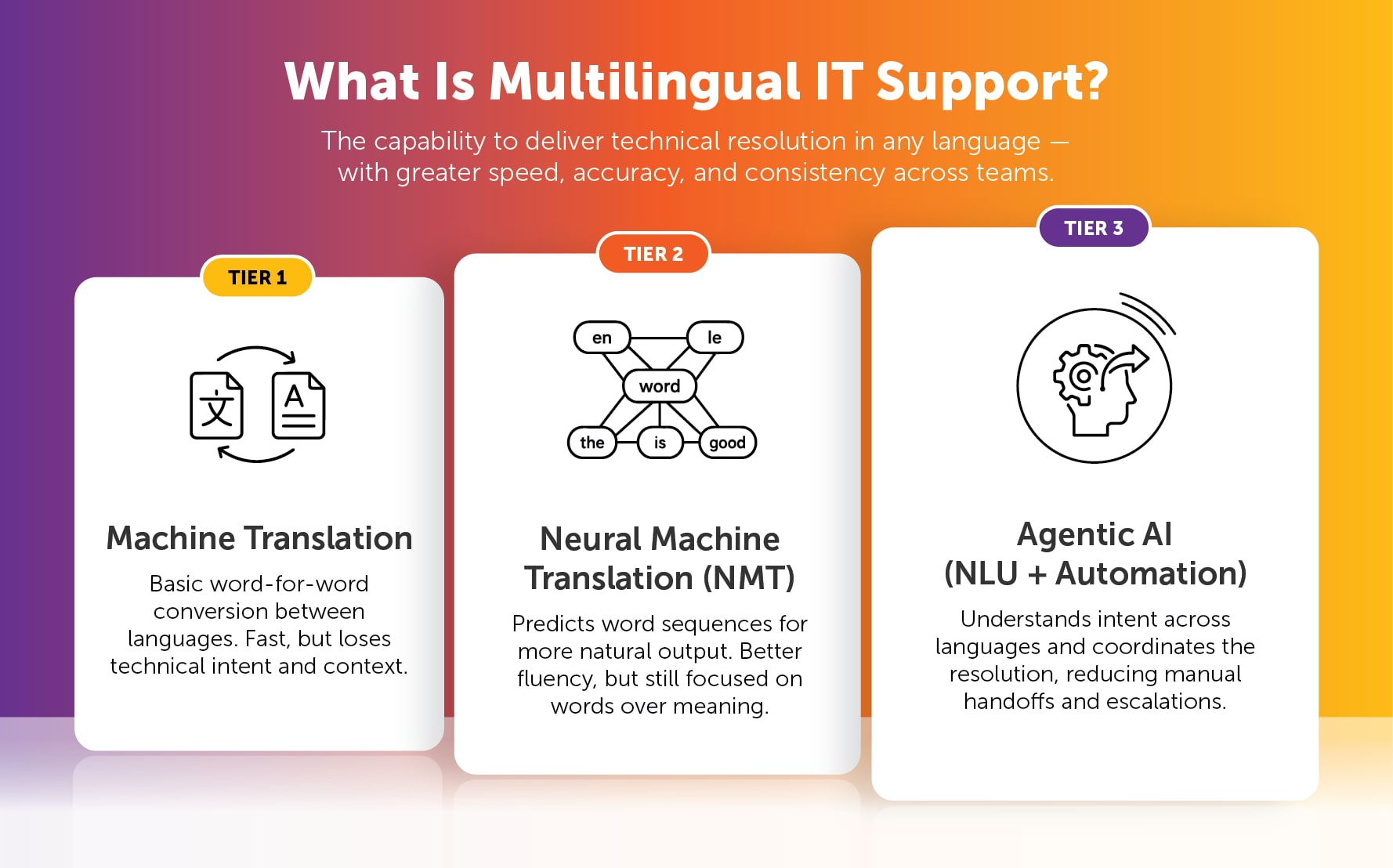
Multilingual IT support is the capability to deliver technical resolution in a user’s preferred language. Combined with agentic AI, it enables autonomous, end-to-end issue resolution at scale and in any language for a global workforce. Unlike traditional models that rely on slow, human-led translation or machine-led, word-by-word translation that loses intent, modern multilingual support leverages advanced AI that goes beyond "word swapping" to comprehend intent. This creates a language-agnostic environment where AI agents can interpret a request in one language — such as a password reset or resource provisioning — and execute the necessary solution without delays and misinterpretations.
Today’s standard for multilingual IT support is to provide high-fidelity technical assistance and autonomous resolution regardless of the employee’s native language.
Every employee (the internal customer), from a developer in Berlin needing a Docker container provisioned to a sales manager in Seoul with a password reset issue, must receive a superior customer support experience in their preferred language. The underlying existing systems must execute the appropriate resolution regardless of the input language or dialect.
Going beyond simple translation
The evolution of multi language support is more than basic word swapping. While legacy translation tools like Google Translate paved the way, they lack the language proficiency required for complex tech support.
- Machine translation is a computational process that converts text or speech from one language into another while incorporating the contextual, idiomatic, and pragmatic subtleties of both the source and target languages.
- Neural machine translation (NMT) uses an artificial neural network to predict the likelihood of word sequence to produces results similar to human translations, with modern NMT using transformer architectures to improve efficiency, accelerate translation time, and increase translation accuracy.
- Natural language understanding (NLU) uses AI to enable machines to interpret, analyze, and comprehend human language by determining its intent, context, and meaning.
NMT, which primarily focuses on word-based translation, contrasts with NLU, which strives to understand the broader intent of the words being translated. While NMT can translate "spinning up a cluster," it often fails to grasp the technical context, leading to unhelpful responses. NLU, however, identifies intent across various languages without losing meaning. This distinction—words versus intent is critical for enabling AI agents to understand technical jargon and translate that into a smart solution.
This distinction, words versus intent is critical for enabling AI agents, such as those from Automation Anywhere, to understand complex technical jargon and translate that understanding into actionable solutions.
Translation vs multilingual AI agents
Feature | Traditional Translation (NMT) | Agentic AI (Automation Anywhere) |
|---|---|---|
Primary Focus | Swapping words | Understanding technical intent |
Technical Jargon | High failure rate; literal | Native-level technical comprehension |
Actionability | Informational only | Executes system changes (MFA, cloud) |
Outcome | User reads a translation | The issue is solved automatically |
Why multilingual support is a competitive advantage
Multilingual AI support is now a strategic imperative that provides a competitive edge for any global customer base.
- Boosts talent retention: Fosters an inclusive environment where internal communication is seamless, increasing employee satisfaction.
- Metric parity: Ensures parity in Mean Time to Repair (MTTR) across all global support locations, eliminating language barriers.
- Compliance & data sovereignty: Manages customer data and regional regulations (GDPR, LGPD) by creating verifiable audit trails via automated service management.
How AI is empowering multilingual support at scale
The promise of truly global operations and efficient IT support hinges on the advanced multilingual features of agentic AI. AI enhances multilingual IT support by turning simple conversational interfaces into intelligent tools for operational execution.
The AI engine powering multilingual support
AI agents provide a reasoning-to-action engine that integrates NLU with automation. Unlike a traditional support staff that might rely on real time translation overlays, AI agents can interpret complex requests, reason through solutions, and trigger workflows to resolve support tickets without human intervention.
How multilingual LLMs work
Multilingual Large Language Models (LLMs) operate on the principle of "latent space." In LLMs, words are converted into mathematical vectors called embeddings.
- Automatic language detection: AI identifies the preferred language automatically based on vector proximity.
- Intent mapping: The English word "children" maintains the same vector space as the Hawaiian word "keiki."
- Technical context: Concepts like "password reset" share the same logical representation across multiple languages. This allows the AI to provide personalized support regardless of phrasing.
From chatting to executing
The evolution from AI chatbots that merely answer questions to AI agents that execute solutions marks a shift in enterprise automation. By integrating and orchestrating robotic process automation (RPA), AI agents, chatbots, systems, data, and human workers, AI agents can understand requests and execute actions across multiple IT and support systems.
For example, an employee might request a chatbot to “reset my MFA”. That request will trigger an agent that interacts with identity management systems, completes the reset, and then confirms the action back to the user — in their native language. This removes the MTTR plateau of traditional RPA for IT service desk bots that could interpret requests, but still required a human to execute the fix.
Enterprise use cases for multilingual AI support
While automation for IT support is a particularly impactful use case for multilingual AI in companies operating in multiple countries and regions, the practical applications of multilingual AI support are vast, transforming a multitude of enterprise functions for global enterprises. Let’s explore just a few examples of multilingual AI support.
Instant tech support across languages and time zones
Imagine a developer in Berlin needing a Docker container provisioned at 2 a.m. Traditionally, this would involve waiting for an English-speaking support agents during headquarters' business hours.
With multilingual AI, the developer submits their request in German. AI understands the technical specifications and requirements, executes the necessary steps, interacts with English-based systems, and confirms the successful provisioning back to the developer in German. This ensures uninterrupted productivity and reduces MTTR, regardless of location or time zone for a seamless customer journey.
Multilingual knowledge bases (The knowledge frontier)
Knowledge silos are a persistent challenge. Multilingual knowledge bases, powered by AI, break these barriers. A fix documented in a German wiki might be invaluable, but not if it’s inaccessible to a team in Canada.
Multilingual enterprise search, powered by AI, breaks these barriers. AI agents can index, understand, and translate documentation across various languages. This means an English- or French-speaking team can access and summarize an important concept originally documented in German. This capability enhances collaboration and knowledge sharing across borders and transforms internal knowledge into a global asset.
Streamlined HR support for a global workforce
Multilingual support extends beyond IT. In HR, employees can ask about payroll or benefits in their native language. The AI recognizes their location and local regulations to provide accurate, compliant answers, ensuring region specific support for every employee.
In the end, consistency and compliance are automated to reduce the workload on HR teams. Even more, every employee, regardless of their location, receives equitable HR support.
Top multilingual IT support platforms for 2026
Choosing the right platform is critical for the successful implementation of multilingual IT support. The market offers various solutions, each with distinct strengths.
- Automation Anywhere: The gold standard for autonomous, language-agnostic IT support resolution. This platform excels at understanding multilingual intent and orchestrating and executing complex automation for IT processes across an enterprise's vast technology stack. Automation Anywhere is also uniquely positioned to handle the action layer of agentic AI.
- Salesforce AI: Strong for CRM-heavy environments, offering robust capabilities for customer service and sales operations. While it provides multilingual support, its primary focus remains within the customer relationship management domain.
- Microsoft Copilot: Limited to the Microsoft 365 ecosystem, this tool offers productivity enhancements within Microsoft's suite of applications. Its multilingual capabilities are largely confined to text generation and summarization within its own environment.
- Zendesk AI: Traditional ticketing with AI overlays. Zendesk's offerings enhance its core helpdesk functionalities with AI-powered translation and routing, but it may require additional integrations for deep, agentic resolution.
- ServiceNow AI: A very customizable solution with a steep learning curve. ServiceNow enables high levels of IT support automation, but its AI agents require ongoing training to maintain effectiveness.
How to choose and implement the right multilingual solution
Implementing a multilingual IT support solution requires a strategic approach. Here are key considerations for enterprises looking to scale their global support with agentic AI:
1. Assess core language & regional heatmaps
Begin by analyzing the global employee base to identify the prevalent languages and regional concentrations. Understanding where the workforce is located and their primary languages will help prioritize implementation efforts and ensure the solution addresses the most critical linguistic needs first. This data-driven approach focuses initially on impact and ROI.
2. Prioritize context-awareness over direct translation
When evaluating solutions, look beyond translation capabilities. The ability of the AI to understand the technical context and intent behind user queries, rather than just performing a literal word-for-word translation, is paramount. Solutions that leverage NLU and semantic understanding will deliver superior accuracy and effectiveness in resolving complex technical issues.
3. Ensure seamless integration with ServiceNow, Jira, and Workday
A truly effective multilingual IT support solution must integrate seamlessly with an existing enterprise ecosystem. Ensure the chosen platform can connect with critical IT service management (ITSM) tools such as ServiceNow and Jira, as well as HR information systems (HRIS) such as Workday. These integrations are vital to end-to-end orchestration and agentic resolution automation, from ticket creation and escalation to user provisioning and data management, across all languages and regions.
The Automation Anywhere difference: Agentic multilingual support
Automation Anywhere’s Agentic Process Automation (APA) System distinguishes itself by offering a truly agentic multilingual support solution that seamlessly integrates reasoning and action into a single system that delivers measurable ROI. It also eliminates the translation tax of delays, misinterpretations, and human interventions, increasing both IT efficiency and employee satisfaction.
The power of one solution lies in having a single platform to reason and act. Unlike solutions that merely translate words verbatim, Automation Anywhere combines advanced multilingual NLU with powerful automation and orchestration engines. APA comprehends the user's request in any language and executes the necessary steps across systems to resolve issues faster. This unified approach eliminates the friction and delays inherent in multi-vendor agentic AI solutions.
APA also puts security first, especially when handling sensitive PII across languages while remaining compliant. It also automates provisioning and role changes, generates audit-ready logs across SSO, HRIS, and SaaS tools to shrink access exposure, cut license spend, and meet compliance requirements.
The ROI factor of APA is significant, too, moving the focus from a per-ticket cost to a per-resolution efficiency. By automating the resolution of multilingual IT tickets, enterprises can reduce operational costs, decrease MTTR, and improve employee productivity.
Conclusion: Making global feel local
Borderless companies require borderless tech support, and that future is agentic, multilingual, and autonomously resolved. By embracing agentic AI, enterprises can overcome linguistic barriers, enhance operational efficiency, and provide an equitable, superior support experience to every employee, everywhere.
Multilingual Support FAQs
What does multilingual IT support mean in simple words?
Multilingual IT support means providing help and fixing issues for employees in their native language, no matter where they are located. It ensures fast, accurate assistance without language barriers.
How does AI handle technical jargon in different languages?
AI uses natural language understanding (NLU) to understand the intent behind technical jargon, not just its literal translation. It maps concepts like “spinning up a cluster” to universal technical actions for accurate resolution.
What are the methods for implementing multilingual IT support?
Implementing multilingual IT support involves assessing language needs, prioritizing AI solutions with strong context-awareness, and ensuring seamless integration with existing IT service management and HR systems.
Is AI translation safe for sensitive HR data?
Yes, advanced AI solutions are safe for sensitive HR data because they are designed with robust security protocols. They anonymize or encrypt sensitive data during processing and comply with global privacy regulations like GDPR and LGPD.
Stay up to date:
 Subscribe to the blog

Try


For Students & Developers
Start automating instantly with FREE access to full-featured automation with Cloud Community Edition.
