

- Login
- Search

- Contact Us

-
Have a question? Our team is here to help guide you on your automation journey.
-
Explore support plans designed to match your business requirements.
-
How can we help you?
-


English
Close
- Resources
Featured
 Named a 2026 Gartner® Magic Quadrant™ Leader for RPA.Recognized as a Leader for the Eighth Year in a Row Download report Download report

- The role of AI in the payments industry
- Key takeaways
- Beyond fraud detection: The shift to lifecycle AI in payments
- Why payments are a state and exception management problem
- Where AI and machine learning create value across the payment lifecycle
- High-value use cases for AI in payments
- Common challenges when adopting AI in payments
- How to introduce AI into payment operations
- The 2026 landscape of artificial intelligence in payments industry
- How Automation Anywhere’s P2P solution makes payments more efficient
- AI and payments industry FAQs
The role of AI in the payments industry
The role of artificial intelligence (AI) in the payments industry centers on managing the complex operational workflows that occur after the initial transaction. Digital payments have moved from a back-office utility to a primary driver of enterprise efficiency. According to McKinsey's 2024 Global Payments Report, global payments revenues reached $2.4 trillion in 2023. As transaction volumes surge, the operational complexity surrounding them has grown exponentially.
The challenge is no longer just the volume of payment processing. It is the downstream work created when payments fail, stall, partially settle, or reverse after initiation. A single failed authorization can trigger a cascade of events: intelligent retries, customer outreach, reconciliation checks, and potential disputes. At scale, these downstream workflows consume more operational effort than the initial transaction itself. That is where AI in payment processing delivers its greatest value.
This guide explores how artificial intelligence manages the end-to-end payment lifecycle to reduce costs and improve customer satisfaction.
Key takeaways
The key takeaways for AI in payment processing center on four capabilities: lifecycle orchestration, exception management, financial accuracy, and agentic automation.
Lifecycle orchestration: AI in payment processing extends beyond fraud detection to manage retries, reconciliation, and dispute resolution.
Exception management: Intelligent models parse ambiguous payment states, reducing manual intervention in soft declines and network timeouts.
Financial accuracy: Automated matching and ledger alignment ensure continuous reconciliation, reducing month-end audit risks.
Agentic automation: Agentic process automation (APA) persists across the payment lifecycle, maintaining state awareness until financial finality.
Beyond fraud detection: The shift to lifecycle AI in payments
The shift to lifecycle AI in payments moves the focus beyond fraud detection at transaction initiation to managing every payment state through settlement, reconciliation, and disputes. Most discussions of AI in payment processing still focus on a narrow set of use cases: fraud detection, authorization optimization, and approval rate improvement. These matter, and according to Juniper Research, merchant losses from online payment fraud will exceed $362 billion globally between 2023 and 2028. But these use cases address only the moment of transaction initiation.
They do not address the operational burden that follows when transactions move into ambiguous or exception states. To streamline operations, finance teams need AI systems that manage the "state" of a payment over time.
Identifying the true friction in payment operations
The true friction in payment operations stems from limited visibility and manual handling of complex payment processes, including:
- Failed and declined transactions: These require sophisticated evaluation, retry logic, and empathetic customer communication to avoid churn.
- Reconciliation mismatches: Discrepancies across gateways, payment providers, banks, and internal ledgers often require manual data entry to resolve.
- Disputes and chargebacks: These processes unfold over weeks, requiring strict adherence to deadlines and evidence requirements.
- Manual coordination: This occurs in the constant back-and-forth between payments operations, treasury, and customer support.
These downstream workflows consume disproportionate resources and introduce compounding financial and regulatory compliance risk as volume scales.
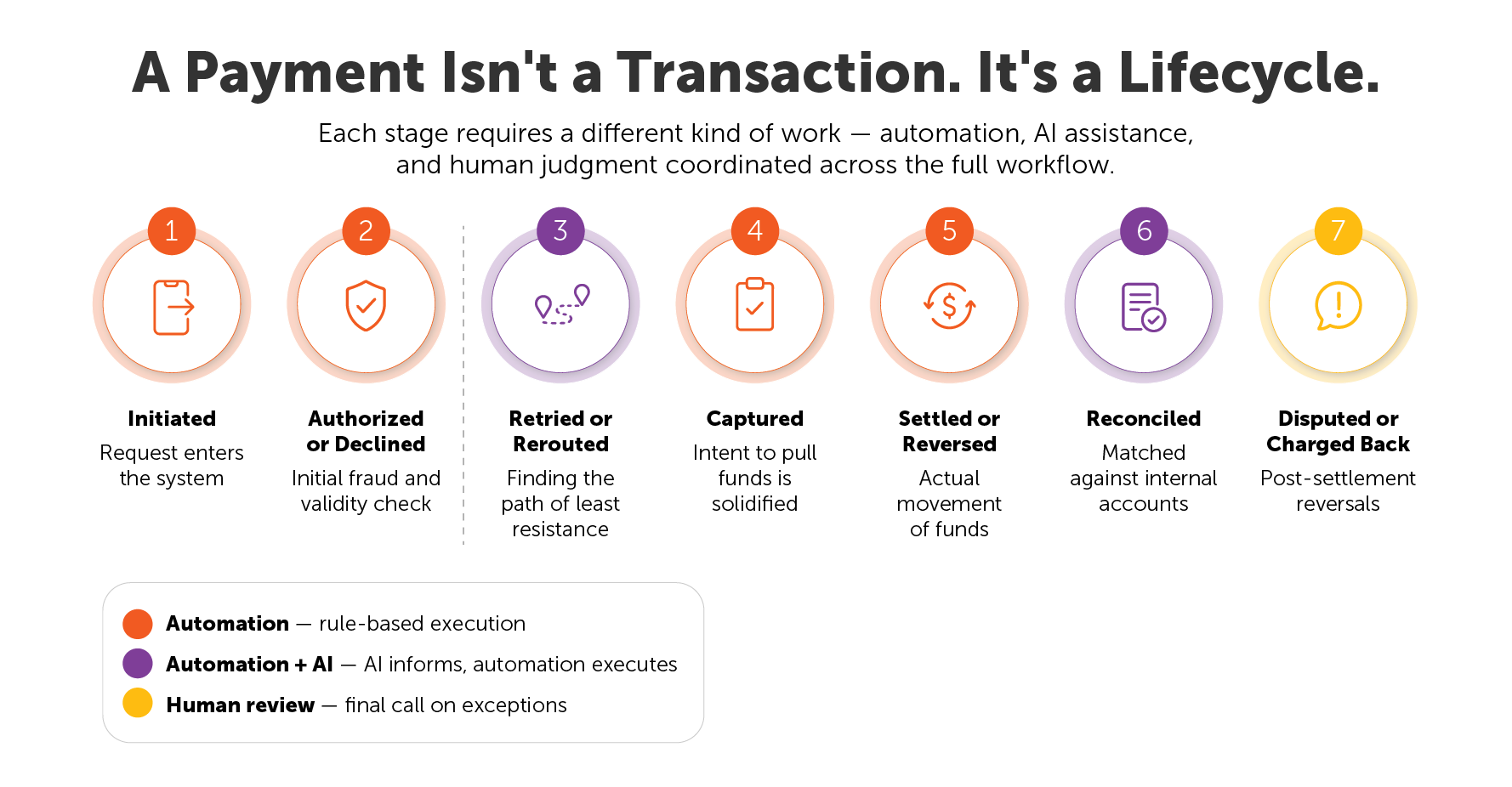
A payment is not a single event, but a stateful process that unfolds over time. Authorization is the beginning, not the end. Financial finality requires settlement, reconciliation, and sometimes dispute resolution. Each stage can introduce exceptions that demand structured follow-through by AI models.
Why payments are a state and exception management problem
Payments are a state and exception management problem because their outcomes evolve after authorization rather than ending in a single approve-or-decline event. Most legacy payment systems still treat a payment as a discrete event with a binary outcome. In reality, digital payments evolve, and their outcomes can change after the initial authorization attempt. Understanding this "statefulness" is critical for implementing AI effectively.
The asynchronous nature of digital payments
A typical payment moves through multiple states, often asynchronously:
- Initiated: The request enters the system.
- Authorized or declined: The initial check against fraudulent transactions.
- Retried or rerouted: Using payment routing to find the path of least resistance.
- Captured: The intent to pull funds is solidified.
- Settled or reversed: The actual movement of financial data and funds.
- Reconciled: Matching the transaction against internal accounts.
- Disputed or charged back: Post-settlement reversals.
Each state transition can occur across systems owned by different parties: gateways, processors, card networks, and issuing banks. When these systems don't talk to each other, human error in data entry and reconciliation becomes inevitable.
Payment Lifecycle Stage | Traditional Approach | AI-Driven Approach |
|---|---|---|
Decline Handling | Blind retries based on static rules | Context-aware retries optimizing approval rates |
Reconciliation | Manual batch processing at month-end | Continuous, automated ledger matching |
Dispute Management | Reactive, manual evidence gathering | Predictive modeling and automated submission |
Distinguishing exceptions from hard failures
Distinguishing exceptions from hard failures matters because most payment failures are not "hard" failures (like an invalid account) but exceptions requiring interpretation:
- Soft declines: Temporary issues that may succeed on a secondary retry.
- Network timeouts: Ambiguous outcomes where the state is unknown.
- Partial settlements: Requiring granular transaction data to reconcile.
- Ledger mismatches: Inconsistencies between payment providers and internal records.
Traditional rules engines assume linear, deterministic flows. They break down when outcomes are ambiguous. Machine learning and AI tools are required to navigate this ambiguity, using predictive analytics to decide the next step.
Where AI and machine learning create value across the payment lifecycle
AI and machine learning create value across the payment lifecycle by reducing friction at every stage, not by optimizing a single one. This is where machine learning models and generative AI tools deliver the most significant return on investment (ROI).
Decline handling and revenue recovery
AI-driven decline handling and revenue recovery turn recoverable declines into captured revenue, because not all declines are final. Soft declines, issuer timeouts, and transient network errors represent recoverable revenue, but separating them from hard declines requires contextual awareness.
Blind retries increase fees and frustrate individual customers. Abandoned declines leave revenue on the table. AI tools can evaluate decline codes, historical issuer behavior, and transaction data to determine whether, when, and how to retry. This directly impacts authorization rates and reduces involuntary churn, which is vital for maintaining customer experience.
Settlement, capture, and financial data integrity
Settlement, capture, and financial data integrity depend on catching exceptions early, because settlement exceptions often surface after customer-facing systems assume success, making downstream correction costly. AI systems monitor settlement files and processor confirmations in near real time, identifying anomalies before they propagate into ledger discrepancies and month-end pressure.
Reconciliation, ledger alignment, and accounts payable
Reconciliation, ledger alignment, and accounts payable form one of the highest-friction stages in global payments. Data arrives on different timelines and in varying formats, and small mismatches escalate if left unresolved.
AI applications using natural language processing (NLP) can match records, flag inconsistencies, and even automate invoice processing. Instead of periodic batch reconciliation, the finance team gains continuous ledger alignment, reducing audit risk and improving cash flow visibility. In accounts payable automation, this ensures that vendors are paid accurately and on time, maintaining healthy supplier relationships.
Disputes and chargeback lifecycle management
Disputes and chargeback lifecycle management form a parallel lifecycle that can reverse settled payments weeks later. According to Mastercard's State of Chargebacks report, global chargeback volume is projected to reach 337 million transactions by 2026. AI in payment processing tracks disputes from initiation, gathers relevant payment data, and ensures timely responses that meet strict evidence requirements, reducing risk and protecting revenue.
High-value use cases for AI in payments
The high-value use cases for AI in payments include intelligent retries, exception triage, reconciliation automation, and dispute management. The following examples illustrate how AI in payment processing operates in practice, going beyond what embedded gateway features can accomplish.
Intelligent retry and fallback orchestration
Intelligent retry and fallback orchestration uses AI models to evaluate decline codes, issuer patterns, timing windows, and customer lifetime value. These models may:
- Delay a retry to align with issuer behavior.
- Route to a secondary gateway via advanced payment routing.
- Switch payment methods (e.g., from card to Automated Clearing House (ACH)).
- Escalate high-value transactions for human judgment.
The outcome is higher recovery rates, fewer wasted retries, and a marked improvement in payment processing efficiency.
Exception triage and investigation automation
Exception triage and investigation automation uses AI systems to gather context from payment logs, enterprise resource planning (ERP) entries, and financial data for transactions in ambiguous states. They classify which exceptions can be resolved automatically and which require a financial professional, shrinking investigation queues.
Reconciliation and invoice processing automation
Reconciliation and invoice processing automation relies on AI agents automation that match records across sources. When discrepancies arise, they request missing files or flag breaks. In accounts payable, AI can automate invoice ingestion, reducing human error and ensuring that data entry is handled with consistently high accuracy.
In this video you will see how accounts payable teams spend hours chasing missing PO documents, managing vendor communications, and manually processing approvals.
Dispute lifecycle and fraud prevention
Dispute lifecycle and fraud prevention automation uses machine learning tools to track disputes end-to-end. By analyzing training data from past disputes, these models can predict the likelihood of winning a case and automate the evidence-gathering process. This is a core component of modern fraud detection and prevention strategies.
Common challenges when adopting AI in payments
The most common challenges when adopting AI in payments are fragmented data, auditability requirements, legacy infrastructure, and the need for human oversight. Adoption is accelerating: according to a 2024 Gartner survey, 58% of finance functions now use AI, up 21 percentage points from 2023. Yet payments leaders still struggle with structural barriers.
Fragmented data and asynchronous systems
Fragmented data and asynchronous systems prevent any single system from having a complete view of payment state, as data is scattered across systems and parties. Effective AI in payment processing requires an orchestration layer that assembles context from gateways to bank portals.
Financial accuracy, auditability, and regulatory compliance
Financial accuracy, auditability, and regulatory compliance require payments automation to preserve financial integrity, making every retry, reversal, and adjustment traceable. Regulators increasingly demand explainability in how AI models make decisions. Frameworks such as the National Institute of Standards and Technology (NIST) AI Risk Management Framework provide a reference for logging decisions and tying them to explicit, governable policies.
Legacy infrastructure and real-time demands
Legacy infrastructure and real-time demands collide because many payment systems still rely on batch processing and legacy application programming interfaces (APIs). AI agents must operate across modern APIs, flat files, and human workflows simultaneously, because pure API-driven automation is often not possible in legacy environments.
Human oversight and decision making
Human oversight and decision making remain essential because payment decisions frequently require human judgment, especially for high-value exceptions or fraud detection cases that might produce discriminatory outcomes. AI technologies must support structured escalation rather than purely autonomous decision-making.
How to introduce AI into payment operations
Introducing AI into payment operations means automating the operational work surrounding money movement, not replacing your existing payment stack.
1. Start with post-authorization workflows
Starting with post-authorization workflows delivers the fastest impact, because authorization and fraud detection are already heavily optimized by gateways. Begin with retry orchestration and reconciliation, where operational impact is high and integration risk is lower.
2. Map payment states and define ownership
Mapping payment states and defining ownership means documenting each state — initiated, authorized, captured, settled — and what triggers transitions. Each state needs an owner, whether an AI agent or a member of the finance team.
3. Encode retry and routing policies explicitly
Encoding retry and routing policies explicitly ensures AI agents operate within clearly defined rules. Explicit policy encoding is critical for trust and regulatory compliance; AI cannot enforce policies that exist only in "tribal knowledge."
4. Establish human-in-the-loop controls
Human-in-the-loop controls route high-risk scenarios, such as disputed charges or reconciliation breaks above a set threshold, to a human reviewer. AI should surface context and recommended actions, balancing risk control with AI speed.
The 2026 landscape of artificial intelligence in payments industry
The 2026 landscape of artificial intelligence in the payments industry will be shaped by widespread adoption of ISO 20022 and the expansion of real-time payments.
Richer data and ISO 20022
ISO 20022 delivers richer data by significantly increasing the depth of transaction data carried through the ISO 20022 messaging standard. This enables more context-aware AI decisions on routing and reconciliation, while raising the burden of processing that data at scale.
AI-initiated spend and machine-to-machine commerce
AI-initiated spend and machine-to-machine commerce emerge as AI moves from analyzing payments to initiating them. According to Gartner, 33% of enterprise software applications will include agentic AI by 2028, up from less than 1% in 2024. Enterprises are deploying agents for procurement and treasury optimization, shifting the challenge toward governing AI-initiated financial activity.
Compressed decision windows in real-time payments
As real-time payments networks expand, the tolerance for delayed reconciliation shrinks. Fraud detection and prevention must occur in near real time. AI systems must react to events as they occur, not hours or days later, to prevent financial loss.
Evolving regulations and explainability
As AI becomes embedded in financial workflows, the regulatory landscape will intensify. Supervisory bodies will focus on traceability. Payment automation cannot rely on "black box" logic. Systems must demonstrate why a transaction was escalated or a retry attempted.
How Automation Anywhere’s P2P solution makes payments more efficient
Automation Anywhere’s P2P solution makes payments more efficient by automating payment operations, retries, reconciliation, disputes, and cross-team workflows, rather than payment processing itself. It does not replace gateways, processors, fraud engines, or card networks. Its Agentic Solution for Procure-to-Pay (P2P) understands each step of the end-to-end payment lifecycle and the intent behind it, using AI agents to execute and coordinate that work.
For enterprises scaling AI in payment processing, Automation Anywhere provides the orchestration layer that most payment stacks lack. Instead of adding another point tool, the Automation Anywhere platform connects existing gateways, processors, and ERP systems so AI agents can manage exceptions from the first decline through final reconciliation.
Its AI agents persist across a payment’s lifecycle, tracking state changes and responding to events like soft declines or settlement delays. They operate across fragmented infrastructure via APIs, robotic process automation (RPA), and file-based integrations, connecting gateways, processors, ERP systems, treasury platforms, and support tools.
Governance is enforced at the process level. Every retry, routing decision, escalation, and adjustment is logged with context, creating an audit trail that finance, compliance, and external auditors require. AI agents handle interpretation-heavy tasks like classifying exceptions, summarizing transaction histories, and recommending next actions. Automation Anywhere’s Procure-to-Pay solution manages routing, execution, and human-in-the-loop oversight for sensitive decisions.
With Automation Anywhere, AI in payment processing is about orchestrating the full lifecycle of money movement. Request a demo to see how organizations can reduce exception cost, improve recovery rates, and maintain the financial integrity required in modern payment ecosystems by applying agentic process automation.
AI and payments industry FAQs
Can AI really reduce false declines?
Yes, AI can reduce false declines. By analyzing training data from successful legitimate transactions, AI in payment processing can identify when a decline is likely a "soft" error, enabling a strategic retry that saves the sale and improves customer experience.
How does AI help with cash flow?
AI helps with cash flow by analyzing payment patterns, predicting inflows and outflows, and flagging risks such as late payments, failed transactions, or liquidity gaps. AI agents also automate collections follow-up, IDP for accounts receivable, and give finance teams real-time visibility into working capital.
How does Automation Anywhere support human-in-the-loop review for sensitive payment decisions?
Automation Anywhere supports human-in-the-loop review through Automation Co-Pilot, an interface for payments and finance teams to review exceptions, approve retry strategies, or evaluate dispute responses. Agents surface context and recommendations, while humans retain decision authority for high-risk cases.
What guardrails help ensure AI-driven payment actions remain auditable and compliant?
The guardrails that keep AI-driven payment actions auditable and compliant are process-level governance, explicit policy encoding, and complete action logging. APA logs every action with context, policy reference, and timestamp. Retry limits, routing constraints, and escalation triggers are encoded explicitly, ensuring traceability for finance, compliance, and external auditors.
What are the latest trends in AI-powered payment gateways?
The latest trends in AI-powered payment gateways include agentic payment initiation, intelligent routing, and real-time fraud scoring. The United States payments landscape has moved far beyond simple transaction processing. AI in payment processing is no longer just a backend optimization tool; it is actively rewriting how transactions are initiated, routed, and secured.
Can AI improve the security of online transactions?
Yes, AI can improve the security of online transactions by helping financial institutions and merchants detect fraud faster and respond more intelligently. It is most effective when combined with established security measures rather than used on its own.
Stay up to date:
 Subscribe to the blog

Try


For Students & Developers
Start automating instantly with FREE access to full-featured automation with Cloud Community Edition.
